Underwater archaeology
Maritime Archaeology Museum Audio Guide
A VOC spice warehouse set into the thickness of Galle’s wall now holds what the sea gave back from the bay’s shipwrecks. Its collection has been wrecked twice.
- 60 min of audio
- VOC shipwrecks
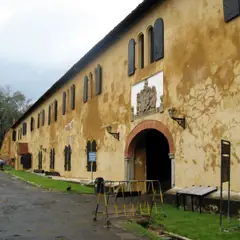
The long Dutch warehouse of the late 17th century is a rare case among VOC fortifications: part of the building is embedded in the wall and the Old Gate, the fort’s original entrance, runs through its ground floor. In the cool basement cinnamon and cardamom were stored; above, in dry rooms, gems, pearls, Chinese silk, porcelain and ivory waited to sail for Amsterdam or Batavia. Since 2010 it has been Sri Lanka’s first national maritime archaeology museum.
Its centrepiece is a ship with three names and two flags: the Avondster, an English merchantman captured by the VOC that sank in 1659 off Galle beach without a single recorded casualty. In 1999 its wreck yielded a human skull that no one has managed to identify, and in 2004 the tsunami destroyed a good part of what had been brought up from the seabed.
Highlights
- VOC warehouse — two floors set into the wall and crossed by the Old Gate
- Avondster gallery — the English ship captured by the VOC and sunk in 1659 about 50 m from the beach
- Finds from the bay’s wrecks — cannons, earthenware, pipes, barrels and sailors’ shoes
- Replica of the Zheng He stele — dated 1409, with text in Chinese, Tamil and Persian
- Bryde’s whale skeleton — stranded in 2003 and hung from the ground-floor ceiling
The story of the Maritime Archaeology Museum in Galle begins with a warehouse and ends on the seabed. The VOC, the Dutch East India Company, built a long two-storey building beside the Old Gate to store Ceylon’s spices; its exact date is disputed, since most sources place it in 1671, one around 1669, the year of the gate’s inscription, and some in 1717. The British turned it into a court, customs house and offices, in 1992 it opened as a maritime museum, in 2004 the tsunami flooded it and on 4 March 2010 it reopened, after its 3,700 m² were renovated with a grant from the Kingdom of the Netherlands, as the country’s first national maritime archaeology museum.
Inside await the wrecks of a bay that has been swallowing ships for centuries: the Avondster of 1659, the yacht Hercules of 1661 and some twenty marine archaeological sites around Galle. Building and collection are survivors of the same sea, and that double story, documented and checked against historical sources, unfolds room by room on a 60-minute route with the audio guide.
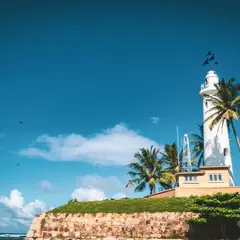
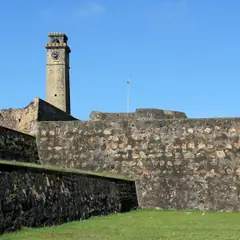
Its historic entrance is the Old Gate, which crosses the building’s ground floor, and the hidden rocks that sank so many ships are watched today by the Galle Lighthouse.
A spice warehouse inside the wall
Maritime Archaeology Museum
Summary of this stop
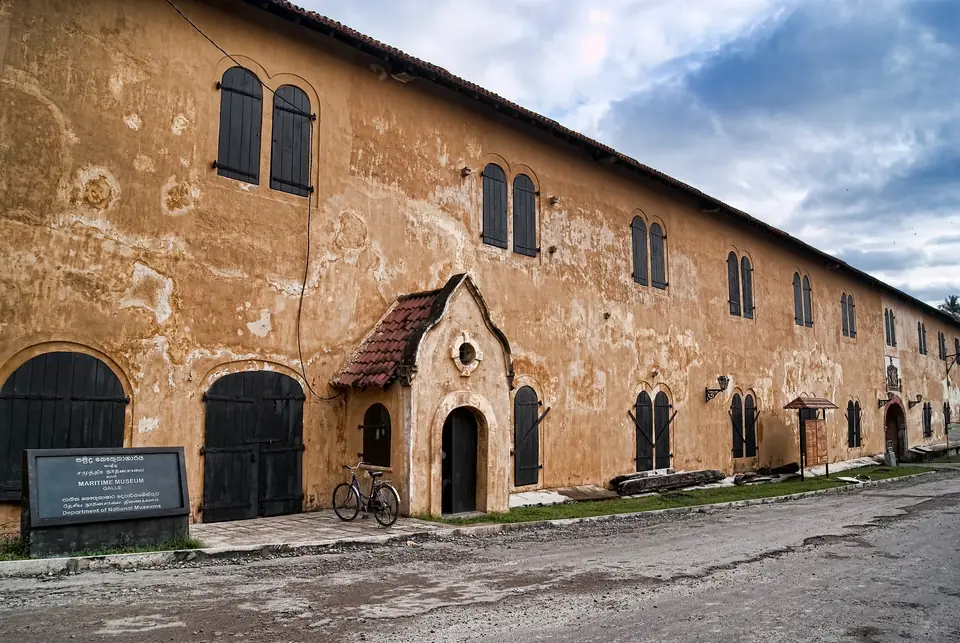
The long yellow façade of the warehouse presses against the Old Gate, and a stretch of the building disappears into the thickness of the wall, something uncommon in Dutch fortifications. From inside, the rooms follow the line of the wall on two levels. The 2010 renovation gave it a double entrance: the upper floor links with today’s main door and the lower one recovers the building’s role as the fort’s portal.
The openings in the façade tell their own story. Under the British the warehouse stopped being one: larger doors and windows were opened and the district court, the police court, the land registry, the Galle customs house, the P&O shipping line and the Galle Sports Club passed through. In the 1980 restoration those openings were removed and the building returned to its original form according to the Dutch plans.
Among what the VOC shipped from Galle was areca nut, the kind still chewed with betel leaf and lime that stains the mouth red. That habit already caused a misunderstanding in 1505, and the link between a street today and a ship of 1659 is the first thread the narration untangles before the gate.
Cinnamon ships and a graveyard of vessels
Introductory documentary room
Summary of this stop
The visit begins with a documentary on the port’s maritime history, under high ceilings designed for stacking sacks. In this warehouse cinnamon and cardamom rested in the cool basement, and outside, watched by armed guards, waited the elephants destined for export. When the building opened as a museum, on 9 May 1992, it was devoted to marine fauna and flora, with models of whales and fish and pieces from the twenty or so submerged sites around Galle.
One of them is the Hercules, a Dutch yacht that on 22 May 1661 crashed into the rocks on leaving for Batavia, after breaking one anchor cable and losing the second. On the seabed remain more than thirty iron cannons, and from it a bronze bell was recovered bearing the inscription “AMOR VINCIT OMNIA ANNO 1625”.
Among the museum’s pieces there is also a slab a little over a metre long, with intertwined lotuses, two dragons and text in Chinese, Tamil and Persian: the replica of the stele that Admiral Zheng He had engraved in 1409 and brought to Galle on his great voyages. Each language dedicates the offerings to a different god, Buddha, Allah and Vishnu, and the place where the original turned up in 1911 is one of the most unexpected twists of the route.
The Avondster, English spoils sunk in 1659
Avondster gallery
Summary of this stop
The Avondster gallery is the museum’s axis. The ship was born English under the name John and Thomas; the English East India Company bought it in 1641 and renamed it Blessing, and the VOC captured it near Persia during the First Anglo-Dutch War and called it Avondster, “Evening Star”. According to a documented tradition, it fell after resisting in an ambush and with the richest cargo of the four prizes.
On 2 July 1659, anchored before the Black Fort while waiting to load areca nut, it dragged its anchor at night and in fine weather, hit the shore, broke in two and sank into the sand. A sailor tried to wake the captain, who took too long; he and the first mate ended up arrested and forced to pay for ship and cargo. Today the wreck, which divers called “the chicken-foot one”, lies in about 5 m of murky water beside Marine Drive, measures some 40 by 10 m and preserves a galley of yellow Dutch bricks and reinforcements that betray its English origin.
The witnesses of the wreck did not record a single death. Even so, in 1999 divers brought up a human skull from a 17th-century layer that seemed intact, and there is not even agreement on whether it belonged to a man or a woman. The hypotheses about who was left out of the official account fill one of the most unsettling moments of the narration.
What the sea took twice
Ship models and traditional boats
Summary of this stop
Beside the ship models and the fishing boats of southern Sri Lanka, such as the madel oruwa, the museum tells its own shipwreck. On 26 December 2004 the tsunami entered the city by the north gate and flooded the building up to 2.2 m, a figure some sources raise to almost 2.5 m. The warehouse stood firm, but the museum was closed for works and all its exhibits were damaged by water.
The rescue excavation of the Avondster, between 2001 and 2004, had closed only days earlier. The wave destroyed the headquarters of the Maritime Archaeology Unit, on an old quay outside the north gate, and of the 3,600 objects rescued from the harbour wrecks only about 20% was recovered. The part of the ship left on the seabed, by contrast, was protected under a thick layer of sediment: less than 30% of the site has been excavated.
The museum looks ahead too. Since 2025 it has had permanent custody of the artefacts of the Godawaya wreck, more than 2,100 years old and found in 2008 at 33 m depth between Hambantota and Ambalantota, the oldest wooden shipwreck discovered in the Indian Ocean. How that ship fits with everything before is the idea with which the visit closes.