Buddhist stupa
Japanese Peace Pagoda Audio Guide
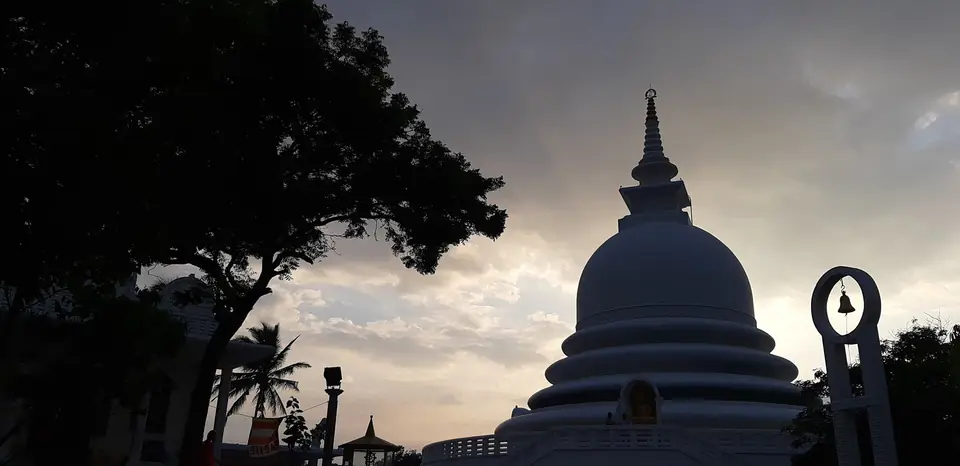
A white dome raised by Japanese monks in the middle of the civil war crowns Rumassala, the hill that the Ramayana has fall from the Himalaya. Across the bay, Galle Fort looks small.
- 45 min of audio
- Viewpoint over the bay
The Rumassala stupa, called Sama Ceitya, is the work of Nipponzan Myohoji, the Japanese Buddhist order founded by Nichidatsu Fujii, the monk who met Gandhi in 1931 and from 1947 sowed peace pagodas around the world. It was built in 2005, with Sri Lanka still in civil war, as part of a plan to build peace temples in conflict zones. A circular walkway rings the dome with four golden Buddhas that tell the life of the Buddha.
The same summit that now wants to be a beacon of peace visible from the sea carries a dark reputation: it is said that in Portuguese times false lights were lit from here to wreck Arab merchantmen on the rocks. At its feet lies the Buona Vista reef, the most diverse on the island according to 1998 studies, and a grey marble memorial to the victims of the 2004 tsunami.
Highlights
- Sama Ceitya stupa — a whitewashed dome of 2005 visible from Galle Fort and from ships
- Four golden Buddhas — birth, enlightenment, first sermon and parinibbana around the walkway
- Daily drum ritual — the Namu Myōhō Renge Kyō prayer, open to visitors
- 360-degree view — the fort, Galle harbour and the Indian Ocean from the terrace
- 2004 tsunami memorial — a two-tone grey marble monument below the pagoda
The story of the Japanese Peace Pagoda begins far from Galle, with a Japanese monk born in 1885. Nichidatsu Fujii founded the Nipponzan Myohoji order, met Gandhi in 1931, began building peace pagodas in 1947, inaugurated the first in Kumamoto in 1954 and by around the year 2000 counted some 80 worldwide. The one at Rumassala, the Sama Ceitya, was built in 2005, when Sri Lanka was still in civil war; on the exact date of its inauguration sources disagree, and while some speak of 23 February 2004, others place it in 2005.
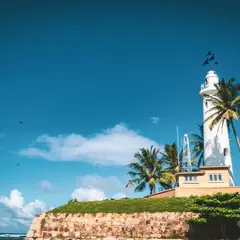
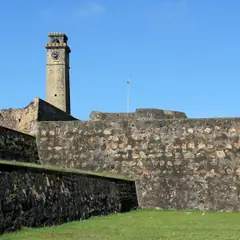
The hill that holds it has more layers than the stupa itself. For the Ramayana it is a fragment of the Himalaya that Hanuman let fall; for modern folklore, a place of magnetic anomalies attributed to Arthur C. Clarke; for biologists, the heart of a 1.71 km² national sanctuary declared in 2003. On the same summit also stands a white column of 1875 that many people take for a false lighthouse and that, in fact, served to guide ships into the harbour. The story of the pagoda and its hill, documented and checked against historical sources, unfolds in four stops over 45 minutes with the audio guide.
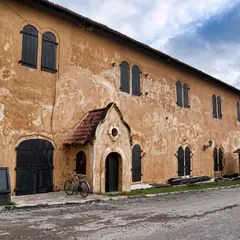
The fort seen across the bay has its own route in the Galle Fort Walls, and its harbour mouth of hidden rocks has been watched since 1939 by the Galle Lighthouse.
A Japanese dome in the middle of a war
Japanese Peace Pagoda
Summary of this stop
At the foot of the staircase, the great whitewashed dome peeks over the jungle of Rumassala cape. It is the work of Japanese monks, and its date says a lot: 2005, in the middle of the civil war, as part of Nipponzan Myohoji’s plan to bring peace temples to conflict zones. Its proper name is Sama Ceitya.
What holds up the dome is another story. According to the Ramayana, Hanuman flew to the Himalaya in search of the herbs that would save Lakshmana, wounded in the war against Ravana, and since he could not recognise them he tore off an entire piece of the mountain. On the way five fragments came loose, which tradition shares among Kachchativu, Thalladi, Ritigala, Dolukanda and Rumassala. All five have an ecosystem different from their surroundings, and on these slopes some 150 species of herbs have been recorded, among them the “Kalu Nika”, to which local people attribute almost magical healing properties. What this hill has in common with its four sisters is the first thing the narration tells at the foot of the staircase.
Four golden Buddhas and Gandhi’s legacy
Golden Buddhas of the walkway
Summary of this stop
The staircase leads to a wide circular walkway that is walked barefoot. Spread around the stupa, four golden statues of the Buddha represent four moments of his life: birth, enlightenment, the first sermon and the parinibbana, his final passage into nirvana. Each carries an explanatory sign in English, and together they turn the walk around the dome into a reading of the Buddha’s biography.
Behind each statue stands the figure of Nichidatsu Fujii, the monk who met Gandhi in 1931 and devoted the rest of his life to building peace pagodas around the world. His legacy still sounds every day: the monks of Nipponzan Myohoji chant Namu Myōhō Renge Kyō while beating hand drums, and in the adjoining prayer hall a drum ritual is held daily in which visitors can take part. The meaning of that repeated beat, and the road that led from Gandhi to this hill in Galle, are best understood by listening to them on the walkway.
The colonial fort, small on the other side
View of the fort and Galle bay
Summary of this stop
From the terrace, across the water, appear the walls of Galle Fort, the harbour and the open Indian Ocean. The gaze works both ways: the white stupa can be seen from the fort and from the ships approaching the harbour. The order’s representative in Sri Lanka, the Japanese monk Venerable Asami, who had spent 27 years on the island, speaks fluent Sinhala and is very well known in Galle, has presented the island’s peace pagodas as a project to protect Buddhism after the loss of religion and culture under the Portuguese, Dutch and British. He speaks of five, Rumassala, Sri Pada, Bandarawela, Walapane and Ampara, although some sources count four; the type, in any case, is defined as a focus open to people of all races and creeds.
Against that reading of the pagoda as a response to centuries of colonial rule, the hill holds a dark episode. It is told that in Portuguese times false light signals were lit from the top of Rumassala to lure Arab merchantmen, which ended up on the rocks. The story is tied to the reputation as plunderers that the Portuguese left on the island, and its contrast with the white column of 1875, a mark for entering the harbour safely, is one of the twists the narration keeps for this point.
Grey marble for the 2004 tsunami
Tsunami memorial
Summary of this stop
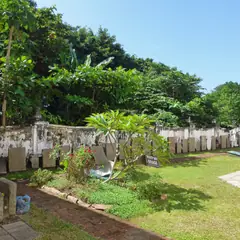
Below and to the right of the pagoda, a two-tone grey marble monument remembers the victims of the 2004 tsunami. It is the quietest stop of the route, and the one that explains this hill’s relationship with the sea around it, at once treasure, wound and risk.
At its feet stretches the Buona Vista reef, the name the colonisers gave to Rumassala: in 1998 it showed the greatest documented diversity of fish and corals in Sri Lanka, and the specialist John Veron found in it at least two coral species new to science. That same reef is now under discussion. In December 2024, a supplementary 500-page environmental impact assessment concluded that the Galle port development project, with 44.97 hectares reclaimed from the sea, would have its most adverse effects on the corals of the Rumassala marine sanctuary. What is at stake under the water, in view of the white dome, closes the route.