Dutch fort
Old Gate Audio Guide
A low arch of 1669 runs through the ground floor of a spice warehouse set into the wall of Galle. Outside it bears the crown of George III; inside, the VOC rooster: two empires stitched into a single gate.
- 20 min of audio
- Dutch colonial architecture
The Old Gate is the older of the two entrances to Galle Fort. The Dutch East India Company finished it in 1669, when it was reached by a causeway between the bay and a marsh and defended by a moat and a drawbridge. It was the fort’s original entrance from the harbour and, although in 1873 the British opened the Main Gate between the Sun and Moon bastions, it remained the main access to the quays.
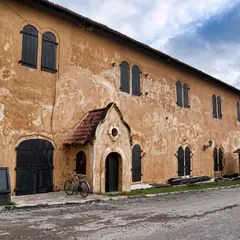
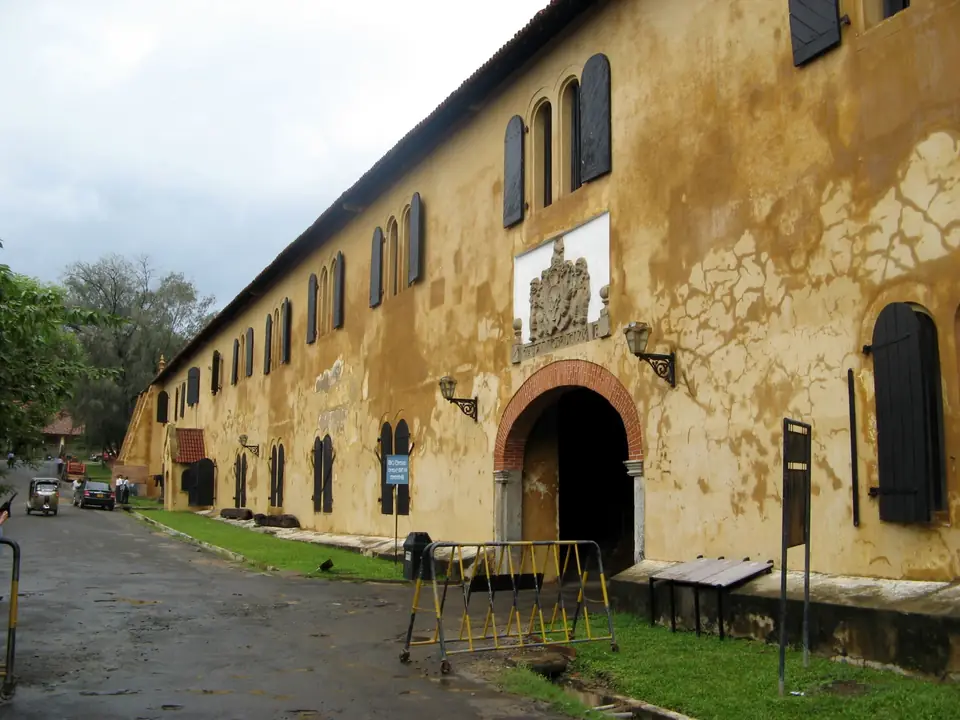
What is unusual is that it is not a freestanding gate: it is a tunnel that cuts in two the ground floor of a long VOC warehouse, built to store spices and supplies and partly embedded in the thickness of the wall, something uncommon in Dutch fortifications. Today that warehouse is the National Maritime Archaeology Museum, and under its arch every morning pass tuk-tuks, motorbikes and the people who work inside the fort.
Highlights
- VOC relief — a rooster on a rock, two lions and the inscription ANNO MDCLXIX
- George III coat of arms — lion and unicorn on the harbour face since 1796
- 1668 VOC stone — the Dutch plaque the British left in place
- Tunnel under the warehouse — a vaulted passage crossing the ground floor and the wall
- Maritime Museum — former VOC spice warehouse, flooded by the 2004 tsunami
Galle did not change hands by cannon fire. On 23 February 1796, a week after the fall of Colombo, the Dutch governor Fretz handed British Captain Lachlan Macquarie, on a large silver tray, the keys to the gates of a garrison whose entrance from the harbour was this one. The story of the Old Gate begins long before, in 1669, when the Dutch East India Company (VOC) finished this arch with a moat and drawbridge, and continues long after: in 1873 the Main Gate took the lead from it, in 2004 the tsunami flooded the warehouse it runs through and in 2022 its 354-year-old iron leaves were removed.
Its architecture reads like a palimpsest. On one face the crown of George III rules; on the other, the rooster the Dutch adopted as Galle’s arms after taking the city in 1640. Sources do not quite agree on which was the original face and which stone stood where, nor on the origin of the gate itself: some tourism websites present it as a Portuguese remnant, whereas most date it as Dutch work and point to the neighbouring Zwart Bastion as the fortification of probable Portuguese origin. The 20-minute route with the audio guide, documented and checked against historical sources, goes from one face to the other and ends down the street, before the commander’s house.
The warehouse the arch runs through is now the Maritime Archaeology Museum, and the Dutch Galle of the following century still stands inside the fort, in the Dutch Reformed Church of 1755.
A British crown over a Dutch stone
Old Gate
Summary of this stop
The first stop is in front of the face that looks to the old harbour. Above the arch rises the British royal coat of arms, with the lion and unicorn as supporters, carved after the arrival of 1796. Just below survives a small VOC stone dated 1668, which the British left in place: two flags, one above the other, on the same façade.
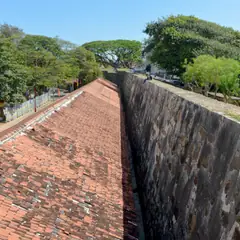
Underfoot lies the layout of the fort’s original entrance. The road that reached this point was a causeway with the water of Galle bay on one side and a marshy area on the other, and where Baladaksha Mawatha now runs towards the port area there was a moat and a drawbridge. Nothing of that defensive system remains in view, and that absence is also part of what is told at this point.
A spice warehouse crossed by the street
Tunnel under the warehouse
Summary of this stop
Inside the vaulted tunnel you understand that this is no simple gate. The passage cuts in two the ground floor of a long, two-storey Dutch warehouse, raised to store spices and supplies for VOC ships and partly embedded in the thickness of the wall. Its date wobbles depending on the source: around 1669, 1671 or even 1717. The empty gap in the arch is the trace of the two iron leaves that the Central Cultural Fund removed on 16 March 2022, so rusted they could injure someone or cause an accident; it was announced they would return after conservation.
Since 1992 the warehouse has been a museum, and its recent history is one of paradox. The tsunami of 26 December 2004 flooded it up to 2.2 m, according to the most cited version, and of the 3,600 objects rescued from harbour wrecks only around 20% survived. Many came from the Avondster, a VOC yacht that sank in 1659 beside the neighbouring bastion with no storm involved, and whose story holds a captain who did not wake in time and a ship with three names. The wave destroyed what had already been rescued and, by covering it in sand, protected what remained on the seabed. In 2010 the building reopened as the National Maritime Archaeology Museum, restored with funds from the Netherlands.
Meanwhile life keeps passing through the arch: librarians, court typists, museum caretakers and ice-cream sellers who work in the fort pass by every day on foot, by tuk-tuk or by motorbike through this narrow tunnel on Queen’s Street.
The rooster that looks inward
VOC relief
Summary of this stop
From inside the fort appears the VOC relief: a rooster on a rock above a shield bearing the Company’s letters, held by two lions, and below it the inscription ANNO MDCLXIX, the year 1669. That rooster is not decorative: it is the arms of Galle that the Dutch adopted. The popular etymology linking the city’s name to the Portuguese “galo” is widely circulated, but other explanations derive it from Sinhalese, and none is settled.
According to the most widespread reading, on arriving in 1796 the British moved the Dutch emblem to this inner face and placed George III’s on the outer one; other sources merely describe each shield on its side, without mentioning a move. In any case, this arch is the place where one empire handed the keys to another, and the scene of that handover, with a moved governor before a captain who years later would govern in Australia, is the centre of the narration.
The commander’s house and the absent queen
Queen's House
Summary of this stop
Down the street, the same rooster appears again. Above the entrance of the former residence of the Dutch commander, a large slab bears the date 1683 and the figure of the bird that identifies Galle.
In 1802 the British governor Frederick North was installed here; the house gained a portico and a second floor and came to be called Queen’s House, and the old Front Street was renamed Queen Street, although Queen Victoria never visited it. In 1870 the residence was put up for auction. The circle closes on this façade, with a street named after a queen who never came.