VOC church
Dutch Reformed Church Audio Guide (Groote Kerk)
A Calvinist church of 1755, towerless and with two great Dutch gables, where the Company’s Galle prayed quite literally on top of its dead. Its whole floor is a mosaic of tombstones, and burial vaults still lie beneath it.
- 30 min of audio
- Dutch colonial architecture
In 1755 the commander of Galle, Casparus de Jong, and his wife, Geertruyda Adriana Le Grand, paid for the church as thanks for a long-awaited daughter, who was not baptised until the church was finished. The work, directed by Abram Anthonisz, superintendent of shipbuilding, had begun on 4 July 1752. With no central tower to carry the roof, two gables topped with flame-shaped pinnacles and kabook walls some 1.5 m thick support the nave.
The pavement is made of carved tombstones that begin with the formula “Hier legt”, here lies, among coats of arms, hourglasses, skulls and crossbones. Under the nave and the north garden are burial chambers: one was opened in 1863 and turned out full of coffins lined with black velvet; another came back to light in the 1970s thanks to a rumour overheard on the terrace of the hotel opposite.
Highlights
- Tombstone floor — 18th-century grave slabs with the formula “Hier legt”, coats of arms, skulls and hourglasses
- Abraham Samlant’s hatchment — the only one of its kind left in a Dutch church in Sri Lanka
- North and south gables — double scroll moulding and three flame pinnacles instead of a tower
- Hexagonal pulpit — calamander and satinwood panels under a sounding board that is also hexagonal
- North garden burial chambers — two limestone vaults reached by a staircase
The Reformed congregation of Galle Fort was born on 6 October 1642, two years after the Dutch East India Company took the fort from the Portuguese, but its great church took over a century to arrive. The Groote Kerk visited today was finished in 1755, and the chronology of the work is still debated: some sources speak of first foundations in 1682 and a long stoppage, others place the start in 1752. Its title of oldest Protestant church in Sri Lanka is also disputed, which others reserve for Wolvendaal in Colombo; the prudent course is to count it among the oldest still in use.
What is not disputed is its character. It is a church where the VOC elite sat in high pews, ladies arrived followed by slaves carrying their chairs and everyone prayed over the tombs of their ancestors. The history of the Dutch Reformed Church, documented and checked against historical sources, is walked in five stops and 30 minutes with the audio guide, from Church Street to the garden crypts.
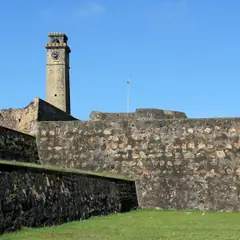
The VOC Galle that raised this church can also be read at the Old Gate, with its 1669 rooster, and in the spice warehouse now occupied by the Maritime Archaeology Museum, a few steps away; a few minutes off is the Clock Tower, the British tribute of 1883.
A church paid for by a late daughter
Dutch Reformed Church
Summary of this stop
From Church Street, the church presents itself as a towerless mass. The weight of the high roof is carried not by a central bell tower but by two great Dutch gables, north and south, topped with three flame-shaped pinnacles and a double scroll moulding found in no other church. The kabook walls reach about five feet in thickness.
Behind that façade lies a family story. Commander Casparus de Jong, lord of Spanbroek, and his wife Geertruyda Adriana Le Grand paid for the building as thanks for the birth of a long-awaited daughter, and the girl was not baptised until the church was ready: the register dates it 24 August 1755.
The street’s name keeps the memory of another church. The first Groote Kerk was the old Portuguese Franciscan chapel, which the Dutch used after the conquest of 1640; when it collapsed, worship moved to a spice warehouse or to the powder magazine beside the lighthouse. What remained of that earlier church is the first clue of the route.
Samlant’s hatchment and a tiny shirt
Abraham Samlant funeral hatchment
Summary of this stop
On crossing the door, the heat of the street stays outside and the nave greets you with the coolness of thick walls. On the south wall, beside the entrance, hangs a carved wooden memorial with the coat of arms of Abraham Samlant, commander of Galle who died in the city on 3 May 1766. It is a hatchment, a funeral escutcheon, and the only one of its kind preserved in a Dutch church in Sri Lanka.
The piece is solemn, heraldic, meant to recall the rank of the deceased. But according to tradition it also holds something tiny and domestic: a little cotton shirt said to have been his baptismal one. That contrast between power and the cradle is the heart of this stop.
Hier legt: walking over the dead
Tombstone floor
Summary of this stop
In the centre of the nave the floor stops being just a floor. The slabs are carved gravestones, almost all with Dutch text, that begin with the words “Hier legt”, here lies, and carry each deceased’s heraldry, hourglasses, skulls and crossbones. According to the most cited version, in 1853 the consistory decided to move the remains of the old cemetery here and lay its gravestones as paving; the congregation itself gives another date, 1932, when the Government acquired the site of that cemetery.
Below are vaults. On 23 February 1863 the one at the west end of the nave was opened to bury Mrs C. P. Walker, wife of the district judge: the gravestone of Mathew Vander Spaar was removed, some six feet of sea sand was dug out and several coffins appeared, some lined with black velvet.
In 1925, with the church roofless for repairs, rains caved in the floor in several places and the Government ordered the same vault reopened. What they found inside, and what they left before closing it again, bottled beside the bones, is one of the strangest episodes the church holds.
Command pews and chairs carried by slaves
Hexagonal pulpit
Summary of this stop
Before the hexagonal pulpit, with its calamander and satinwood panels under a six-sided sounding board, the nave reads like a map of hierarchies. The commander, the deacons and the VOC officers occupied high pews along the walls. Women had no pews: they sat on their own chairs, which slaves carried behind them to church and took home again after the service.
The same logic reached the cemetery, the kerkhof, which survives in Sinhala as kerakoppuwa: the more distinguished the deceased, the closer to the church they rested, while ordinary people were buried outside the fort, on the plot now occupied by the Galle police station.
With the British came another kind of dispute. Until 1867 the Anglican community used the church and removed the pews at the south end for its altar; the Reformed consistory and the Anglican clergy ended up in court over the building, and a bell rung in the middle of a service was grounds for a trial. How that forced coexistence ended is told by the narration.
The crypt revealed by a waiter’s gossip
North garden burial chambers
Summary of this stop
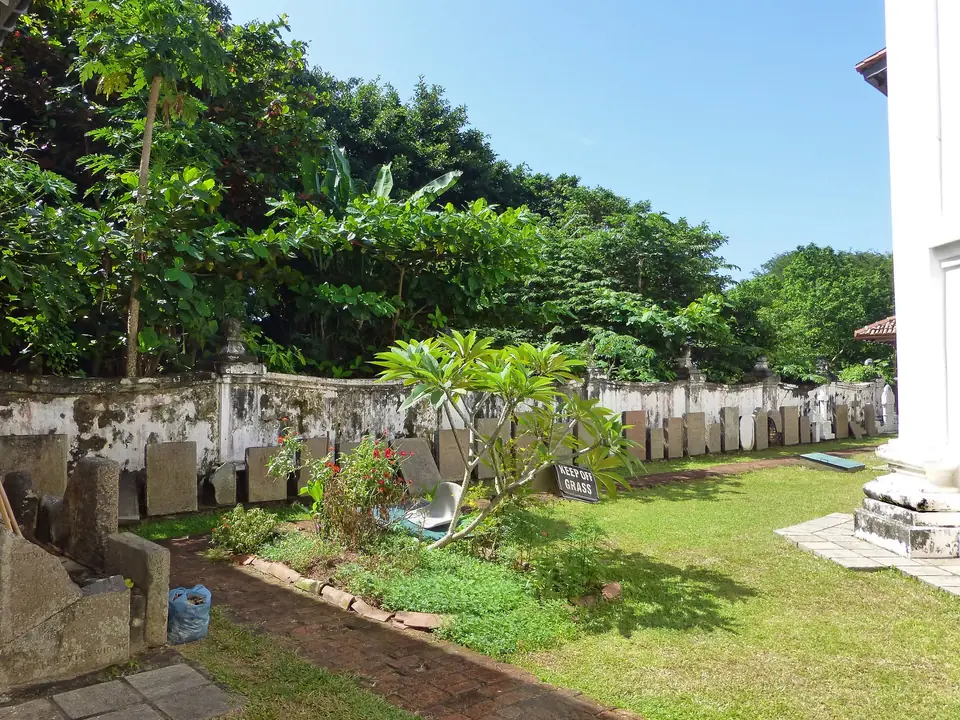
The north garden is strewn with gravestones laid wall to wall, and in it open two vaulted burial chambers, restored with Dutch funds, reached by a staircase down to damp limestone arches. Their rediscovery began, according to a documented tradition, with a waiter’s remark on the terrace of the New Oriental Hotel in the 1970s: the garden soil had sunk. What happened when Deloraine Brohier crossed the street to check is the finale of the route.
The church is still in use. Restored with a grant from the Dutch Embassy, it was reopened on 28 November 2004, and a month later the tsunami of 26 December did not damage it: it stands more than 12 m above the sea, at the highest point of the fort and sheltered by the walls. Since 2007 its congregation has been called the Christian Reformed Church and holds a Sunday service in Sinhala at 9.30.