Nuclear shelter
Cold War Tunnel Audio Guide (Tuneli i Luftës së Ftohtë)
Beneath the rock of Gjirokastër Castle, Enver Hoxha’s home town, hides another city of concrete: a nuclear shelter dug in secret so that the local communist leadership could survive an invasion that never came.
- 40 min of audio
- Cold War history
The Cold War Tunnel was built in secret in the early 1970s as one of the most ambitious pieces of Enver Hoxha’s “bunkerisation”, the campaign that filled Albania with more than 170,000 military bunkers. About 800 metres of corridors joined the two seats of local communist power, the Party Committee and the Executive Committee, and connected nuclear shelters with dozens of offices for the military command, the secret police and prosecutors, a courtroom, dormitories, a bakery and water tanks.
When the shelter first opened to visitors, in July 2008, nobody in Gjirokastër knew that such a vast structure had lain beneath their feet for more than three decades. Each door, covered in dust, still bore the name of the party official and the family it was assigned to. Today that bunker, built against foreigners, is a museum that lives, precisely, on the curiosity of foreigners.
Highlights
- Entrance behind the Bashkia — the current town hall was the seat of the Party Committee, one of the two power centres the tunnel joined
- Corridor of labelled doors — offices, dormitories, courtroom and rooms of 4 × 4 or 4 × 6 metres depending on rank
- Generator room — a rusting Czechoslovak generator next to the decontamination and air-filtering rooms
- Listening room and arsenal — phone taps, Kalashnikov rifles and TT pistols to hold out for days and weeks
- 2026 exhibition — regime uniforms, banned books and works by Enver Hoxha
Gjirokastër is a city of stone, but for decades it had another of concrete beneath it. The history of the Cold War Tunnel begins in the early seventies, when, in Enver Hoxha’s home town, crews working in shifts and in secret dug beneath the citadel a shelter designed to withstand a nuclear attack and house the military command in case of foreign assault. The figures vary by source: about 800 metres is the most repeated length, although some speak of a kilometre or of 1,500 metres, and the number of rooms ranges from 59 to about 100, perhaps because some count only the visitable stretch and others the whole network.
After the fall of the regime, in 1990, a good part of the furnishings was looted and the tunnel was left abandoned for years. It opened to visitors in July 2008, the Gjirokastra Foundation researched and adapted it between 2010 and 2015, and in 2015 it was inaugurated as a museum; in 2026 it was reconceived with a mini-exhibition. What to see in the Cold War Tunnel, how it was organised and against whom it was dug are questions best understood underground: its story, documented and checked against historical sources, accompanies the visit with the audio guide.
The rock beneath which it was dug is crowned by Gjirokastër Castle, which the same regime turned into a political prison, and on the other side of the old town the Ethnographic Museum occupies the plot where Enver Hoxha was born.
The secret door behind the town hall: the mouth of the network
Cold War Tunnel
Summary of this stop
The main entrance is not hidden in the hills but in plain sight: behind the Bashkia, the current town hall, in Çerçiz Topulli square. That building was the seat of the Party Committee, one of the two centres of local communist power, and the tunnel joined it underground with the other, the Executive Committee. A massive door gives way to a labyrinth of narrow corridors and rooms dug beneath the rock of the citadel.
The network was one of the most ambitious pieces of Hoxha’s “bunkerisation”, which scattered more than 170,000 military bunkers across Albania. The works were done in shifts and in secret, so that no worker would see the complete plan. The secret worked so well that, when the shelter opened to visitors in July 2008, through the town hall, the district councils and the local branch of PAKARD, nobody in the city knew that the structure had lain beneath their feet for more than three decades.
There is not even agreement on when it stopped being a secret: the most repeated version places the rediscovery in the 1990s, one in 1992, another in 2008. And there remains an uncomfortable paradox about who knew these rooms while the city, supposedly, knew nothing, which the narration reveals on the threshold.
Doors named after bosses, and a courtroom
Corridor of labelled doors
Summary of this stop
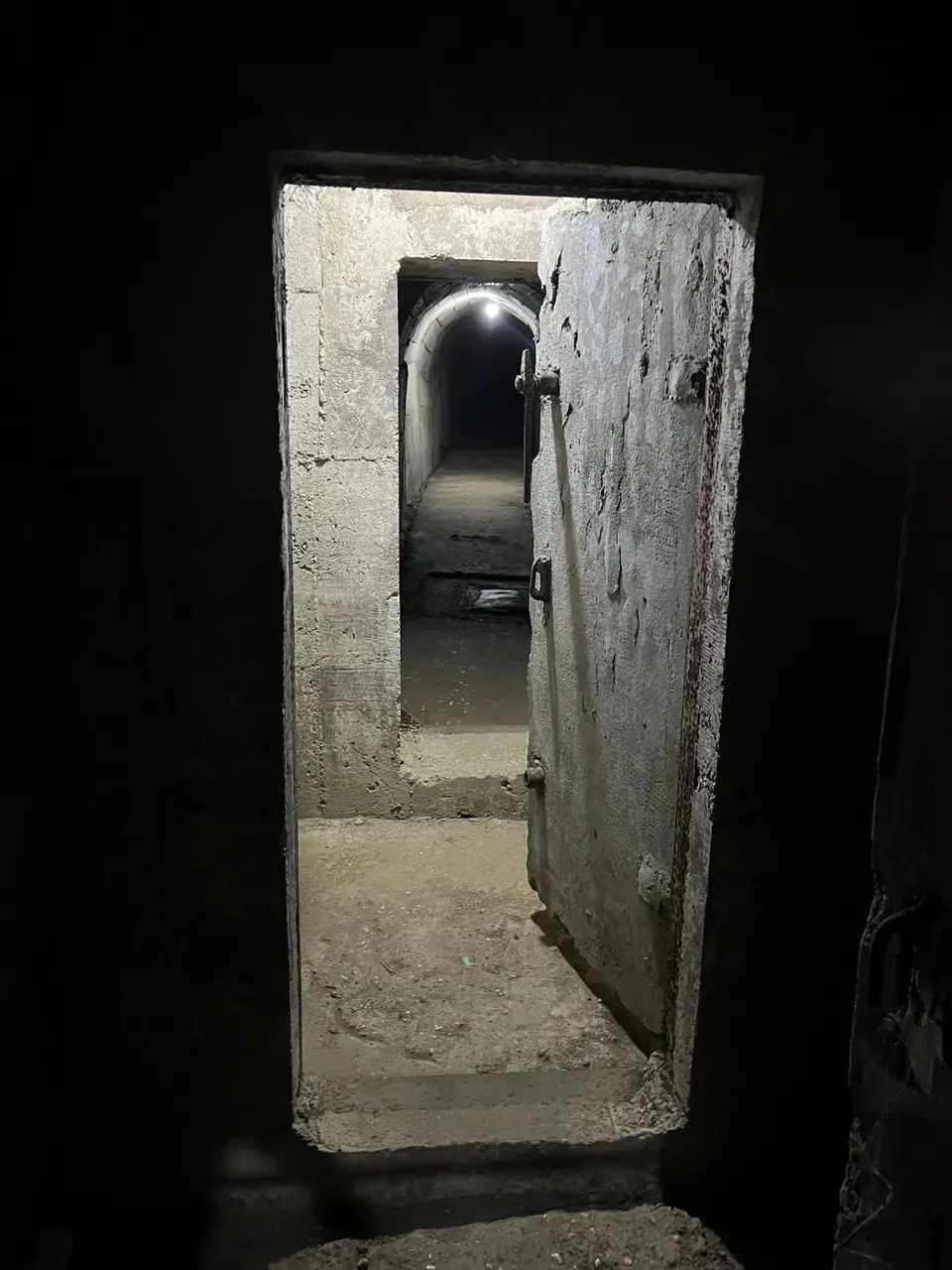
On the other side opens a long, bare concrete corridor, with scant light and rooms on both sides. Each door is labelled with its intended function, and read in order they make up the plan of a city beneath the city: offices for the military command, the secret police and prosecutors, dormitories, a classroom and a courtroom. The plan also included interrogators. In 2008 the doors still showed the name of the assigned official and family, with rooms of 4 × 4 metres for small families and 4 × 6 for officials with somewhat larger ones.
The hierarchy reached the most basic things. It is said that in the whole complex there were only two toilets: one reserved for Enver Hoxha and the other to be shared among all the other occupants.
In October 2013, before the tunnel was adapted for visitors, the town hall’s tourism officer, Magdalena Margariti, opened the door and asked for the way in to be noted on a piece of paper so as not to get lost. Behind a door armoured with mortar and 30 centimetres of iron appeared a straight corridor a metre and a half wide, whitewashed rooms and rusty metal doors with paper labels such as “Chief”, “Secretary” or “Investigation and Courts”. What lay beside the great meeting room turns the shelter into a true miniature city, and the audio guide tells it right there.
A Czechoslovak generator for the final day
Czechoslovak generator
Summary of this stop
The generator room keeps much of the original technical equipment, with a generator made in Czechoslovakia and now rusted. Beside it, the decontamination and air-filtering rooms show how far the regime was preparing for an atomic war. The complex had a phone-tapping room, a bakery, water tanks and an arsenal of Kalashnikov rifles and TT pistols to repel an enemy incursion, with resources to hold out for days and weeks.
In the mid-1980s the tunnel hosted military drills with civilian participation. The radio journalist Engjell Serjani was given the task of “covering” an invented war, writing reports of attacks, deaths and damage on a front that did not exist.
The question remains open of against whom all this was dug. One version points to a probable aggression from neighbouring Greece, and adds that it was probably built with help from Mao’s China; others speak of an attack by the superpowers or by the West. The debate remains unresolved, and the narration raises it in front of the machinery of the final day.
Uniforms in display cases after the looting
Exhibition of uniforms and banned books
Summary of this stop
What survived the looting of 1990 is now museum material. Some pieces remain in place, such as dusty furniture, telephones, newspapers and books about Stalin and Hoxha, and since 2026 the central room has held a mini-exhibition with uniforms of soldiers, generals and officials of the regime, banned books and works by Enver Hoxha.
Interest has soared: according to the municipal Tourism Directorate, between 1 January and 30 September 2024, 53,638 visitors went down into the tunnel, mostly Spanish, Italian, French, Belgian and Dutch, compared with a little over 3,500 in the whole of 2022, although another source lowers the 2024 figure to 25,000 in ten months.
A former soldier, Beqir Malaj, recalled in 2013 the slogan of the Albania of fortifications: “The more sweat in building fortifications, the less bloodshed in war”. The line with which the city itself turned it around closes the visit, and is best heard on the way out, back in the light of the square.