Birthplace and museum
Ismail Kadare House Audio Guide (Shtëpia e Ismail Kadaresë)
The stone house where the most translated Albanian writer was born in 1936 was not a nest but a character: a cistern that answered back, cellars with a dungeon and a mother who felt the walls devouring her. Gutted by fire, it reopened as a museum in 2016.
- 35 min of audio
- First-category monument
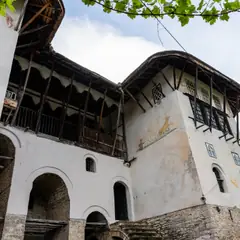
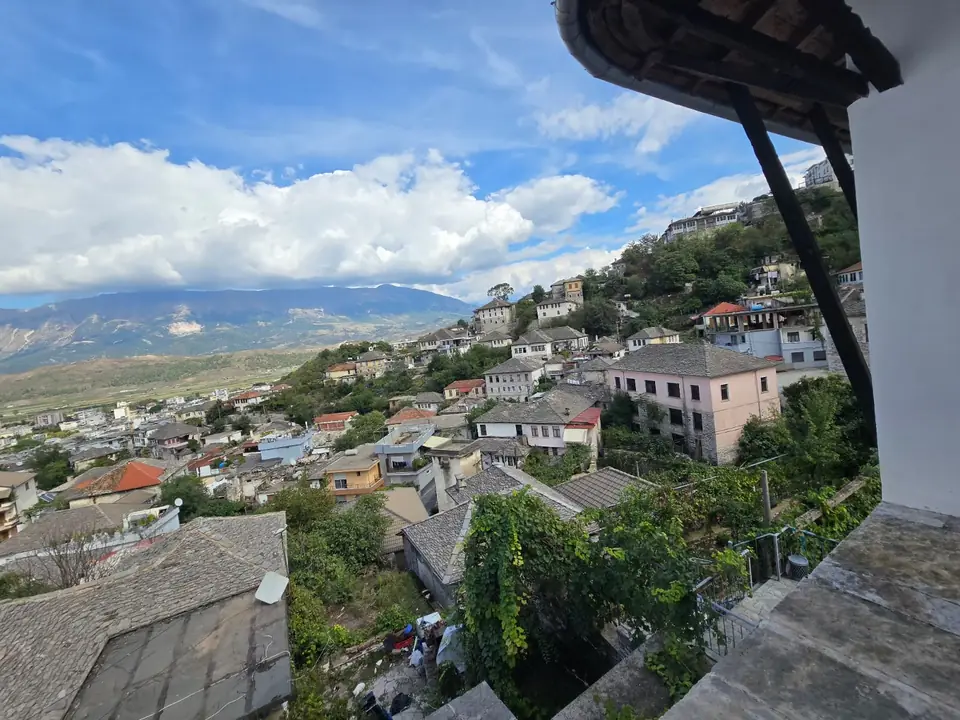
Ismail Kadare was born in this house in Gjirokastër on 28 January 1936, the son of Halit Kadare, a post office clerk, and Hatixhe Dobi, in the Kingdom of Albania of King Zog I. It is a typical house of the old town, with stone walls and steep roofs, on a narrow street in the Palorto district; declared a first-category monument on 5 July 1991, an accidental fire destroyed it in the late 1990s and it was rebuilt with support from UNESCO and the Albanian Ministry of Culture.
The visit goes from the bottom up, as the architect Agron Doraci planned it: first the rainwater cistern with which “Chronicle in Stone” begins, then the cellar of winter provisions and, at the end, the wooden floor where the teenage Kadare wrote his first texts. In between, a plaque with Greek letters and a tiny Asian figure playing a drum, which emerged from the walls during the works.
Highlights
- Rainwater cistern — the well the child narrator of “Chronicle in Stone” (1971) speaks to, the first object of the visit
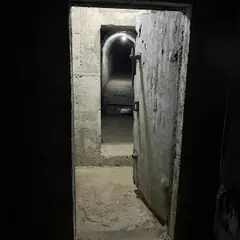
- Stone cellar (qilar) — former stable and winter pantry, where the tour begins
- Stonemasons’ plaque — Greek letters, a date from the 1700s and the names of Mihos, Gjikas and Kolas
- Drummer figure — an Asian miniature carved into a wall, found during the restoration
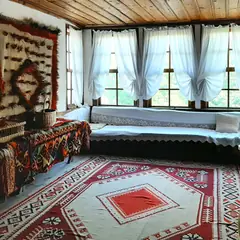
- Wooden floor — the original layout of the rooms, the chest and the Kadare family photographs
Few houses have had a tenant who turned them into literature so insistently. Ismail Kadare was born in this stone house in Gjirokastër on 28 January 1936, and within its walls he wrote his first texts before becoming the most translated Albanian writer. His novel “Chronicle in Stone” (Kronikë në gur), from 1971, begins precisely here, beside the house’s cistern, and tells the story of the city in the Second World War in the voice of a child who is the alter ego of the young Kadare.
The history of the Ismail Kadare House has its shadowy zones too. Its dating is disputed: some take it back to the 17th century, some speak of 1799, and a plaque found in the restoration points to the 1700s. Nor is there agreement on the fire that gutted it: the most widespread version speaks of an accidental fire in 1999, others place it in 1997, the year of civil unrest in Albania. Declared a first-category monument on 5 July 1991, it was the writer himself who donated it for a cultural, museum and residential centre, and on 7 January 2016 the Ministry of Culture and the Municipality of Gjirokastër signed the agreement to revitalise it as “Shtëpia Kadare”. It reopened as a museum in January 2016, the “Kadare Year” of his 80th birthday, although some source moves the date to 2018.
In its architecture the preserved and the borrowed coexist: the layout of the rooms on the first floor is still the original, while the reconstruction took elements from other manor houses of the city and introduced glass. A year after reopening it was already one of Gjirokastër’s most visited heritage sites. Its full story, documented and checked against historical sources, is best enjoyed walking through it floor by floor with the audio guide.
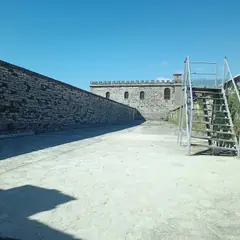
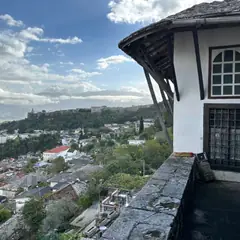
In the same Palorto district you can visit Skenduli House, an Ottoman tower house from the early 18th century, and above the roofs rises Gjirokastër Castle, the citadel that Ali Pasha rebuilt.
A crooked alley for two destinies
Stone façade on Rruga Fato Berberi
Summary of this stop
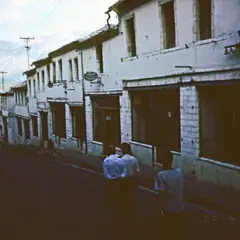
From the town hall square, past the post office, a narrow street descends towards the Palorto district to the stone façade on Rruga Fato Berberi. Stone walls, steep roofs: at first glance it is just another Gjirokastër house. But here was born in 1936 the son of Halit Kadare, a post office clerk, and Hatixhe Dobi, and as a child he lived on a narrow, twisting street known as the Alley of the Mad.
That street has an uncomfortable neighbour in the writer’s memory. Kadare placed Enver Hoxha there too, the dictator who ruled Albania until 1985 and who was also born in Gjirokastër, and he translated its name as “the Alley of the Crazy People”: Sokaku i të Marrëve. It is an episode of disputed history, told by Kadare himself, and the old town has another narrow passage as well, the “Fools’ Passage”, with its own reputation for noisy nights.
The façade seen today is not the one the child knew: an accidental fire wiped out the house in the late 1990s, and in October 2015 the reconstruction was in its final phase. What happened the only time the writer and the dictator met face to face, and the literary gift that came out of that meeting, is left for the narration in front of this door.
The cistern that opens “Chronicle in Stone”
Rainwater cistern
Summary of this stop
The first object the visitor meets is not a manuscript or a portrait but a stone well. It is the rainwater cistern with which “Chronicle in Stone” begins: the child narrator leans over it to speak to it, and it answers him in its deep voice. Few novels can point so exactly to the place where they begin.
Published in 1971, the novel tells of Gjirokastër in the Second World War through the eyes of a boy who is the alter ego of the young Kadare and who reads Macbeth, as the author himself did at eleven. The stone city, the war and Shakespeare mix in that child’s head, and the cistern is the first doorway into that world.
The cistern, together with the enclosing wall and the exterior stone staircase leading to the ground floor and the basement, was renewed in the works funded by UNESCO and the Albanian State. How a household object passes from the mouth of the well to the printed page is best understood listening beside the cistern.
The stone cellar and its finds
Winter provisions cellar
Summary of this stop
In its original form, the ground floor of the house was an entrance and stable for the animals, next to a large cellar, the qilar, where the winter provisions were kept. The architect Agron Doraci decided that the visit should start at the bottom, with that cellar and its stone rooms, so that the house is first read as what it was: a machine for withstanding winter.
The restoration works brought two surprises out of the walls. A stone plaque with the year of construction, from the 1700s, written in Greek letters and with the names of three master stonemasons, Mihos, Gjikas and Kolas, who are held to be Albanian. And, carved into a wall, a miniature sculpture of an Asian figure playing a drum, a strange figure in an Ottoman house in southern Albania.
The family had its own domestic legend about these stones. Kadare’s father was called “the Restorer”, “the Great Rebuilder”, because he was always caught up in repairs he could not afford and that sank the family into hardship; his son suspected that what he really wanted to restore was his own authority. What that house of underground cistern, hidden stairs and closed rooms concealed, and what was said of the grandmother and the vaults, is discovered going down with the audio guide.
The wooden floor where it all began
Wooden residential floor
Summary of this stop
Upstairs, stone gives way to wood. The first floor keeps the original layout of the rooms, with wooden interiors and the glass introduced by the reconstruction, which took elements from other manor houses of Gjirokastër, those of the Babameto, the Skënduli and the Çabej. On display are a decorated wooden chest and original photographs of the Kadare family.
These stairs hold a less kindly family story. In 1933 a seventeen-year-old girl of the Dobi clan, richer but less illustrious, came as a bride into this large, old and run-down house, where a stern mother-in-law ruled. A coldness settled between them that ended in genuine domestic trials, with the father, a court official, as arbiter; Kadare would remember his mother weeping and telling him: “The house is devouring me”. He portrayed her decades later in “The Doll” (Kukulla, 2015), the book he dedicated to his mother.
On this same floor the teenage Kadare wrote his first texts, before becoming the most translated Albanian writer. Decades later he donated the house to his city, which opened it as a museum in the year of his 80th birthday. The most extravagant habit of that lad with a notebook, and the hook he chose for a novel he had not yet written, are told in the narration between these wooden walls.