Ali Pasha’s citadel
Gjirokastër Castle Audio Guide (Kalaja e Gjirokastrës)
A ship-shaped citadel stranded above the Drino valley, rebuilt by Ali Pasha, used to hold the communist regime’s political prisoners and now home to a Cold War American aircraft displayed on its walls.
- 90 min of audio
- Fortress and former prison
Gjirokastër Castle crowns the city, about 500 metres long and between 90 metres and a little over 10 metres wide. Its history begins long before the Ottomans: excavations have brought up pottery from four earlier phases of occupation, the oldest from the 5th-2nd centuries BC. Ali Pasha of Tepelena, who took the city around 1811-1812, rebuilt it in barely a year and a half, with towers of almost 30 metres, walls about 3.4 metres thick and barracks for a garrison of 5,000 soldiers.
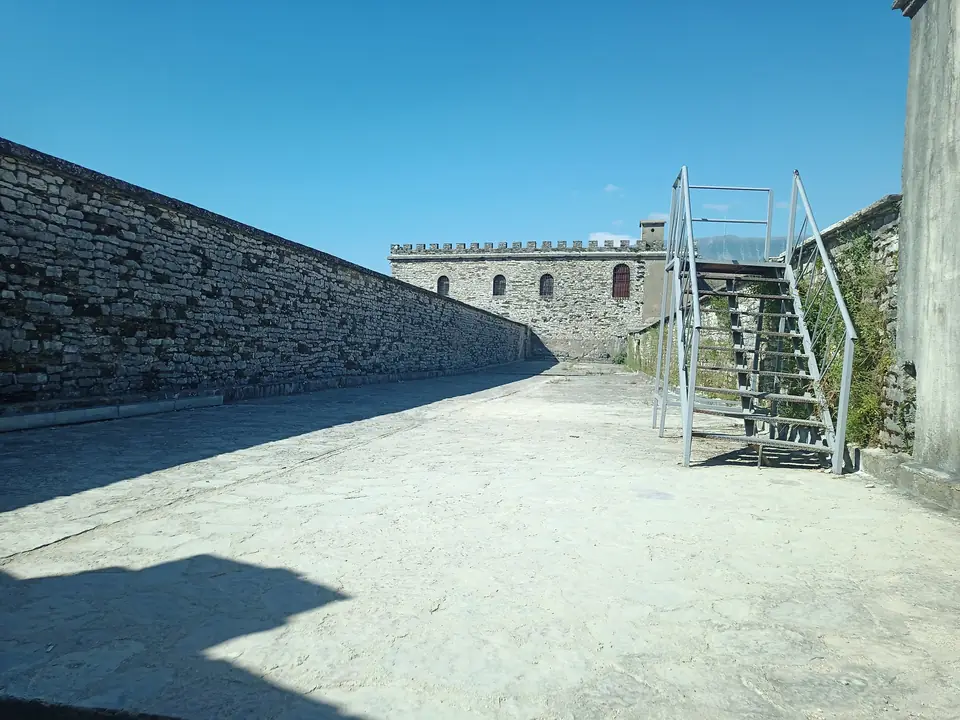
The same wall that is photographed today was for years the roof of a prison. The prison that King Zog finished in 1932 passed to the Italian and German occupiers and then to the communist regime, which made it Political Prison No. 17: in 1950 it held about 740 prisoners in cells of 2 x 3 metres. Above them, a US fighter forced to land in 1957 was put on display as a trophy.
Highlights
- Artillery gallery — cannons and a small Italian Fiat tank captured in the Second World War
- Prison of the seven windows — cells of Political Prison No. 17 with the prisoners’ inscriptions
- T-33 aircraft — the US Air Force Lockheed forced to land in Albania in 1957
- Red stage — the courtyard of the National Folklore Festival, born in 1968
- Clock tower — built by Ali Pasha to mark the five daily prayers
Every stone of Gjirokastër Castle has served a different master. The first written mention of the city and its fortress dates from 1336, when the Byzantine chronicler John Kantakouzenos recorded it as Argyrókastron; in 1672 the Ottoman traveller Evliya Çelebi found inside the enclosure a street lined with some 200 houses; around 1811-1812 Ali Pasha of Tepelena turned it into the elongated citadel that now overlooks the Drino valley. The 20th century brought King Zog’s prison, the occupiers of the Second World War, the communist regime’s political prison and, later, the museums and the National Folklore Festival.
The history of Gjirokastër Castle reads in layers: pre-Roman walls beneath the Ottoman work, vaulted galleries full of cannons, cells with letters scratched into the wall and a rooftop that commands the old town. The exact age of the fortification is still debated, from those who place it in the 12th or 13th centuries to those who read in the pottery and the block walls a fortress of the 5th century BC or of the Hellenistic period. Its full story, documented and checked against historical sources, is best enjoyed walking its ramparts with the audio guide.
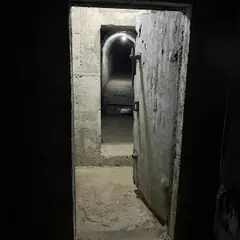
Beneath the same rock opens the Cold War Tunnel, the communist regime’s nuclear shelter, and a few steps to the north the streets of the Old Bazaar knot together. In the Palorto district, the Ismail Kadare House gives back the stone city the writer described in “Chronicle in Stone”.
Walls of silver and the fall of Argjiro
Main castle gate
Summary of this stop
At the main gate appears a fortress much older than it looks. Excavations inside have identified pottery from the 5th-2nd centuries BC and the 5th-7th, 9th-10th and 12th-13th centuries AD, and the oldest phase brings walls of large blocks, a sign of a pre-Roman fortification dating from before roughly 168 BC. In July 2025, after some 30 years without excavations, the National Institute of Cultural Heritage uncovered next to this same entrance the remains of a stone tower from the 4th-6th centuries AD, under the direction of the archaeologist Mareglen Meshini.
The name has its own puzzle too. John Kantakouzenos called it Argyrókastron in 1336, a name that suggests the Greek argyros, silver, and some link it to the grey stone that shines in the rain or to the Argjyri clan. The city, however, prefers another explanation: legend has it that Princess Argjiro, sister of the lord Gjin Zenebishi, threw herself from the walls with her child in her arms so as not to fall into Ottoman hands. Ismail Kadare took up that fall in his 1960 poem “She Fell Like a Star, but Did Not Go Out”.
The legend leaves a mark that can be pointed out: some white veins in the rock at the foot of the walls, which geology attributes to calcareous deposits. What tradition says about those stains, and why the city’s name is older than the legend itself, is revealed when you listen to the narration right there.
Ali Pasha’s cannon gallery: a ship of stone
Artillery gallery
Summary of this stop
To the left of the gate opens a long vaulted gallery lined with pieces of artillery, abandoned or captured from the Italians and Germans in the Second World War, with a small Italian Fiat tank among them. Here the scale of the fortress is felt in the body: after Ali Pasha’s rebuilding, some walls reached about 3.4 metres thick and some towers almost 30 metres high.
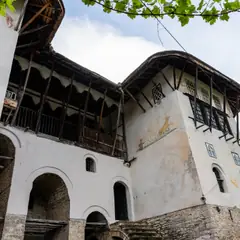
The architecture of Gjirokastër Castle is that of a ship-shaped citadel, some 500 metres long, at most 90 metres wide and at least a little over 10. Ali Pasha of Tepelena took the city around 1811-1812, depending on the source consulted, and rebuilt the fortress, a seraglio and several annexes in barely a year and a half. The enclosure housed barracks for 5,000 soldiers and underground stores of ammunition and provisions; on its residential tower alone, by the southeast corner, 1,500 men worked.
The contrast with what was there before is enormous. In 1672 Evliya Çelebi described inside the enclosure a wide street running east to west with some 200 houses, two iron gates with three pairs of leaves each and a moat 100 paces long and 200 wide. How that walled village became the barracks of an ambitious pasha is left for the narration.
Seven windows and the prisoners’ letters
Prison of the seven windows
Summary of this stop
From the first gallery of the National Museum of Armaments you enter the harshest side of the fortress. The castle prison, finished in 1932 on King Zog’s orders, served his regime, then the Italian and German occupying forces and finally the communist regime. Several sources have it in use until 1968, although a Ministry of the Interior order of 1953, cited by the researcher Kastriot Dervishi, closed Political Prison No. 17 and moved prisoners and staff to Vlora; it may have kept working with another use until 1968.
As Political Prison No. 17, in 1950 it held about 740 prisoners in cells of 2 x 3 metres with an always-damp cement floor; in 1946 it was guarded by 54 men and a special platoon of 34. One of its rooms is known as “burgu i shtatë penxhereve”, the prison of the seven windows, and the inscriptions left by prisoners are still there. In 1971 the National Museum of Armaments opened in part of the old prison, with weapons from independence in 1912 to the end of the Second World War, rooms devoted to the partisan struggle and a socialist-realist museography; it was looted in the unrest that followed the fall of the regime.
The most unsettling shadow lies outside the walls. In November 2018 the associations of former political persecutees, led by Nebil Çika, reported a suspected mass grave next to the castle, based on what elderly neighbours had seen from afar, while other testimonies place the graves elsewhere. It is a disputed story, and the narration tells it with the caution it deserves.
Footsteps above the prison and the captive aircraft
T-33 aircraft on the wall
Summary of this stop
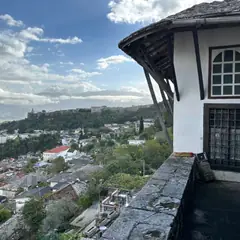
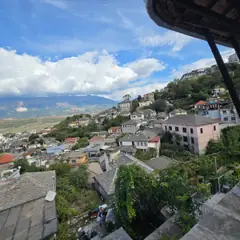
A ramp to the right of the main gate climbs to the prison rooftop, an esplanade that commands the old town. The view gains meaning when you know that this esplanade is the roof of the cells. The political prisoners who passed through the jail in 1945-1946, many of them from the Greek minority, said they slept so crowded together that one man’s legs rested on another’s stomach, while armed patrols walked the top without rest in heavy hobnailed boots.
Even the stone has a story here. Ali Pasha brought drinking water to the fortress by an aqueduct of about 12 kilometres from Mount Sopot; in the 1930s King Zog dismantled it to reuse its stone in the castle prison, and only a stretch of arches survives in the Manalat district, the so-called Ali Pasha Bridge.
In front, on the walls facing the city, rest the remains of a US Air Force Lockheed T-33 with its nose towards the Drino valley. On 23 December 1957 two Albanian MiG-15s, flown by Anastas Ngjela and Mahmut Hysa, forced it to land at the unfinished Rinas airstrip; its pilot, Major Howard J. Curran, was freed on 11 January 1958. The regime presented it as a captured spy plane, other versions speak of a breakdown and an emergency landing, and even the sign beside the aircraft mixes both readings.
A red stage for Hoxha’s birthday
National Folklore Festival stage
Summary of this stop
In the upper courtyard stands a large red metal structure from the 1980s: the stage of the National Folklore Festival. The first was held in Gjirokastër from 8 to 16 October 1968 to celebrate the birthday of Enver Hoxha, born in the city, and it was repeated every five years; it moved to Berat in 1995, returned to the castle in 2000 and its latest edition ran from 24 June to 1 July 2023.
On the east side of the enclosure rises the clock tower that Ali Pasha built to mark the five daily prayers. It was restored in the 1980s and the current clock, installed in the 1990s, does not work: a tower that once measured the time of prayer and is now standing still.
One of the castle’s galleries has housed, since late September 2012, the Gjirokastra Museum, which was to be called “Chronicle in Stone”, like Ismail Kadare’s novel. It traces the history of the city and the Drino valley from prehistory with archaeological pieces, restored weapons and traditional costumes, and brings together local figures such as Çerçiz Topulli, Musine Kokalari and Kadare himself, with a corner devoted to Enver Hoxha. How all those lives fit into one fortress is the close of the narration.