Cultural monument
Ethnographic Museum Audio Guide (Muzeu Etnografik)
A stone house built in 1966 on the plot where Enver Hoxha was born: it was a regime museum, lost its façade in an explosion in 1997 and today holds the domestic life of a rich Gjirokastër family of the 19th century.
- 40 min of audio
- Traditional Gjirokastër house
Gjirokastër’s Ethnographic Museum occupies the plot of the house where Enver Hoxha was born in October 1908, in the Palorto district. That dwelling burned down and the current building was constructed in 1966 on Hoxha’s own initiative, but not as a replica: it was designed as a model traditional house, with classic features taken from specific houses in the city. Since 1973 it has been declared a cultural heritage monument of Albania.
The house has changed its narrative as many times as it has changed regimes. Between 1966 and 1991 it was the district’s Museum of the Anti-Fascist National Liberation War; when communism fell it received the ethnographic collections of Zekate House, and in mid-December 1997, amid the Albanian crisis, a blast destroyed its façade. More than twenty years after the anti-fascist museum closed, its original leaflet was still on sale at the ticket desk.
Highlights
- Stone façade with arched door — the 1966 model house, blown up with explosives in 1997 and rebuilt over the years
- Four visitable floors — furnished like those of a rich 19th-century Ottoman merchant or administrator family
- Oda and guest rooms — carpets, decorated seats and original objects from the 18th and 19th centuries
- Enver Hoxha section — the birth room and biographical material about the dictator and the house
- Third-floor terrace — views over the stone-slab roofs of the old town and the mountains
On Rruga Hysen Hoxha, a street named after the dictator’s uncle, stands a stone house that looks as if it has always been there. It has not. Enver Hoxha was born on this plot in October 1908, the son of Halil Hoxha, a cloth merchant who travelled through Europe and the United States, and Gjylihan Çuçi. The family house burned down in 1916, according to several sources, although others place the fire in the 1960s, and in 1966 Hoxha himself pushed for the current building to be raised in its place.
The history of Gjirokastër’s Ethnographic Museum is that of a building born as a stage set. The national tourism agency and part of the press present it as the dictator’s birthplace; other sources, such as the Gjirokastra Foundation, describe it as a new construction, conceived as a model of the city’s traditional house and with features copied from other dwellings. It was an anti-fascist museum for a quarter of a century, survived a blast in 1997 and since 1991 has displayed the domestic life of Gjirokastër. Its full story, documented and checked against historical sources, is best enjoyed walking through its four floors with the audio guide.
Its collections arrived in 1991 from Zekate House, then returned to its owners; the same regime that raised the building dug the Cold War Tunnel under the castle rock, and the commercial life of that city is still on view in the Old Bazaar.
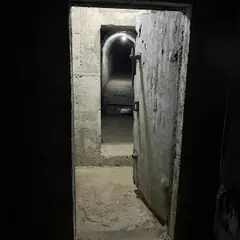
The arched door that was blown up in 1997
Ethnographic Museum
Summary of this stop
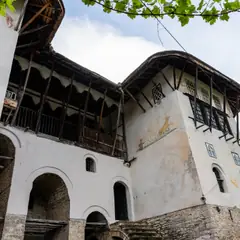
In front of the stone façade, with its arched door and slab roof, the visitor finds a textbook Gjirokastër-style Ottoman house. Precisely for that reason it deserves a second look: the architecture of the Ethnographic Museum does not copy the house where Hoxha was born but a type, that of the city’s ideal house, composed with details from real houses nearby.
That façade also keeps a scar. According to the accounts, on the night of 15 December 1997 someone left 30 kilos of TNT beside the main door. The explosion destroyed the façade, badly damaged the ground floor and reached several neighbouring houses; Sabrie Hoxha, aged 50, a distant relative of the dictator, was injured inside her own home, about seven metres away. Nobody claimed the attack immediately, and the reconstruction took years.
The house “burned” again on Friday 13 July 2018, this time as a pretence: a drill with fire engines and ambulances to test the response to a fire in the city’s museum district. That it was staged right here did not go unnoticed, and what links this false fire with the real one is left for the narration in front of the door.
Carpets, costumes and a wedding on video
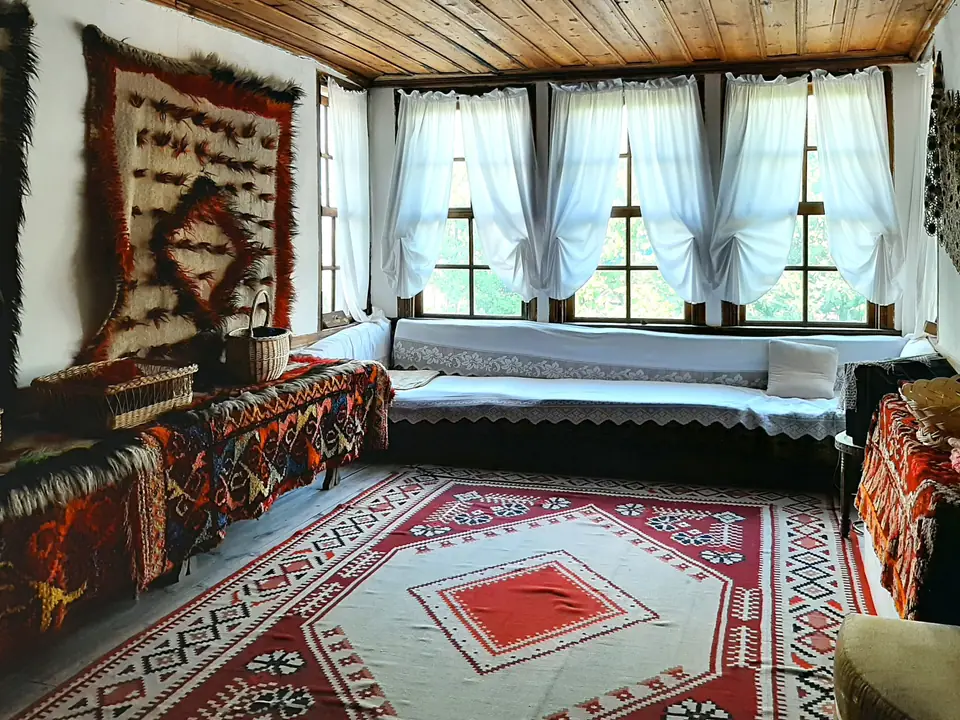
Reception oda with carpets and seats
Summary of this stop
Inside, the house fills with life. The museum’s four floors, all open to visitors, are furnished as a rich family of Ottoman merchants or administrators in 19th-century Gjirokastër would have used them. The oda and the guest rooms appear in their traditional state, with carpets, decorated seats, furniture and crafts, just as visitors were received in a well-off house.
What to see in the Ethnographic Museum also comes down to its objects: original pieces from the 18th and 19th centuries gathered from houses in the city and grouped by themes such as the wedding, the kitchen or religious life. A room of folk costumes explains, through the region’s ceremonial dress, social customs and the roles of men and women.
In the kitchen the traditional utensils wait, and beside it, multimedia displays with music and recordings of weddings and rituals. Models of typical Gjirokastër houses show how they were built, with a closed stone base and noble wooden floors, the same logic the visitor has just walked through from the inside.
A birth room for the camera
Enver Hoxha’s birth room
Summary of this stop
The section devoted to Enver Hoxha contrasts with the rest of the house. According to the Municipality’s sheet, it brings together his birth room and biographical and documentary material, although the descriptions do not match: some guides claim there is nothing about him, and a 2024 report speaks of family photos, partisan maps and books of his kept in a restricted-access cupboard.
Between 1966 and 1991 the building was the district’s Museum of the Anti-Fascist National Liberation War, with many objects of Hoxha and his comrades. The dictator’s childhood comes in here too: while his father emigrated to the United States, his uncle Hysen Hoxha (1861-1934), mayor of Gjirokastër and founder of “Liria”, the first school in the Albanian language in the region, weighed on it.
The house was also a film set. In the 1967 documentary “Happy days”, with a script by Ismail Kadare, Hoxha enters his birth house, already turned into a museum, and sits “as before” in the winter room chatting with neighbours, in a building raised barely a year earlier. In 1983 it served as a setting again for “Memory from Gjirokastra”, by Dhimitër Anagnosti. How a memory is manufactured for the camera is what the narration reveals in this room.
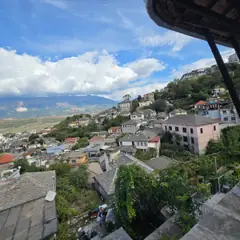
Zekate House across the rooftop
Third-floor terrace
Summary of this stop
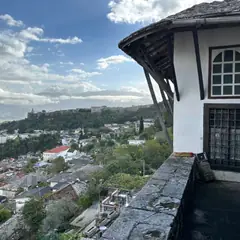
The third-floor terrace opens over the stone-slab roofs of the old town and the mountains. Further up, in Palorto, stands Zekate House, the former seat of the Ethnographic Museum: in 1991, when communism fell, its collections were moved to this building and the house was returned to its owners. Domestic life thus took the place of propaganda.
The set-house is cared for today as heritage: it has been declared a cultural monument of Albania since 10 June 1973 and is managed by the Gjirokastër regional heritage directorate. On 6 February 2021 Prime Minister Edi Rama announced that it would have the rank of National Ethnographic Museum, and in October that year the works of the Albanian Development Fund, with plastering, stone walls and the reconstruction of the roof, were 40% complete.
In the district seen below another episode survives. It is said that around 1916, with the city under Greek occupation, the Palorto school operated in the district mosque and a young neighbour taught Albanian for free, although it was forbidden. There Hoxha received his first Albanian lessons, and the way the pupils fooled the agents is the finale of the audio guide.