Ottoman bazaar
Old Bazaar Audio Guide (Pazari i Vjetër)
Five stone streets knotted at a single crossing, shops with hidden cellars and a mosque that survived state atheism with circus trapezes hanging from its dome. Gjirokastër’s bazaar has burned, emptied and been patched up again and again, and it still stands.
- 40 min of audio
- First-category monument
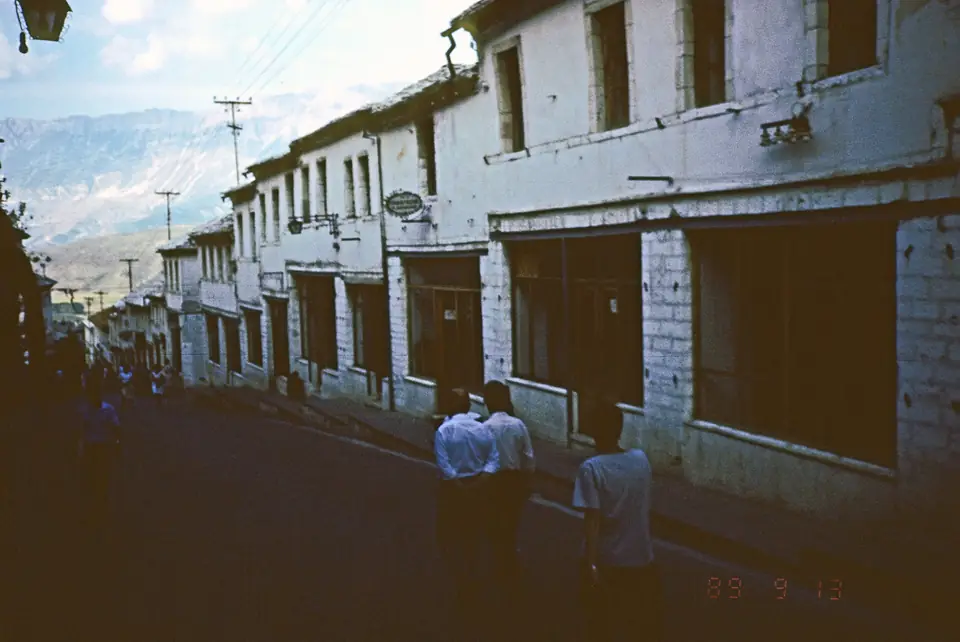
Gjirokastër’s Old Bazaar was born, paradoxically, as a new district: in the 17th century the Ottoman governor Memi Pasha laid out a commercial centre here with a mosque and all its streets converging on the “neck” of the bazaar, Qafa e Pazarit. Today it brings together about 100 shops, warehouses and workshops from the 18th and 19th centuries, with a narrow commercial ground floor and an overhanging residential floor, protected as a first-category monument.
Beneath that uniform façade there is more than meets the eye. The works of 2019 brought to light cellars and underground rooms beneath almost every shop, some connected to each other, and stretches of paving 200 to 400 years old. And in the centre of the bazaar, the mosque that was saved when the anti-religious campaign pulled down 12 of the 13 still left in the city ended up as a training hall for acrobats.
Highlights
- Qafa e Pazarit — the “neck” where the five streets of Memi Pasha’s plan meet
- Bazaar Mosque — the only one of the 13 left in the city that was saved from demolition
- About 100 stone shops — workshop below and overhanging home above, from the 18th and 19th centuries
- Hidden cellars — underground rooms found in 2019 beneath almost every shop
- Paving 200 to 400 years old — two stretches uncovered in 2019, on view and signposted
The name is misleading. Gjirokastër’s first market, older than the Ottoman arrival of 1419, occupied the approaches to the castle’s east gate, and that sector keeps the name Pazari i Vjetër, “old bazaar”. The one you walk today came later, as the “New Bazaar” that the governor Memi Pasha laid out in the 17th century: a commercial district with its mosque and a radial plan in which all the streets lead to the same point. In 1670 the Ottoman traveller Evliya Çelebi counted in the city some 2,000 houses, eight mosques, three churches, 280 shops, five fountains and five inns, and one of the districts he listed bore the name Memi Bey.
The history of Gjirokastër’s Old Bazaar is a succession of fires and comebacks. The first planned centre burned almost entirely and was rebuilt, according to some sources, in the 1750s; others speak of a great fire in the 19th century after which everything was redone, and there was another fire in 1912, although the exact chronology still does not match between sources. From the first years of the Hoxha regime, new flats in the valley emptied the upper town and the shops closed, but the bazaar’s architecture was preserved thanks to the proclamation of Gjirokastër as a museum-city in the 1960s. In 1997, after the collapse of the pyramid schemes, a good part of the bazaar was burned or damaged. The architecture of the Old Bazaar, with its grey slab roofs and stone fronts, is the result of all those repairs, and its full story, documented and checked against historical sources, is best enjoyed walking the paving with the audio guide.
Above the slab roofs rises Gjirokastër Castle, and a few minutes away the Ethnographic Museum shows indoors how a rich family of the city lived in the 19th century.
Five streets at the neck of the bazaar
Qafa e Pazarit crossing
Summary of this stop
The route starts at Qafa e Pazarit, the “neck of the bazaar”, the knot that explains Memi Pasha’s plan at a glance. Four streets branch off the main street, each towards a residential district, and all five cross here. More than three centuries later, the layout still makes residents and visitors pass through the same point, and from the crossing you take in the group of stone shops that climb and descend the slope.
At this same crossing there is a corner that smells of freshly roasted coffee. Lubjana Baoja has brought here the ritual of Gjirokastër’s old houses: the fire, the iron trivet, the copper pot, the glass of raki and the stone on which the beans are ground with blows of an iron bar. The coffee is roasted in the qebap, a cylindrical box turned over the fire, and then it takes between 600 and 800 blows, always at the exact centre of the mortar, to grind about 100 grams in nearly an hour.
In the houses, this coffee was the welcome ritual for a guest and became an institution of the afternoon gatherings, especially among women. What that same quantity of beans weighed in communist times, and why every blow on the stone carries something of family memory, is revealed when you listen to the narration right there.
Shops with steel beams and hidden cellars
Row of stone shops
Summary of this stop
The row of stone shops shows uniform fronts of two and three storeys: a narrow commercial ground floor and an overhanging upper floor, now occupied by souvenir shops, carpet sellers, workshops and cafés. According to documented local tradition, after one of the great fires the shops were rebuilt almost identically, with the workshop where the craftsman spent his day below and the home or lodging above. Some had a back door used only by the owner, and a pavement was built in front for passers-by, something uncommon in other bazaars of the period.
The fronts also hold a technical detail: after the 1912 fire, the reconstruction used steel beams for the first time to support the shop façades. And beneath the ground there is a third layer. The 2019 works at Qafa e Pazarit uncovered rooms under the existing shops: almost all had cellars and underground rooms, in some cases connected to each other, a hidden world beneath the same slabs that visitors walk on today.
The acrobats’ mosque
Xhamia e Pazarit
Summary of this stop
Facing the portico stands the Bazaar Mosque, Xhamia e Pazarit, also called the Memi Bey Mosque: a square hall under a dome covered in stone slabs, with its minaret and an inscription over the entrance that is largely illegible. Most sources date it to 1757, built in the centre of the bazaar after the great fire that had destroyed it, although others give 1754 and the legible date of the inscription points towards 1763-1764. Beside it stands an octagonal two-storey domed building from 1727, a former Bektashi tekke closed in communist times and now a madrasa.
Under the entrance portico there were shops, and the rent the merchants paid financed the upkeep of the temple: a mosque sustained by the bazaar’s own trade. In the anti-religious campaign of the late 1960s, 12 of the 13 mosques left in Gjirokastër were pulled down. The Bazaar Mosque was saved, was declared a Cultural Monument in 1973 and served as a warehouse and as a training hall for circus acrobats, who hung their trapezes from the dome. The full irony of that survival is told in the narration, in front of the same portico.
Centuries-old paving and patched-up roofs
Signposted stretch of old paving
Summary of this stop
The bazaar is a skin of stone that burns, is abandoned and is repaired. In 2019 four stretches of paving 200 to 400 years old appeared in different places, about 15 m² in all: two were covered over again and two were left on view, with panels indicating their age. They formed part of the rehabilitation of Qafa e Pazarit (2018-2019), which covered 5,290 m², repaired 85% of the paving and renewed networks installed about 60 years earlier; in 2018 alone, private businesspeople invested 2 million euros in the area.
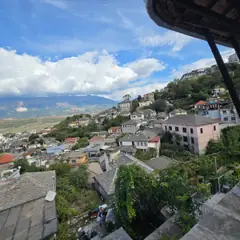
Above, the roofs tell another story. The roofs are of grey limestone slabs, but on some buildings they have been replaced with ordinary red tile, which stands out like a patch. Restoring a shop does not depend on money alone: it needs the consent of all the owners of each building, often many and scattered around the world. In 2011 signatures were being collected from a single family, the Kokolari, with 70 members spread between Gjirokastër, Tirana, England, the United States and Canada. Why one neighbour ended up putting red tile on his house is one of the episodes the audio guide unpacks on the spot.