Palace of the Nguyễn dynasty
Imperial City of Hue Audio Guide (Hoàng thành Huế)
Thirteen emperors were crowned in its throne hall, and the last one abdicated above its main gate. The Imperial City of Hue alternates restored gilded halls with the empty plots left by the wars of 1947 and 1968.
- 120 min of audio
- Imperial palace of 1804
The Imperial City of Hue, the Hoàng thành Huế, began to be built in 1804 under Gia Long and was not complete until 1833, under Minh Mạng, with some 147 structures. Gia Long took the Forbidden City of Beijing as his model, but the almost square compound, about 600 metres a side, with a 4-metre brick wall and a moat, does not face due south: it is oriented to the southeast, towards the Perfume River, and shifts the imperial residence towards the river side.
What is missing counts as much as what still stands. In 1947 the core of the palace burned, and the fighting of the 1968 Battle of Huế damaged it badly again: the Cần Chánh hall and the Càn Thành palace are today foundations, while the Kiến Trung palace, rebuilt since 2019, reopened at Tết 2024. Between the two, the Nguyễn throne, a National Treasure, watches over the coronation hall behind tempered glass.
Highlights
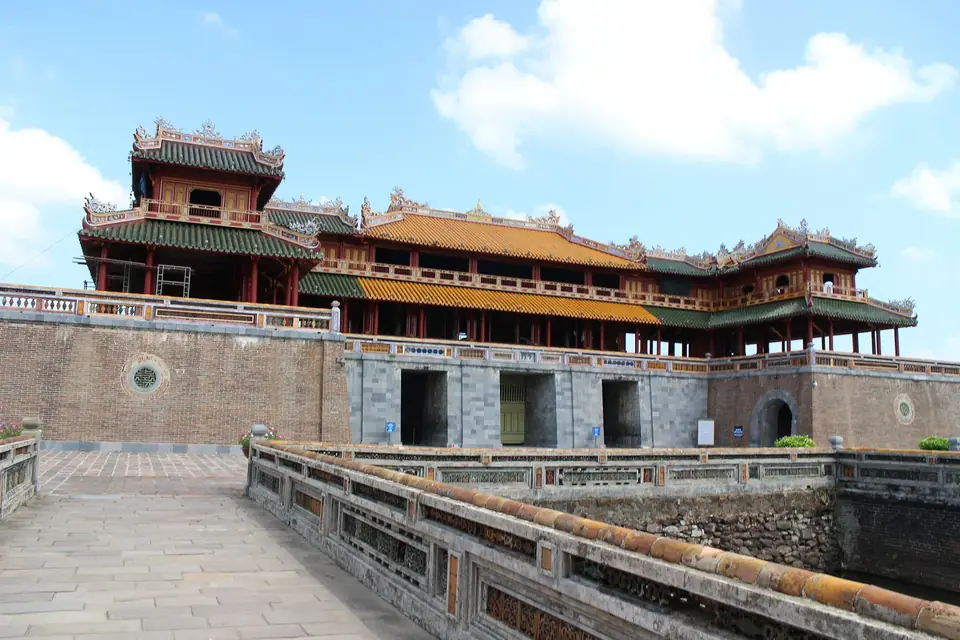
- Ngọ Môn Gate — five passages by rank and nine roofs on 100 columns
- Ngọ Môn Tribune — stage of Bảo Đại's abdication in 1945
- Thái Hòa throne hall — coronations of all 13 Nguyễn emperors
- Plots of Cần Chánh and Càn Thành and the rebuilt Kiến Trung palace
- Nine bronze urns before the Thế Miếu — the largest weighs 2,061 kg
The history of the Imperial City of Hue is that of an entire dynasty told within a single compound. Work began in 1804, under Gia Long, the first Nguyễn emperor, and his successor Minh Mạng did not complete the complex, some 147 structures, until 1833. Gia Long laid out the complex on the model of the Forbidden City of Beijing, but turned it towards the Perfume River: the citadel of Huế faces southeast and the imperial residence is shifted towards the water, instead of occupying the centre of concentric rings.
In that throne hall the thirteen emperors of the dynasty were crowned, from Gia Long to Bảo Đại, and above the main gate the last of them abdicated on 30 August 1945. Then came the wars: in 1947 the core of the palace burned and in 1968, during the Battle of Huế, the fighting battered the Imperial City again. The figures for what was lost differ between sources, but the walk today alternates restored gilded halls with empty esplanades and bullet marks on the walls.
What to see at the Imperial City of Hue is arranged along one axis: from the Ngọ Môn gate to the esplanade of the mandarins, from the Thái Hòa hall to the plots of the Purple Forbidden City, and from there to the temple of the nine bronze urns. The audio guide follows that path in six stops, with a narration researched and fact-checked against historical sources, and reserves for each point the story that the walls do not tell at first sight.
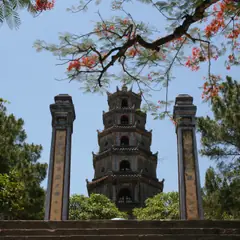
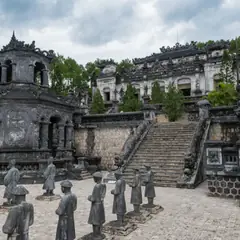
Upriver, the Thien Mu Pagoda completes the portrait of the Hue of the Nguyễn, and south of the city the Tomb of Khai Dinh shows how the father of Bảo Đại, the emperor of the abdication, wished to be remembered.
Ngọ Môn: the gate that divides by rank
Ngọ Môn
Summary of this stop
The entrance to the Imperial City is already a lesson in hierarchy. Ngọ Môn, the south gate raised in 1833 over the old Nam Khuyết đài, has five passages: the central one, higher, reserved for the emperor; the two beside it, Tả Giáp and Hữu Giáp, for civil and military mandarins; and the two outer ones, bent at an angle inside the U-shaped wings, for soldiers, elephants and horses. Above, the Ngũ Phụng pavilion links nine roofs on 100 columns of lim wood, and only the central one has yellow tile.
Over the central passage, a panel holds the two characters “Ngọ Môn”. The plaque, commissioned in 1846, was destroyed in 1943, the 18th year of Bảo Đại, when the glass protecting it was broken to tear off the gold that covered the letters. Today only the bronze characters remain.
It was not the first plunder. According to accounts of the time, after the fall of Huế in July 1885 the Citadel was left for weeks at the mercy of looting, with scenes such as two plunderers who fought over a golden elephant until it was smashed to pieces. Where that treasure ended up, and the fate of an imperial sword that travelled as far as Paris, is the story the audio guide opens with before the gate.
The tribune where the monarchy ended
Ngũ Phụng Pavilion Tribune
Summary of this stop
In a way, the tour begins with the end. On the Ngọ Môn tribune, on 30 August 1945, Bảo Đại, the last Nguyễn emperor, read his edict of abdication and handed the seal and the sword to the representatives of the provisional government. With that gesture the monarchy in Vietnam came to a close.
A famous phrase is usually attributed to that act: “I prefer to be a citizen of an independent country than king of an enslaved one.” The documents point to another date. The surviving abdication edict does not contain it, and the poet Cù Huy Cận, present that day, denied that it was spoken; Bảo Đại had written it in the edict of 17 August 1945 and repeated it in the one addressed to the imperial family on 25 August.
From the top of the gate the geometry of the complex also becomes clear: a palace that copies Beijing but faces the Perfume River, to the southeast. What was seen from this same tribune on that morning in 1945 is one of the scenes the narration reconstructs on the spot.
Đại Triều Nghi: hierarchy written on the ground
Đại Triều Nghi Rank Steles
Summary of this stop
Past the Trung Đạo bridge, which crosses the ponds of Thái Dịch lake, the Đại Triều Nghi esplanade opens in front of the throne hall. Here the mandarins attended the great audiences of the 1st and 15th of each lunar month, arranged on two terraces: first to third rank above, fourth to ninth below. Each stood beside a small stone stele that marked his rank, civil officials on the left and military on the right.
The two rows of steles are still in place and give the measure of a court ordered to the centimetre. They also give the measure of the palace: an almost square compound of some 600 metres a side, enclosed by a 4-metre brick wall and a moat, which took almost three decades to complete, from 1804 to 1833.
How one of those audiences unfolded, and what each official had at stake according to the stone that fell to him, is told in the audio guide from the esplanade itself.
Thái Hòa: thirteen coronations and a throne behind glass
Điện Thái Hòa
Summary of this stop
The Thái Hòa throne hall was built between February and October 1805, some 50 metres north of where it stands today; in 1833 Minh Mạng rebuilt it on its current site. Under its roof the 13 Nguyễn emperors were crowned, from Gia Long to Bảo Đại. In the centre, the throne rests on a three-step pedestal beneath a gilded wooden canopy with nine dragons, from 1923, and the facade has two round windows of the character Thọ, about 1.4 metres in diameter, added in the renovation of that same year.
The throne, a National Treasure since 2015, recently lived through an episode of its own. On 24 May 2025 a visitor jumped the barrier, sat on it and broke its left arm. Restored with its 14 original fragments, it returned to its pedestal on 4 June 2026, now surrounded by tempered glass and cameras.
What it meant for each new emperor to sit in that seat, and what changes when it is seen today behind the glass, is the thread of the narration inside the hall.
The palaces left as foundations
Điện Kiến Trung
Summary of this stop
Behind Thái Hòa begins the Purple Forbidden City, and with it, absence. In February 1947 the Việt Minh took the citadel and the French counterattack led to six weeks of fighting in which the core of the palace burned: the Cần Chánh hall and the Càn Thành palace were reduced to foundations. There is no agreement on who bore the blame for that destruction; one version attributes it to the Việt Minh’s scorched-earth tactics and another to the French siege and counterattack. In 1968, during the Battle of Huế, the initial restrictions meant to avoid damaging the Citadel were lifted as casualties mounted, and the fighting battered the compound again.
The plots remain in view, and Cần Chánh has been under reconstruction since late 2024. At the end of the axis stands the Kiến Trung palace, built by Khải Định between 1921 and 1923 with a mix of European and Vietnamese styles, reduced to its foundations after 1945 and rebuilt since 2019 at a cost of over 123 billion dongs. It opened to the public at Tết 2024.
In the Cần Chánh hall, which is today only an empty plot, tradition places in 1934 an investiture that broke court protocol: that of a young empress who advanced alone, dressed in the colour reserved for the sovereign. Who she was and what happened next within the walls of Kiến Trung is revealed by the audio guide before the rebuilt palace.
Nine bronze urns and emperors without an altar
Thế Miếu
Summary of this stop
In front of the Thế Miếu, the dynastic temple raised in 1821-1822, stand the nine bronze urns, the Cửu Đỉnh, cast between December 1835 and June 1837 by order of Minh Mạng. Each bears its own name and 17 reliefs of landscapes, rivers, animals and plants. The largest, Cao, measures 2.5 metres, weighs 2,061 kg and occupies the centre, set 3 metres ahead of the others. Opposite stands the Hiển Lâm Các pavilion, of wood, three storeys and 17 metres, the tallest building in the compound.
Seven urns bear the posthumous title of an emperor, from Cao to Tuyên. Two, Dụ and Huyền, never corresponded to any: deposed, exiled or abdicated emperors, Bảo Đại included, received no posthumous title. Inside the temple, where the women of the court, empresses included, could not attend the rites, there were only 7 altars until October 1958, when the Nguyễn Phúc clan added those of Hàm Nghi, Thành Thái and Duy Tân, anti-French emperors who had been excluded. Dục Đức, Hiệp Hòa and Bảo Đại still have no altar.
This same courtyard relives a court rite at the end of each lunar year: since 2015 it has recreated here the raising of the cây nêu, a great bamboo pole with which the empire announced Tết and closed its administrative year. What was hung at the top of that bamboo, and why, is the story with which the audio guide closes the tour.