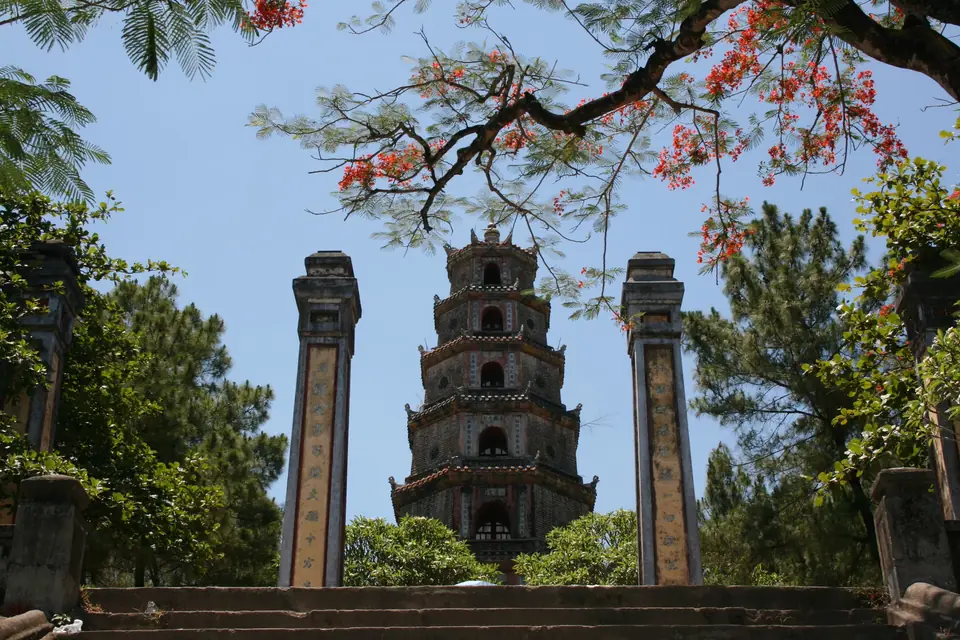
Buddhist pagoda
Thien Mu Pagoda Audio Guide (Chùa Thiên Mụ)
On Hà Khê hill, facing the Perfume River, stands since 1601 the pagoda born of the prophecy of a celestial old woman. Its seven-storey tower is the emblem of Huế, and behind the sanctuary it keeps a blue Austin that changed the history of 1963.
- 45 min of audio
- Dynastic pagoda of 1601
In 1601 Nguyễn Hoàng, the first Nguyễn lord of the south, ordered a temple built on top of Hà Khê hill, facing the Hương River, and named it Thiên Mụ, “Celestial Lady”, after the old woman dressed in red who, according to local legend, announced there the coming of a true lord. There was already a Cham shrine on the hill, and the Celestial Lady is a Vietnamese adaptation of the goddess Po Nagar. Lords and emperors enlarged it over centuries: the great bell of 1710, the reconstruction of 1714, the stele of 1715 and the octagonal Phước Duyên tower of 1844, 21 metres tall.
Behind the serene postcard over the river stands an ordinary car: a blue Austin A95 Westminster, licence plate DBA 599. On 11 June 1963 it took the monk Thích Quảng Đức to a Saigon intersection, where he set himself on fire in protest against Ngô Đình Diệm's religious policy. Its owner, a layman devoted to the pagoda, donated it in 1964, and the sedan has rested in Huế ever since, among imperial pavilions and abbots' stupas.
Highlights
- Phước Duyên Tower — octagonal, 7 storeys and 21 m, raised in 1844 for the 80th birthday of a dowager empress
- Đại Hồng Chung Bell — bronze of 1710, 3,285 cân (almost 2,000 kg), National Treasure since 2013
- Stele of 1715 on a stone turtle — 2.60 m, 1,250 characters and the seals engraved over the text
- Triple gate tam quan — statues of Nguyễn Hoàng and the Celestial Lady on the upper floor
- Blue Austin A95 Westminster — the car that took Thích Quảng Đức to his self-immolation in 1963
The history of the Thien Mu Pagoda begins with a prophecy. In 1601 Nguyễn Hoàng, first Nguyễn lord of Đàng Trong, the south of the country, ordered a temple built on top of Hà Khê hill, facing the Hương River, the Perfume River. He named it Thiên Mụ, “Celestial Lady”, in memory of the old woman dressed in red who, according to local legend, announced in that place the coming of a true lord. The hill was not empty: a Cham shrine had stood there before, and the Celestial Lady is a Vietnamese adaptation of the Cham goddess Po Nagar.
From then on, each generation of lords and emperors left its mark. In 1695 a Chan master arrived from China to take charge of the monastery; in 1710 the great bell was cast; in 1714 came the largest reconstruction in its history, and in 1844 Emperor Thiệu Trị raised the octagonal tower that is today the emblem of Huế. Around 1788, under the Tây Sơn dynasty, the monastery even served as an altar for sacrifices to the Earth. The typhoon of 1904 flattened it and the reconstruction of 1907 was more modest than that of its heyday. In the 20th century, the pagoda also became one of the centres of the Buddhist protest of 1963.
What to see at the Thien Mu Pagoda, its history and its architecture are best understood on the spot, climbing from the landing stage to the abbots’ pine grove with the audio guide’s narration, researched and fact-checked against historical sources.
A dynastic pagoda of the Nguyễn, its history runs parallel to that of the court of the Imperial City of Hue, downriver, and that of the emperor tied to the story of its name continues at the Tomb of Tu Duc.
A tower for a grandmother’s 80th birthday
Phước Duyên Tower
Summary of this stop
On the esplanade rises the Phước Duyên tower, the silhouette that appears in almost every photo of Huế. Emperor Thiệu Trị had it built in 1844 to celebrate the 80th birthday of his grandmother Thuận Thiên, widow of Gia Long, known as Từ Nhân. It is an octagonal brick tower, 21 metres and seven storeys tall, with a Buddha image on each floor and a spiral staircase climbing to the top, where there once was a golden Buddha.
In front of the tower, the emperor also raised the Hương Nguyện pavilion. Today only its base remains: the typhoon of 1904 brought it down completely, and the reconstruction Thành Thái undertook in 1907 was on a smaller scale. The tower did not escape the passage of time unscathed either: when the Huế Monuments Conservation Centre restored it, between 2003 and 2006, it was leaning 7 degrees. The lean was corrected and the tower strengthened against winds and typhoons.
Behind the esplanade lies the landing stage on the river, with its steps and a warning that passes from generation to generation in Huế: popular belief says that a couple who climb to Thiên Mụ together end up splitting. The story of love and river that explains that curse, and the more down-to-earth version that circulates in the city itself, is revealed by listening to the narration beside the pier.
The 3,285-cân bell and the seal stele
Great Bell Pavilion
Summary of this stop
Beside the tower, two hexagonal pavilions house two works commissioned by the same lord, Nguyễn Phúc Chu. In one hangs the great bell Đại Hồng Chung, cast in bronze in 1710 as an offering to the Buddha, with Buddhist, Confucian and Taoist inscriptions and motifs. It measures 2.5 metres in height according to most sources and has been a National Treasure of Vietnam since 2013. Its weight carries a curious confusion: 3,285 cân, the unit of the Nguyễn lords, equivalent to almost 2,000 kg today, although the figure often circulates as if it were 3,285 kilos.
In the other pavilion, on the back of a great stone turtle, stands the stele “Ngự kiến Thiên Mụ tự”, of 1715. It measures 2.60 metres, bears 1,250 Chinese characters written by the lord himself and has a singular feature: the seals, among them the dynastic seal, are engraved over the text, as if they had been stamped on a paper document. It has been a National Treasure since 2020.
Thiệu Trị included Thiên Mụ among the twenty landscapes of the capital and dedicated a poem to it, “The sound of the Thiên Mụ bell”. He chose not the tower but the toll: one of his lines says that the bell’s one hundred and eight strokes undo a hundred knots of the soul. The other famous verse tied to this bell has a disputed history, which Huế and Hanoi have fought over for a century and which the narration unpicks before the bronze.
The Celestial Lady and the wounded dragon
Triple Gate Tam Quan
Summary of this stop
The triple gate, the tam quan, is a two-storey structure with three bays guarded by stucco guardians. On the upper floor wait two statues that sum up the origin of the place: Nguyễn Hoàng, the lord who founded the temple in 1601, and the Celestial Lady, the old woman of the prophecy, heir to the Cham goddess Po Nagar who was worshipped on the hill before his arrival.
The name of the temple also has its own story. In 1862, Emperor Tự Đức, who wanted an heir, feared that the word “Thiên”, Heaven, might offend Heaven itself and renamed the pagoda Linh Mụ, “the Sacred Lady”. The ban lasted until 1869, and since then the two names have coexisted. Some give another explanation, tied to the pronunciation of Huế, and the exact origin is still debated.
Legend says that, long before Nguyễn Hoàng, a Chinese general skilled in geomancy ordered a trench dug behind the hill to cut the dragon’s veins and keep the South from growing strong. What happened that night at the foot of the hill, and how the first Nguyễn lord gave the dragon back its strength, is told in the audio guide in front of the gate itself.
The blue Austin that went to Saigon
Blue Austin A95 Westminster
Summary of this stop
Within the pagoda compound, beside the sanctuary buildings, a sedan in faded blue paint is on display with the original Austin emblem on the bonnet. It is an Austin A95 Westminster, plate DBA 599, accompanied by the photograph of the self-immolation and panels in Vietnamese and English. On 11 June 1963 it took the monk Thích Quảng Đức from the Ấn Quang pagoda to a Saigon intersection, where he set himself on fire in protest against the religious policy of Ngô Đình Diệm’s government.
The car belonged to Trần Quang Thuận, a layman devoted to Thiên Mụ itself, who lent it for the procession. The Saigon police impounded it as evidence and later returned it, and in 1964 he donated it to the pagoda, which moved it to Huế. Its presence here is no coincidence: in the summer of 1963, after the death of nine Buddhists at the Vesak in Huế, Thiên Mụ was one of the organising centres of the Buddhist movement and the scene of hunger strikes, barricades and protests.
The story did not end there. In May 1993, after a Buddhist layman set himself on fire before the pagoda, the authorities drove away the abbot Thích Trí Tựu; the crowd overturned the vehicle, which ended up burning, and four monks were sentenced to prison. Accounts of what happened that day differ, and the narration presents them beside the Austin.
The lord’s month among the pines
Pine Grove and Abbots' Stupas
Summary of this stop
At the back of the garden, a pine grove gathers the funerary stupas of former abbots, among them that of Thích Đôn Hậu, abbot during the 20th-century reconstruction. After the noise of history, this corner returns the pagoda to what it still is: a monastery inhabited by monks.
Its monastic life has ancient roots. In 1695 the Chan master Thích Đại Sán, of the Tào Động school, arrived from China at the invitation of the Nguyễn lords; he was named abbot of Thiên Mụ and, before returning to China in 1696, gave the bodhisattva vows to the lord Nguyễn Phúc Chu. That same lord undertook in 1714 the largest reconstruction of the monastery, with dozens of buildings and more than a thousand sets of sutras brought from China.
After the inauguration, Nguyễn Phúc Chu ate vegetarian and lived a whole month in the Tỳ Gia garden, behind the temple. How that retreat of a lord fits with the abbots’ stupas and closes the tour is discovered by listening to the last stop among the pines.