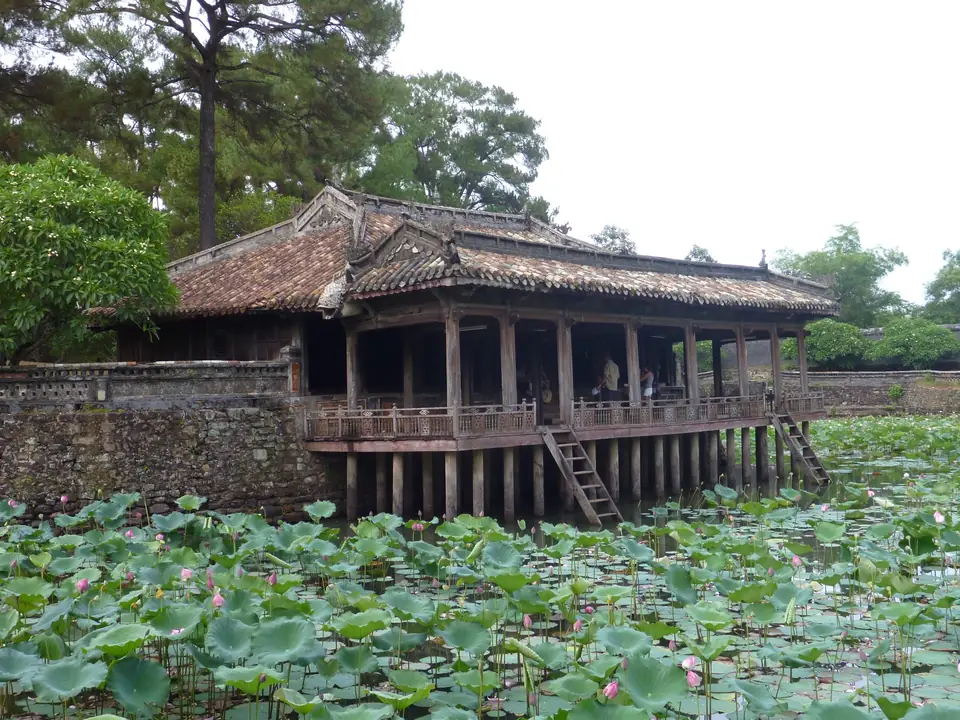
Imperial garden tomb
Tomb of Tu Duc Audio Guide (Lăng Tự Đức)
A closed valley with a lake, pavilions over the water and a private theatre: the poet emperor Tu Duc lived in it while alive as a second palace. Its forced labour sparked a revolt in 1866 and made him rename it with a single word, Humility.
- 75 min of audio
- Tomb and palace of the poet emperor
The Tomb of Tu Duc, officially Khiêm Lăng, was begun in 1864 in a narrow valley in the village of Dương Xuân Thượng, on the outskirts of Hue, under the name Vạn Niên Cơ. After the revolt of 1866 Emperor Tự Đức renamed it Khiêm Cung, palace of humility, and on his death in 1883 it became Khiêm Lăng. Inside a wall of over 1,800 metres are spread almost 50 structures that carry the word Khiêm in their names: a lake with its island, pavilions on stilts, lacquered halls, one of the oldest theatres preserved in Vietnam and, at the back, the stele with the longest inscription in the country.
The contrast lies in the water. The Lưu Khiêm lake, where the king took boat rides and composed poetry, was the worksite where some 3,000 soldiers and labourers toiled day and night, until one dawn they left the dig with the lime-pounding mallets as weapons. Years later, the same king had it carved in stone that the loss of territory to France was his own fault.
Highlights
- Lưu Khiêm Lake — Pavilions on stilts where Tu Duc composed poetry and took boat rides
- Minh Khiêm Đường Theatre — Private theatre of 1865 under a ceiling of sun, clouds and stars
- Khiêm Cung Ký Stele — 4,935 characters written by the emperor himself, the longest inscription in Vietnam
- Almost 50 structures with the word Khiêm, “humility”, in their names
- Bồi Lăng — 37 cm mound of the teenage king Kiến Phúc
On the outskirts of Hue, in a narrow valley closed by a wall 2.5 metres high, Emperor Tự Đức had his tomb and his second palace built at the same time. This is the Tomb of Tu Duc, officially Khiêm Lăng: a garden of curving paths, a lake with an island, pavilions over the water, a court theatre and, at the back, a stone mound of surprisingly sober appearance. Tu Duc did not wait to die to enjoy it: he used it as a residence.
The history of the Tomb of Tu Duc begins in 1864, when work started in the village of Dương Xuân Thượng under the name Vạn Niên Cơ, the foundation of ten thousand years. Many sources present it as the name the king chose for his eternal home, although another maintains that “vạn niên cơ” was the common term for any royal tomb under construction. The building demanded so much that in 1866 a revolt of labourers broke out; the emperor then changed the name to Khiêm Cung, palace of humility, and wrote a memorial to justify himself. On his death, in 1883, the complex came to be called Khiêm Lăng. The completion date is not unanimous: the most cited is 1873, ten years before the king’s death, but other sources put the end back to 1867.
The architecture of the Tomb of Tu Duc follows two parallel axes, that of the palace and that of the tomb, embraced by the Lưu Khiêm lake. A popular tradition in Hue holds that servants collected the dew from the lotus leaves of that lake to prepare the emperor’s tea; real or not, it sums up the refinement attributed to this poet king, and the lotus still blooms there from May to August.
What to see at the Tomb of Tu Duc is arranged in five stops, from the entrance gate to the small tomb of the adopted son, and the full tour, researched and fact-checked against historical sources, makes complete sense when heard on the spot with the audio guide.
South of Hue, the Tomb of Minh Mang and the Tomb of Khai Dinh allow a comparison of three ways of conceiving an emperor’s eternal home, and the Thien Mu Pagoda keeps another trace of Tự Đức in the story of its name.
One word on every gate: Humility
Vụ Khiêm Gate
Summary of this stop
The tour starts at the Vụ Khiêm gate, opened in an outer wall of over 1,800 metres. From there, a Bát Tràng brick path winds among trees towards the lake without a single straight line. On the left is Chí Khiêm Đường, the temple where Tu Duc’s wives are worshipped, and at its sides the courtyards of Y Khiêm and Trì Khiêm, where the concubines lived during the emperor’s life and also after his death.
The name of the gate already gives the first clue. Almost 50 structures in the compound, in the palace zone and in the tomb zone, carry the word Khiêm, humility: the Vụ Khiêm gate, the Lưu Khiêm lake, the Xung Khiêm pavilion, the Hòa Khiêm hall. It was not an aesthetic choice, but the trace of an apology forced by the revolt of 1866.
Along this same entrance path there is also a recent and dark episode, of documented tradition: in 2017, the bulldozers of a visitor car park levelled a mound and, after more than two days of searching, members of the Nguyễn Phước clan pulled from the earth the stele of one of the emperor’s wives. How her name could be recovered, and what happened next to her tomb, is revealed by listening to the narration at the gate.
Lime mallets before the poet’s lake
Lưu Khiêm Lake
Summary of this stop
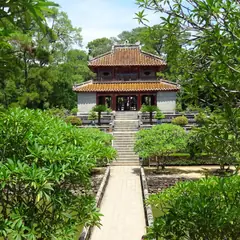
At the Dũ Khiêm Tạ landing, where the royal boats were moored, the Lưu Khiêm lake appears calm. It was born from a widened stream, and at its centre rises the island where Tu Duc hunted small game. Opposite, on stilts, the Xung Khiêm Tạ pavilion, where the king read, composed poetry and attended performances, today hosts shows of traditional Hue music.
That serenity had a price. On the Vạn Niên worksite some 3,000 soldiers and labourers toiled day and night, and among them circulated a couplet that is still remembered: “What ten thousand years are these? Walls made of soldiers’ bones, moats dug with the people’s blood.” It is passed down as the labourers’ popular complaint, although the historian Phạm Văn Sơn suggests it may have been spread by the coup faction itself.
On 16 September 1866, at dawn, Đoàn Hữu Trưng led the labourers out of the dig armed with lime-pounding mallets, crossed the Perfume River and entered the Imperial City to seat Đinh Đạo on the throne. The Pháp Vân pagoda, a kilometre from the worksite, had served as the conspirators’ secret base. The coup failed, and Trưng, aged 22, was executed along with his two brothers. How he went from this lake to the Imperial City in a single night is part of what the audio guide tells beside the water.
A private theatre under painted stars
Minh Khiêm Đường Theatre
Summary of this stop
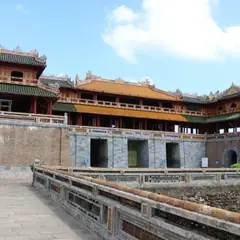
Past the Khiêm Cung Môn gate, two storeys high with three flights of stone steps, the palace zone begins. The Hòa Khiêm hall, the emperor’s former office and today the altar of his tablets and those of the empress, shines newly restored with yellow glazed tiles. Very close stands Minh Khiêm Đường, Tu Duc’s private theatre, built in early 1865 for tuồng, song, dance and court music: it is one of the oldest theatres preserved in Vietnam.
Its ceiling represents a small cosmos of sun, clouds and stars, and that sky still gives people something to talk about. In the restoration of 2024 to 2026 the repainted stars rose from 143 to 183 and two doors in the east wing were walled up; the contractor defended it, researchers such as Nguyễn Xuân Hoa and Phạm Đức Thành Dũng rejected it, and in April 2026 the Hue Monuments Conservation Centre ordered both elements returned to their previous state. It is also still debated from where the king watched the performances: from the east gallery or from the west dais.
Next door, the Lương Khiêm hall was the king’s resting bedroom and later the altar of his mother, the dowager empress Từ Dũ. According to a documented tradition, Tu Duc visited her every other day during his 36 years of reign and copied her advice into a book. One of those visits, after a hunt that dragged on too long, ended up in popular theatre under the title “Tự Đức offers the rod”; what happened that midnight is revealed in front of these halls.
A confession of 4,935 characters
Khiêm Cung Ký Stele
Summary of this stop
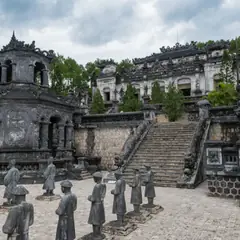
On the axis of the tomb, the court of honour gathers two rows of stone civil and military mandarins, with elephants and horses, strikingly small in scale. The explanation repeated as a joke is that they were carved that way because the emperor was short, 1.53 metres tall according to what is attributed to him; it is more popular quip than history, but it is hard not to look at them differently.
Behind, in a roofless pavilion flanked by two obelisk-columns, rises the Khiêm Cung Ký stele, of about 20 tonnes. According to the sources, the stone came from Thanh Hóa, some 500 kilometres away; that the transport lasted four years is an anecdote that some sources repeat and others consider unrecorded. What is beyond dispute is the text: 4,935 Chinese characters engraved on its two faces in 1871, the longest inscription in Vietnam and the largest stele of its type at the Nguyen tombs. Today it is a National Treasure.
What is extraordinary is who wrote it. At the other Nguyen tombs that stele was drafted by the heir son; Tu Duc, with 103 wives and no children owing to the after-effects of smallpox, wrote his own epitaph, and in it he declares himself guilty of the loss of territory to France for not having known how to choose his men. Further on, beyond the crescent-shaped Tiểu Khiêm pond, the Bửu Thành holds a very sober stone mound; a widely spread version holds that the king rests in another secret place, something other sources regard as a legend never proven. What the emperor confesses exactly on the stone is heard before the stele.
The tiny tomb of the adopted son
Bồi Lăng
Summary of this stop
Set apart from the main axis appears the Bồi Lăng, a small tomb with a mound barely 0.37 metres high. There was buried in 1884 Kiến Phúc, adopted son of Tu Duc, who reigned only eight months. Beside it, Chấp Khiêm Điện, the emperor’s former reading room, became his altar: the garden of the childless king ended up sheltering his heir.
The death of Kiến Phúc, at only 15, remains a disputed story. The official court chronicle speaks of illness, and the French resident Rheinart described it as natural but so sudden that it left everyone stunned; in the palace another version circulated, and the Chinese annals of the Qing dynasty recorded a third. None has been settled, and what they are is told before the small mound.
On the other side of the lake rises the Khiêm Thọ tomb of Empress Lệ Thiên Anh, Tu Duc’s principal wife: begun in 1888, under Đồng Khánh, with four stepped terraces, a double wall and a screen of inlaid ceramic with phoenixes, the empress was buried there in 1902, facing the Lưu Khiêm lake. In the service wing, foundations and remains of courtyards of the concubines’ area, such as Tòng Khiêm and Dụng Khiêm, recall what time has taken from the palace of humility.