Nguyen imperial tomb
Tomb of Khai Dinh Audio Guide (Lăng Khải Định)
The last imperial tomb of the Nguyen climbs a hillside in Hue in 127 steps of grey concrete, between dragons and stone mandarins, to a palace lined inside with broken porcelain and glass. At the top, the emperor waits seated in bronze.
- 45 min of audio
- Porcelain and concrete mosaic
The Tomb of Khai Dinh, Ứng Lăng in Vietnamese, was begun on 4 September 1920 under General Lê Văn Bá and finished in 1931 by Bao Dai, the emperor's son and successor: eleven years of work. With a footprint of 117 by 48.5 metres it is the Nguyen imperial tomb of smallest area and, at the same time, the one that took longest to build. It also breaks with the earlier ones, of wood and stone: it is reinforced concrete, with iron, steel, cement and slate bought in France and porcelain and coloured glass brought by ship from China and Japan.
The contrast lies in its owner. Khai Dinh came to the throne in 1916, after the French colonial government exiled his predecessor Duy Tan, and by the end of his reign he was regarded as little more than a salaried employee of France. A satirical poem of the time called him a wooden statue polished by the Protectorate; today he sits here turned, literally, into a statue, of bronze cast in France.
Highlights
- Stairway of the dragons — 127 steps on 7 terraces, with dragons crawling along the balustrades
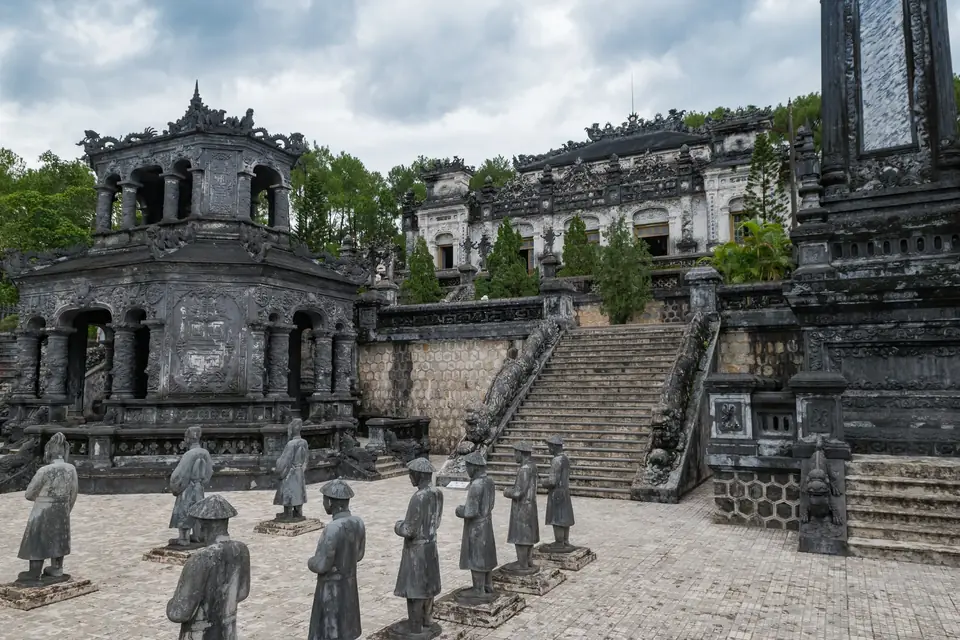
- Courtyard of the mandarins — Stone mandarins, soldiers, horses and elephants in double rows for lack of space
- Stele pavilion — 3.1 m stele with the emperor's official biography, attributed to Bao Dai
- Thiên Định Palace — Mosaics of broken cups and bottles where an alarm clock and a tennis racket appear
- Bronze statue — The emperor under a concrete canopy of almost a tonne that imitates velvet
On a hillside on the outskirts of Hue, a block of grey concrete emerges from the vegetation like a set from another age. This is the Tomb of Khai Dinh, officially Ứng Lăng and also known as Lăng Khải Định: the last imperial tomb of the Nguyen dynasty. Outside, grey and severe; inside, a palace lined with broken porcelain and glass where even a tennis racket is a mosaic.
The history of the Tomb of Khai Dinh is that of an uncomfortable emperor. Khai Dinh came to the throne in 1916, when the French colonial government exiled his predecessor Duy Tan, and before choosing where he would rest he consulted several geomancers: the choice fell on Mount Châu Chữ, which he renamed Ứng Sơn and which gave its name to the tomb. Work began on 4 September 1920, directed by General Lê Văn Bá, and was not closed until 1931, with his son Bao Dai already on the throne. While it was being built, in 1922, Khai Dinh became the first Nguyen emperor to leave the country, bound for the Colonial Exposition in Marseille. According to a documented tradition, that trip inspired the mockery of Nguyễn Ái Quốc, the future Ho Chi Minh, who in 1923 published in L’Humanité a tale in which a French couple mistake a Vietnamese man on the Paris metro for the emperor and laugh at him.
The architecture of the Tomb of Khai Dinh breaks with everything before it. The preceding Nguyen tombs were of wood and stone; this one is reinforced concrete and combines dragons and swastikas with Western-style arches, columns halfway between obelisk and stupa, and pillars of Indian influence. For some it is a bastard mix that breaks the harmony between architecture and landscape of the tombs of Minh Mang and Tu Duc; for others, the summit of porcelain and glass mosaic of the early 20th century. The debate remains open. Aerial photographs from 1932 to 1972 show it as it is today, only with more vegetation around, and since 1993 it has been part of the World Heritage Complex of Hue Monuments.
What to see at the Tomb of Khai Dinh is arranged in five stops, from the stairway of the dragons to the emperor’s statue, and the whole makes full sense when walked with the audio guide.
For comparison, the Tomb of Tu Duc and the Tomb of Minh Mang keep the wood, stone and landscape of the earlier tombs, and at the Imperial City of Hue his son Bảo Đại closed the dynasty’s history in 1945.
A renamed mountain and concrete brought from France
Stairway of the Dragons
Summary of this stop
At the foot of the stairway, the tour starts with a first flight of 37 steps divided into three lanes, along whose balustrades great dragons crawl downwards. Tomb and temple form a single stepped axis on 7 terraces and 127 steps: 37 to the main gate, 29 more to the courtyard of the mandarins and flights of 13 between the upper terraces. The effort of the climb is already part of the message.
The hillside is no accident. Khai Dinh consulted several geomancers before choosing Mount Châu Chữ, changed its name to Ứng Sơn and gave the tomb the name of the mountain. At the top waits the three-arched gate, with two five-clawed dragons fighting over a flaming pearl and wrought-iron gates made in France.
That iron is the first clue. For the works, iron, steel, cement and slate were bought in France, and ships were sent to China and Japan for porcelain and coloured glass. What that change of material means in a dynasty that had built its tombs in wood and stone is what the narration poses at the foot of the dragons.
Mandarins in double rows for lack of space
Courtyard of the Mandarins
Summary of this stop
The courtyard of the mandarins, the sân Bái Đình, measures 47 by 40.5 metres and gathers stone civil and military mandarins, soldiers, horses and elephants. Here they form two rows on each side: the double row makes up for the lack of space.
That tightness sums up a paradox. With a footprint of 117 by 48.5 metres, Ứng Lăng is the Nguyen imperial tomb of smallest area and, at the same time, the one that took longest to build: eleven years, from 1920 to 1931, finished by Bao Dai after his father’s death.
The stone guard watches over a king who came to the throne because the French exiled his predecessor, Duy Tan, and who by the end of his reign was regarded as little more than a salaried employee of the colonial government. How that figure fits into a courtyard designed for imperial majesty is revealed by listening to the narration among the mandarins.
A stone biography against seven charges
Stele Pavilion
Summary of this stop
On the next terrace rises the octagonal stele pavilion, of reinforced concrete, with two slate roofs and Western-style arches. Inside, a 3.1-metre stone stele records the emperor’s biography, attributed to Bao Dai. On either side, two tall commemorative columns stand halfway between the obelisk and the Buddhist stupa.
Against that official version stands another story. In 1923 Khai Dinh authorised the French administration to raise taxes on the peasants, and his unpopularity hit its peak. Several sources link that increase to the cost of the tomb; others attribute it to the ruin of the treasury after the celebration of his 40th year, and some historians doubt it was due only to the works, because finances were controlled by the French.
The year before, in the midst of construction, he had travelled to Marseille as the first Nguyen emperor abroad. According to a documented tradition, from France the patriot Phan Chau Trinh then wrote him the so-called letter of the seven points, a list of accusations in which he did not even call him by his reign name. What those seven charges were is told in front of the stele.
An alarm clock among porcelain flowers
Khải Thành Hall
Summary of this stop
On the highest terrace, behind an off-white grey facade of five arches with dragons, swastikas, longevity symbols and phrases from the Analects of Confucius, opens the Thiên Định palace. Inside, the Khải Thành hall holds the central discovery: a concrete altar entirely covered in porcelain and walls where Hue craftsmen cut and recomposed pieces of cups, bowls, vases and bottles into birds, flowers and animals.
Among the four seasons, the eight treasures and the five blessings appear objects nobody expects in a funerary palace: an alarm clock, a tennis racket and a kerosene lamp. On the ceilings of the three central halls, three paintings of nine dragons hidden among clouds, the work of the craftsman Phan Van Tanh, are among the largest of their type in Vietnam.
About those dragons a popular legend circulates in Hue: it is said the painter made them with his feet, and that a visit by the emperor to the worksite nearly cost him dearly. How he saved his head, and whether this hall is a bastard mix or the summit of mosaic, is left for the narration under that same ceiling.
Bronze from France above the buried emperor
Bronze Statue under the Canopy
Summary of this stop
At the back of the palace, under a canopy, sits the gilded bronze statue of the emperor in imperial dress. The canopy is a concrete block of almost a tonne, covered in mosaic so that it looks like velvet stirred by the wind; behind it, a setting sun in mosaic alludes to the king’s death. The statue was cast in France by P. Ducing and F. Barbedienne, although the sources do not agree on the year or the exact city.
The tomb lies right below. The emperor’s remains were introduced beneath the statue through a tunnel of almost 30 metres that starts behind the stele pavilion. Khai Dinh died on 6 November 1925 and was buried in late January 1926 in a tomb still unfinished: 160 bearers carried his 6-tonne gilded catafalque for two days.
In the side rooms, former guardhouses, photographs, gifts from the French government and another bronze statue, standing and with a sword, are preserved. In his lifetime, a ditty that ran around Hue and the satirical poems of the scholar Ngô Đức Kế already mocked his docility before Westerners. What those verses said, and which detail of the funeral procession is still remembered, is the closing the narration keeps for the front of the emperor.