Imperial tomb of the Nguyễn dynasty
Tomb of Minh Mang Audio Guide (Lăng Minh Mạng)
A straight axis of over 700 metres, laid out like a man lying down between lakes and pines, with his head on the hill and his feet towards the confluence where the Perfume River is born. Emperor Minh Mạng took 14 years to choose the site and never saw it finished.
- 75 min of audio
- Symmetrical axis of over 700 m
The Tomb of Minh Mang, officially Hiếu Lăng, the “tomb of filial piety”, stands on Mount Cẩm Kê, 12 km from the centre of Hue, beside the Bằng Lãng confluence, where the Tả Trạch and Hữu Trạch rivers join to form the Perfume River. The emperor personally approved the plans in 1840 and died in January 1841 without seeing it finished; his son Thiệu Trị completed it following those plans to the letter. The result is 18 hectares inside a wall of 1,750 metres and some 40 structures arranged in symmetrical pairs on three parallel axes.
Seen in plan, the tomb draws a human body at rest: the head resting on Mount Kim Phụng, the feet stretched towards the confluence of the rivers and the two halves of the Trừng Minh lake like arms fallen to the sides. Walking the central axis is, literally, walking from the emperor's feet to his head.
Highlights
- Đại Hồng Môn Gate — Three bays and 24 stepped small roofs, opened only once, in 1841, for the coffin
- Thánh Đức Thần Công Stele — 2,616 Chinese characters composed by Thiệu Trị in praise of his father
- Sùng Ân Temple — The tablets of Minh Mạng and Empress Tá Thiên Nhân, among panels of carved poems
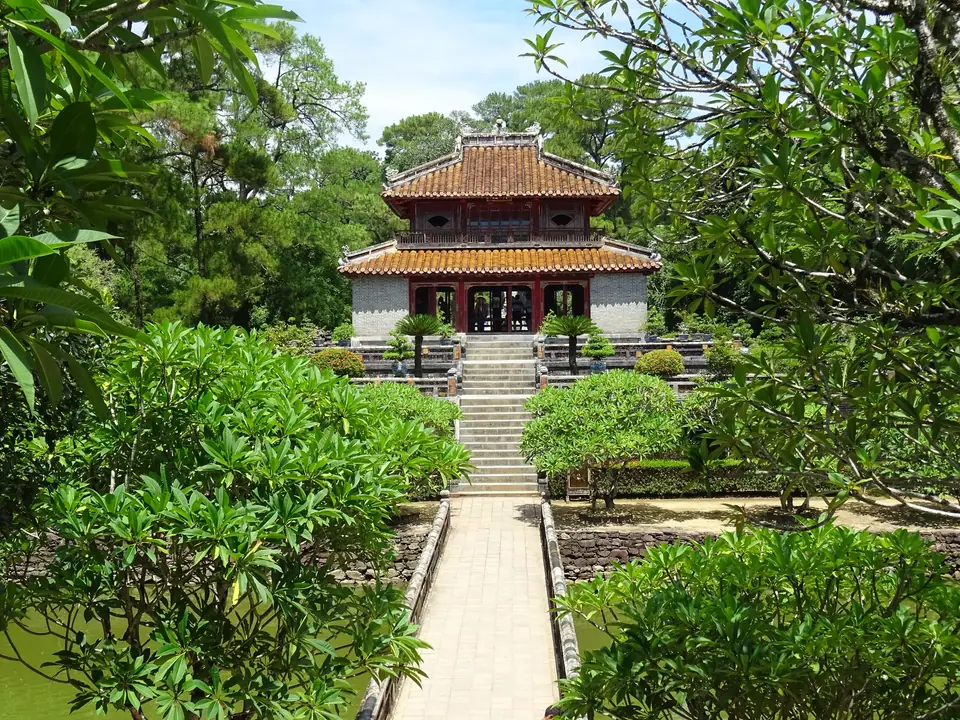
- Minh Lâu Pavilion — Two vermilion storeys on a three-terrace hill, beyond three bridges over Trừng Minh lake
- Bửu Thành circular wall — A brick sun of 273 m perimeter embraced by the crescent Tân Nguyệt lake
Twelve kilometres from the centre of Hue, among lakes and pine groves, the Tomb of Minh Mang, officially Hiếu Lăng, also known as Lăng Minh Mạng, is the most symmetrical of the imperial tombs of Hue. Some 40 structures are arranged in symmetrical pairs on three parallel axes, and the central one, the Thần Đạo, runs over 700 metres from the Đại Hồng Môn gate to the end of the outer wall. The complex covers 18 hectares inside a wall of 1,750 metres, surrounded by a protected zone of 475 hectares.
The history of the Tomb of Minh Mang is that of a work its patron never saw. The emperor began to look for a site around his seventh year of reign and took 14 years to decide. The court geomancer Lê Văn Đức chose Mount Cẩm Kê, beside the Bằng Lãng confluence, where the Perfume River is born; in 1840 Minh Mạng approved the plans of the mandarins Bùi Công Huyên and Trương Đăng Quế, and renamed the mountain Hiếu Sơn and the tomb Hiếu Lăng, “tomb of filial piety”. Work started in April 1840 and the emperor died on 20 January 1841, a date that in the lunar calendar still fell in the twelfth month of the year Canh Tý, which is why some sources end his reign in 1840. It was his son Thiệu Trị who finished the mausoleum, with close to 10,000 soldiers and workers according to most sources, although others give different figures that probably correspond to different phases of the work.
The architecture of the Tomb of Minh Mang also holds a hidden reading: in plan, the complex draws a man lying at rest, and some 600 panels with carved poems turn its pavilions into an anthology of early 19th-century Vietnamese poetry. Around it also circulate disputed tales, such as that of a secret burial through underground channels, which the court records do not support, or that of a medicinal liquor that popular tradition associates with the emperor’s name.
What to see at the Tomb of Minh Mang is arranged in five stops along the axis, from the closed gate to the circular wall that guards the funerary hill, and the full layout makes sense when walked with the audio guide, researched and fact-checked against historical sources.
South of Hue, the Tomb of Tu Duc turns the tomb into a garden and pleasure palace, and the Tomb of Khai Dinh swaps wood and stone for concrete and broken porcelain.
A gate opened only once
Đại Hồng Môn Gate
Summary of this stop
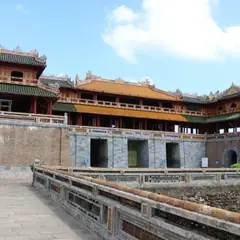
The tour starts before the Đại Hồng Môn gate, over 9 metres high and 12 wide, with three bays, 24 stepped small roofs and reliefs of carp turning into dragons. Its particularity lies in what it does not do: it was opened a single time, in 1841, to let the emperor’s coffin pass, and has remained closed ever since. Visitors enter through the side gates, Tả Hồng Môn and Hữu Hồng Môn.
The location is no accident either. It was chosen by the court geomancer Lê Văn Đức, on Mount Cẩm Kê, beside the point where the Tả Trạch and Hữu Trạch rivers join to form the Perfume River. Why that confluence mattered so much, and what relation it has to the shape of the complex, is the first clue the narration reveals in front of the gate.
The stele of the son who finished the work
Thánh Đức Thần Công Stele
Summary of this stop
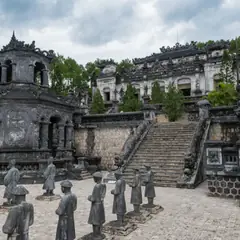
Past the gate opens the Bái Đình court of honour, a 45-by-45-metre square paved with Bát Tràng brick, where two facing rows of stone civil and military mandarins, elephants and horses guard the way. Higher up, on Phụng Thần Sơn hill, the Bi Đình pavilion shelters the great stele “Thánh Đức Thần Công”.
Its text, of 2,616 Chinese characters, was composed by Thiệu Trị in praise of his father. It is the son’s signature on someone else’s work: in February 1841, already on the throne, he put the senior mandarins Tạ Quang Cự, Hà Duy Phiên and Nguyễn Tri Phương in charge of close to 10,000 soldiers and workers to finish the tomb following his father’s plans to the letter. How that obedience fits the name “tomb of filial piety” is understood by listening to the narration before the stele.
Two tablets and an erased flower
Sùng Ân Temple
Summary of this stop
Beyond a four-step esplanade and the wooden Hiển Đức Môn gate appears the Sùng Ân temple, the ritual heart of the tomb, with a footprint of 23.45 by 22.05 metres. On its altar are the tablets of Minh Mạng and Empress Tá Thiên Nhân. Badly damaged during the wars, the temple was restored in the 1990s, and its walls form part of the network of panels with carved poems that runs through the complex.
The second tablet holds an episode of documented tradition. Hồ Thị Hoa, first wife of the future emperor, died very young a few days after giving birth to her firstborn, the future Thiệu Trị, and was never empress in her lifetime: Minh Mạng left that rank empty throughout his reign, and it was his son who proclaimed her Tá Thiên Nhân and had her worshipped beside his father. Her body, however, rests far from here. What her forbidden name has to do with that of Hue’s most famous market is the twist the audio guide keeps for this altar.
The lake that enraged the emperor
Minh Lâu Pavilion
Summary of this stop
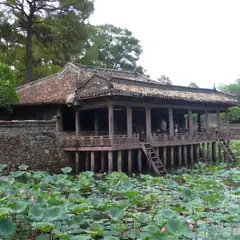
Behind the temple, the Hoằng Trạch Môn gate leads to 17 stone steps and three parallel bridges, Tả Phù, Trung Đạo and Hữu Bật, that cross the Trừng Minh lake. On the other side rises Minh Lâu, a square vermilion pavilion of two storeys and eight eaves, on an artificial three-terrace hill, the Tam Tài Sơn. According to the custom remembered, the central bridge was reserved for the emperor, and the pavilion was the place the monarch would climb to contemplate the landscape on clear moonlit nights.
From this terrace the plan becomes legible: the two halves of the Trừng Minh lake stretch like arms fallen at the sides of the lying body. That same lake provoked a crisis in the middle of construction. In August 1840, Minh Mạng went up to inspect the works, disapproved of the excavation of the lake, demoted the mandarins responsible and halted the works for a month. What the emperor saw that day is part of what the narration tells at the viewpoint.
A pine hill behind a sealed door
Bửu Thành Circular Wall
Summary of this stop
The axis ends at the head of the lying man. The crescent-shaped Tân Nguyệt lake embraces the circular Bửu Thành wall, 3.5 metres high and 273 in perimeter, a symbol of the sun. It is crossed by the 49-metre stone bridge Thông Minh Chính Trực, with carved gateways of dragons and phoenixes, before climbing 33 steps to a closed door. Inside, the pine hill Khải Trạch Sơn holds the burial chamber, Huyền Cung, underground. There Minh Mạng was buried on 20 August 1841, while the rest of the complex was still under construction until early 1843.
As the story goes, that door was opened each year around the spring festival of Thanh Minh, with a small court ceremony to clear the hill and seal it again. What that ritual consisted of, and with what ingenuity the seal was protected against the rain, is the last detail the audio guide reveals at the foot of the stairway.