Buddhist temple and viewpoint
Bahirawakanda Buddha Audio Guide (Bahirawakanda Sri Maha Bodhi Viharaya)
A white Buddha almost 27 metres tall meditates on the hill that Kandy feared for centuries as the dwelling of the demon Bahirawa. The city took hundreds of years to dare set foot on it; today it is the balcony from which the whole of it can be read.
- 40 min of audio
- Buddhism, legends and viewpoints
Bahirawa Kanda means “Bahirawa’s mountain” in Sinhala, the name of a bloodthirsty deity linked to the protection of the land. At the top of that hill stands the Bahirawakanda Sri Maha Bodhi Viharaya, a Buddhist temple born in the early 1970s, when the minister Hector Kobbekaduwa donated the land to the monk Ampitiye Dammarama Thero, of the Amarapura Nikaya. Its great seated Buddha, 26.83 metres high and in dhyana mudra, the meditation posture associated with Enlightenment, was completed in 1992 and is one of the tallest Buddha statues in Sri Lanka.
That calm came at a price. The senior monks of the Temple of the Tooth opposed the new temple, fearing it would eclipse the centre of the Siyam Nikaya, and it took the intervention of Ranasinghe Premadasa to grant it the land legally. Premadasa himself inaugurated the statue on 1 January 1993 and was assassinated four months later, on 1 May.
Highlights
- Great white Buddha — 26.83 metres seated in dhyana mudra, visible from almost all of Kandy and lit at night
- Inner gallery — images from the life of the Buddha, from childhood to adulthood, inside the statue itself
- Rear platform — a staircase to walk round the figure and command the city and hills from higher up
- Legend of the hill — maidens tied to a stake for the demon Bahirawa and an officer of the king’s elephants
- Bogambara Prison — the courtyards of the 1876 jail, closed in 2014, seen from the summit
From almost anywhere in Kandy the same figure can be seen: a white seated Buddha meditating on a green hill, lit up at night above the sleeping city. The history of Bahirawakanda begins long before the statue. The oldest mention of the name appears in a palm-leaf manuscript of the late 18th century, the Asgiri Talpotha, which places the hill as the southern boundary of a monastic retreat founded in the area by King Parakramabahu I (1164–1197). During the kingdom of Kandy, and until the early years of the British rule begun in 1815, it was a taboo belt of jungle: it was held to be the dwelling of the demon Bahirawa and not even poachers ventured into it alone.
The temple came late and with difficulty. In the early 1970s, Hector Kobbekaduwa, Minister of Agriculture and Lands from 1970 to 1977, gave the land to Ampitiye Dammarama Thero, who lived on the hill in a temporary dwelling while he raised funds. The statue was begun in the late 1980s and inaugurated on 1 January 1993, although several guides date it to 1972 or 1973, the year the temple actually began. What to see at Bahirawakanda runs from the footwear stand at the entrance to the shrine, the stupa and the Bodhi tree, the gallery hidden inside the Buddha and the rear platform, the city’s great viewpoint.
The audio guide’s documented route climbs from the entrance, where shoes and hats are left, passes the shrine’s offerings, pauses at the Buddha’s feet and ends behind the statue, facing the lake, the Temple of the Tooth and the mountain ranges that enclose Kandy.
From the top, the Temple of the Tooth and Kandy Lake lie below; about five kilometres away, outside the centre, the city’s other great open-air outing is the Peradeniya Botanical Gardens.
Barefoot on the demon’s mountain
Bahirawakanda Vihara Buddha Statue
Summary of this stop
Before stepping into the sacred precinct, visitors leave shoes and hat at a stand beside the entrance, for a small donation. It is an everyday gesture at any temple in Sri Lanka, but here it carries a different weight: for centuries, nobody in Kandy wanted to live on or stroll up this hill, despite its closeness to the city and its finest views.
In English, guides and locals call it “Gnome Mountain”, thus translating Bahirawa. The nickname sounds like a children’s tale, but in tradition the bahirawas were blood-thirsty beings who plagued the mountain, and Bahirawa was also thought to be the guardian of treasures hidden in rocks, rivers, ponds, temples, statues and dagobas. It is said the temple was built precisely to counter the ill effects of those beings, and today the great Buddha is said to watch over the city as its spiritual guardian.
How such a fearsome name came to sound almost friendly, and what the oldest manuscript says about the limits of this summit, is what the narration tells at the threshold, with feet already bare.
Flowers where legend set a stake
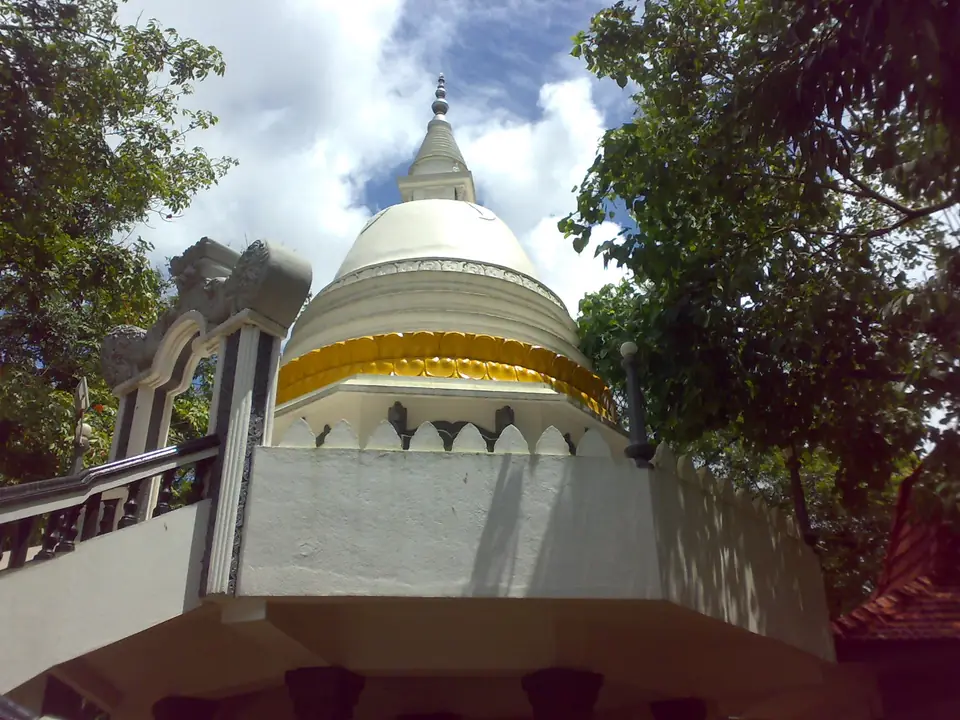
Shrine, stupa and Bodhi tree
Summary of this stop
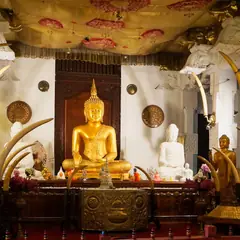
The ritual core of the precinct is formed by the main shrine, the stupa and the Bodhi tree, where worshippers leave flowers and light oil lamps. It is a serene scene that contrasts with what tradition placed on this same hill: the yearly sacrifice of a maiden to the demon Bahirawa.
The legend, in its several documented versions, speaks of the king’s men travelling the villages in search of the most beautiful girl. In Galagedara, in Thumpane, they saw Weligala Menike (Dingiri Menika in another version) returning from the well, and the king chose her as the “billa”, the blood offering. They took her up the hill amid Kandyan drums, conch shells and kapurala priests and tied her to a stake in front of the demon’s altar. There, shivering with cold, she heard a whisper pronouncing her name. It was not Bahirawa: it was an officer of the king’s elephant department, in love with her, who cut the ropes and fled with the girl to the bank of the Mahaweli. Whether these sacrifices really took place remains under discussion: for some sources they are a memory of the Nayakkar era, for others a superstition or the distortion of a cult that never included them.
The one who finally dared to settle here was a monk, Ampitiye Dammarama Thero, who lived in a temporary house on the hill while raising funds for the temple, on land donated by a minister. The alternative endings of the legend, and the specific address in central Kandy where one of its versions ends, are left for the audio guide in front of the offerings.
Twenty-seven metres of Buddha against wind and monks
Great white seated Buddha
Summary of this stop
A staircase climbs to the Buddha’s feet, and from there the scale takes over: 26.83 metres, 88 feet, of seated figure. The hands rest in dhyana mudra, the gesture of meditation associated with Enlightenment, although one description speaks of a “Nirvana pose”, and there is no agreement on its material either. Inside the statue opens a small gallery with images from the life of the Buddha, from his childhood to adulthood.
That stillness rose in the midst of a dispute. The senior monks of the Sri Dalada Maligawa, the Temple of the Tooth, opposed the new Amarapura Nikaya temple, arguing that it would eclipse the centre of the Siyam Nikaya. In the 1980s, Hinatiyana Dhammaloka, chief monk of the Amarapura Nikaya, got Ranasinghe Premadasa to intervene to grant the land legally to Dammarama. The statue was begun in the late part of that decade and finished in 1992.
On 1 January 1993, Premadasa, president of Sri Lanka since 1989, officially inaugurated it. On 1 May he was assassinated. What it means that the Buddha who now looks over Kandy was born of this rivalry between orders, and of a president who did not live to see the summer, is the thread the narration untangles at its feet.
The lookout facing the Temple of the Tooth
Statue’s rear platform
Summary of this stop
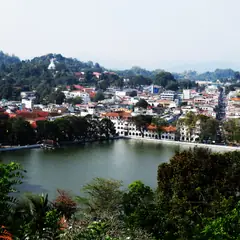
Behind the statue, a staircase climbs to a platform that allows a walk round the figure and a view of the city and hills from higher up. From there the centre of Kandy, the lake, the Temple of the Tooth and the mountain ranges around it are all taken in. The exact height of the hill varies by source: about 100 metres above the city for some, about 200 for others. The precinct is open from 6:00 to 18:00.
The view also reaches into the courtyards of Bogambara Prison, at the foot of the hill. It opened in 1876 on the infill of an artificial lake, went on to execute 524 prisoners and closed on 1 January 2014, after 138 years; since 2019 it has been converted into the Bogambara Cultural Park. Around it, the former taboo hill has become, over some 50 years of urbanisation, one of Kandy’s most sought-after residential districts, the local equivalent of Cinnamon Gardens in Colombo.
Another explanation of this summit’s past circulates in Kandy as well, as it faces the Temple of the Tooth head-on: it is said to have been used to punish those who disobeyed royal orders, and people believe the king’s warriors used it as a communication point in a network of peaks that watched over the kingdom. Which other peaks made up that network is the detail with which the route says goodbye from the platform.