Royal shrine
Natha Devale Audio Guide (Sri Natha Devalaya)
A small stone shrine opposite the Temple of the Tooth that almost everyone walks past. Here the kings of Kandy received their names from the hand of a god, and from here set out the procession that is now the Esala Perahera.
- 25 min of audio
- Stone temple and royal ritual
The Natha Devale is the oldest standing building in Kandy: a stone gedige, Dravidian in inspiration and with the air of a Hindu temple, rising in three levels under a vaulted roof and unlike anything else in Kandyan architecture. It is attributed to the reign of Vikramabahu III of Gampola, in the 14th century, and an inscription of 1381 already calls the god of Kandy Nathasami. Within its walled precinct stand two white stupas, a great Bodhi tree and the foundation where royal ceremonies were held.
Beneath the calm of the courtyard lie centuries of violent history: the shrine burned in the Portuguese incursions, a European soldier scratched three sailing ships over its mural paintings and, beside the Bodhi where vows are now offered in prayer, a seven-year-old boy was beheaded in 1814 on the orders of Kandy’s last king. Even so, every Sinhalese New Year the devale still distributes the ritual oil to the city’s temples.
Highlights
- Stone gedige — the oldest standing building in Kandy, attributed to the 14th century
- Frieze of the hare and the jackal — Kandy’s founding legend, a motif found nowhere else in Sri Lanka
- Welbodhiya — the Bodhi tree of vows, beside the site of the 1814 execution
- Two white stupas — one of them, that of the Buddha’s bowl, plundered in 1889
- Otunu Mandapaya — the circular foundation where kings received their reign names
Right opposite the Temple of the Tooth, across the street, a stone wall encloses a quiet courtyard that most visitors cross without stopping. Inside stands the Natha Devale, the oldest standing building in Kandy: a gedige-type stone shrine that tradition and popular accounts attribute to the reign of Vikramabahu III of Gampola (1357–1374). The date is not unanimous: the Sagama inscription of 1381 documents the cult of Nathasami, the god of Kandy, but not the building, and one study traces the present construction with certainty only to the 16th century, before the arrival of the Portuguese. A slab set into the west wall, which mentions a ruler named Jayaweera and his gratitude to those who helped defeat the Portuguese troops, proves that the shrine already had its present form by then.
The history of the Natha Devale is that of a temple that made kings and outlived almost all of them. It burned during the Portuguese incursions in the time of King Senarat, from 1603; King Sri Vira Parakrama Narendrasinha (1707–1739) surrounded the Bodhi, the stupas and the temple with a high, stuccoed stone wall, described in the Culavamsa chronicle, although a parapet added between 1860 and 1887 is also mentioned. Over the paintings of a small shrine in the precinct, the Gambara Devalaya, someone scratched three European sailing ships with flags: naval specialists place them in the late 18th century, at least two with a Dutch flag, probably the work of a soldier from a Dutch invasion, while the first archaeologist to study them took them to be Portuguese and much older.
What to see at the Natha Devale runs from the gate with its makara arch to the gedige, the two whitewashed stupas, the Welbodhiya and the stone with the Buddha’s footprint in the image house. The audio guide’s documented route crosses the Vahalkada, circles the shrine, pauses in the shade of the Bodhi tree and ends at the circular foundation where kings received their names.
The shrine stands opposite the Temple of the Tooth and next to the Royal Palace of Kandy, and behind the temple begins the forest of Udawatta Kele Sanctuary.
The gate where the Perahera was born
Natha Devalaya Vahalkada
Summary of this stop
The entrance to the precinct is the Vahalkada, a covered gate with a double hipped Kandyan roof, flanked by two guardstones and crowned by a makara arch with sculptures of spirits. Crossing it, the street noise is left behind. Few of those who pass by know that Sri Lanka’s most famous procession, the Esala Perahera, was originally a procession in honour of Natha, together with Kandy’s other three devales.
Around 1775, King Kirti Sri Rajasinha, at the urging of the Siamese monk Upali, joined the procession of the Tooth to it and placed it at the head with a motto: “gods and men must follow the Buddha”. Since then the Natha procession marches second, right behind the Dalada, recognisable by its colour, golden yellow. Its main elephant carries a decorated sword in the karanduwa on its back, a reminder that the procession was born as a parade of military victory and of what went on inside this precinct.
The festival, moreover, begins not with elephants but with a tree. In the Kap Situveema ritual, flowers, betel and a lamp are offered to a young jak tree, the deity that may dwell in it is asked to leave and, once it is felled, the first piece is set aside for the Natha Devale. What happens next to that trunk, and why Kandy’s families bring their small children to see the first procession, is what the narration tells beside the gate.
The hare that stood up to the jackal
Sri Natha Devalaya
Summary of this stop
In the centre of the courtyard rises the gedige, a stone cube of Dravidian inspiration that climbs in three levels under a vaulted roof recalling a stupa and has three decorated entrances to the sanctum. It is built entirely of stone, in the form of a Hindu temple, and so it clashes with the timber and tiles of the rest of Kandy’s architecture. The architecture of the Natha Devale is, in that sense, that of another era: that of the kingdom of Gampola.
At the base of the roof, above the sanctum, runs a decorative frieze repeating the legend of Kandy’s foundation in the final years of that kingdom: a hare turning on the jackal that chases it. It is a motif that appears nowhere else in Sri Lanka.
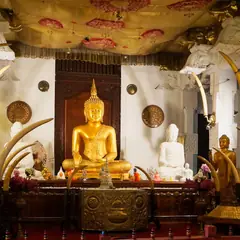
Beyond the antechamber, the sanctum with Natha’s bronze is closed to visitors. Kandy’s Buddhists venerate Natha as Maitreya, the Buddha to come, but the statue’s iconography unmistakably corresponds to the bodhisattva Avalokiteswara, venerated here also as a healer. It is a disputed story, and how a god could change his name without changing his body is the question the audio guide poses in front of the shrine.
Seven years old and a sentence before the executioner
Welbodhiya
Summary of this stop
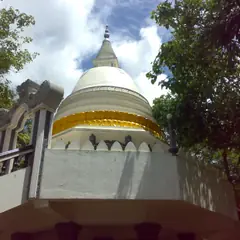
On its terrace grows the Welbodhiya, the precinct’s great Bodhi tree, a sapling of the Sri Maha Bodhi of Anuradhapura, where devotees pray and make their vows. According to the tradition of the Chulabodhivamsa, the shrine owes its name not directly to the god but to a brahmin named Natha who planted a Bodhi here. Beside it stand two white stupas, unusual in a devale: the one closer to the shrine is said to have held the relic of the Buddha’s alms bowl and was plundered by relic hunters in 1889.
Next to this same tree stood Devasanhitha. There, on 17 May 1814, Madduma Bandara, the seven-year-old son of First Adigar Ehelepola, was beheaded on the orders of King Sri Wickrama Rajasinha. Tradition preserves the sentence he addressed to his elder brother, frightened behind their mother, and what the king then forced Ehelepola Kumarihami to do, one of the darkest episodes of the kingdom of Kandy.
The story did not end with the execution: after the fall of the kingdom, the British governor Robert Brownrigg invoked it before the Kandyan chiefs as proof of the last king’s barbarity. What the boy said before the executioner and where the stone mortar of that night ended up is what the narration reveals beneath the Bodhi.
The name the god gave the king
Otunu Mandapaya
Summary of this stop
West of the stupa lies a circular foundation: the Otunu Mandapaya, the pavilion of the naming, anointing and coronation ceremonies, with the Otunugala, the stone on which the crown is believed to have been placed. The kings of Kandy, between 1469 and 1815, received their reign names here. According to the sources, the names were written on palm leaves and placed on a silver tray before the image of Natha; another version speaks of gold plates with precious stones. On an auspicious day, the king took one and it was proclaimed that the god had given it to him. The Nayakkar kings also kept the custom.
The name was followed by the sword of state blessed by Natha, which was girded on the king before he swore to rule with virtue before the statue of this devale, and not before the Tooth. One source places the coronation at the neighbouring Vishnu Devale, and the debate remains open. The foundation lay buried for generations: in the early 19th century, Sri Wickrama Rajasinha dug Kandy Lake over paddy fields and a good part of the earth ended up in this precinct. The UNESCO Cultural Triangle excavation, led by P. L. Prematilaka, brought to light the bases of two stupas, a mandapa, fragments of a large bronze Buddha and heaps of cannonballs.
The courtyard, however, is not only the past. Every Sinhalese New Year the devale distributes the mixture of Nanu and oil to Kandy’s temples, and on 15 April 2017 it hosted the national New Year anointing with President Maithripala Sirisena. Which other oil leaves here every November, and towards which lamps, is the detail with which the route says goodbye.