Sacred relic
Temple of the Tooth Audio Guide (Sri Dalada Maligawa)
Beside Kandy's old royal palace lies the tooth of the Buddha, the relic that for centuries decided who ruled the island. Seven golden caskets, drums three times a day and keys shared between monks and a lay custodian still protect it.
- 90 min of audio
- Buddhism and the Kandyan kingdom
The Temple of the Tooth is the last refuge of a relic that has always travelled in hiding. Around 1595 it reached Kandy from Delgamuwa, where it had been concealed inside a grinding stone, and King Vimaladharmasuriya I raised a two-storey building for it, long since vanished. The shrine seen today is attributed to Vira Narendra Sinha, who reigned from 1707 to 1739, and in 1802 Sri Vikrama Rajasinha added the facade, the moat and the octagonal pavilion from which he showed the tooth to his people.
Neither the Portuguese, nor the British, nor a bomb managed to interrupt its custody. On 25 January 1998 a truck packed with explosives went off at the entrance and broke the original moonstone into 43 pieces, but the inner chamber and the relic came through intact. When the plaster fell away, an 18th-century painting also came to light, overturning what was believed about Kandyan art.
Highlights
- Maha Maluwa — the esplanade with the statues of Princess Hemamali and Prince Dantha, who according to tradition brought the tooth
- Pattirippuwa — the eight-sided pavilion from which the last king showed the relic, now a library of palm-leaf manuscripts
- Mahawahalkada moonstone — carved anew after the original was left in 43 pieces by the 1998 bomb
- Hewisi Mandapaya — the hall where drums mark the three daily offerings and the symbolic Wednesday bathing
- Relic chamber — a golden stupa-shaped casket enclosing six others, with keys shared among three custodians
Sri Dalada Maligawa, the Temple of the Tooth, stands beside Kandy’s old royal palace, ringed by a moat and a white wall with a wavy profile whose niches fill with coconut-oil lamps. Inside is kept the tooth of the Buddha, the object that for centuries decided who reigned over the island: whoever held it held legitimacy. The story of Sri Dalada Maligawa is that of a relic on the run. During the reign of Dharmapala of Kotte it was hidden inside a grinding stone at the Delgamuwa Vihara, in Ratnapura; Hiripitiye Diyawadana Rala and the monk Devanagala Rathnalankara carried it to Kandy, where Vimaladharmasuriya I built it, around 1595, a two-storey building. In 1603, facing the Portuguese invasion, it left the city again, bound for Meda Mahanuwara, in Dumbara.
Its authenticity is not a closed matter either. The Portuguese chroniclers João de Barros and Diogo do Couto state that the tooth was captured in the 1560 expedition against the kingdom of Jaffna and destroyed in Goa on the orders of Viceroy Constantino de Bragança, in 1561 according to the historian John S. Strong; the Sinhalese Buddhist tradition holds that the relic in Kandy is the genuine one. According to that tradition, the monks of Delgamuwa had made ivory replicas, and what the Archbishop of Goa ground in a mortar, burned and threw into a river would have been a copy, while the true tooth travelled in a monk’s waistband. A more popular, miraculous version says the ashes pieced themselves back together on the seabed and the tooth flew back to the island.
What to see at Sri Dalada Maligawa runs from the Maha Maluwa esplanade to the octagonal pavilion, the Mahawahalkada gateway, the drummers’ hall and the upper floor, where the golden casket is visible, never the tooth. The grounds also display the stuffed body of Raja, the elephant that carried the casket in the perahera for 37 years and for whom the government declared a day of national mourning when he died, in July 1988. The audio guide’s documented route follows that order, from the outside to the heart of the temple, among drums and barefoot worshippers.
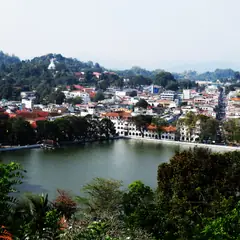
A step from the temple stand the Royal Palace of Kandy, where the last king lived, and the Natha Devale, the oldest building in the city; at its feet spreads Kandy Lake, dug in 1807.
The princess who brought the tooth in her hair
Maha Maluwa
Summary of this stop
The Maha Maluwa, the great esplanade opening in front of the temple, is the starting point. The statues of Hemamali and Prince Dantha stand here, giving a face to the origin of it all according to the tradition gathered in the Dalada Sirita and the chronicles: King Guhasiva of Kalinga, about to lose a war, sent the tooth to Sri Lanka so it would not fall into enemy hands. The princess hid it in her hair and, with Dantha, her brother in some versions and her husband in others, set sail from the port of Tamrapitti and landed at Lankapattana in the 4th century.
One of those versions adds a twist: King Mahanama, for whom it was meant, had died by the time they arrived, and it was his son Kithsiri Mevan who received it at Anuradhapura. Centuries later the relic was still travelling in secret, as the Delgamuwa grinding stone it came out of before reaching Kandy around 1595 shows.
This same esplanade saw a very different outing in 1828. The British governor Edward Barnes asked to display the relic in public at the Maha Maluwa; it came out under a drizzle that turned into torrential rain for seven days, remembered as “Dalada Wathura”, the rain of the tooth. What that deluge meant to the Kandyans, barely thirteen years after losing their king, is the detail the narration keeps for this spot.
The octagon from which the king showed the tooth
Pattirippuwa octagonal pavilion
Summary of this stop
From the edge of the moat, the Pattirippuwa can be seen: the octagonal pavilion with a Kandyan roof that the royal architect Devendra Moolacharya built for Sri Vikrama Rajasinha on the site of the temple’s old kitchen. The most quoted date is 1802, although the Sinhala Wikipedia places the work between 1805 and 1812. The moat and the front facade date from the same reign, that of Kandy’s last king.
The architecture of Sri Dalada Maligawa has its most theatrical gesture here. From this balcony the king showed the relic to the crowd, watched the processions and addressed his subjects, and its eight sides placed him symbolically at the centre of the eight points of the compass. On 11 February 1948, after Ceylon’s independence, the lion flag was raised here for the first time. Today the octagon holds the temple’s library of palm-leaf manuscripts.
Past it, every July or August, goes the Esala Perahera, which originally honoured the gods of the four devales. According to tradition, the Siamese monk Upali Thera judged it contrary to Buddhism in the mid-18th century and the king proclaimed that gods and men would follow the Buddha: since 1775 the procession of the tooth has led the parade. What the elephant carries under the canopy is a replica casket, and why cannon fire echoes across Kandy during the festival is part of what is told in front of the octagon.
The moonstone the bomb split
Mahawahalkada moonstone
Summary of this stop
The Mahawahalkada, the great entrance gateway over the moat, flanked by stone elephants, a makara torana and two guardstones, holds the temple’s most recent scar. On the early morning of 25 January 1998, three LTTE Black Tigers drove a truck carrying between 300 and 400 kilos of explosives at the entrance, days before Kandy hosted the 50th independence anniversary on 4 February. Wikipedia puts the dead at 17, three of them the attackers; other sources speak of 16 victims and differ on the exact time. Neither the inner chamber nor the relic suffered damage.
The sandakada pahana, the moonstone stepped on when entering, is a newly carved copy: the original was broken into 43 pieces, which were reassembled in a museum inside the grounds alongside the remains of the destroyed stone elephants. The two guardstones, by contrast, were left intact.
After the attack many called for the Pattirippuwa to be demolished and rebuilt. Diyawadana Nilame Neranjan Wijeyeratne refused, and the engineer Munidasa P. Ranaweera, of the University of Peradeniya, concluded that it was enough to rebuild the roof; the restoration finished in August 1999. Which element of the temple spared the octagon from the blast wave is the revelation waiting at the moonstone.
Drums before a shrine of three hides
Hewisi Mandapaya
Summary of this stop
Beyond the Ambarawa, a vaulted passage shaped like a cart awning, waits the Hewisi Mandapaya, the covered courtyard where the hewisi drummers play during the offerings. Monks of the Malwatte and Asgiriya chapters conduct worship in the inner chamber three times a day, at dawn, at noon and at dusk, and every Wednesday the Nanumura Mangallaya symbolically bathes the relic with water scented with herbs and flowers, which is then shared among those present.
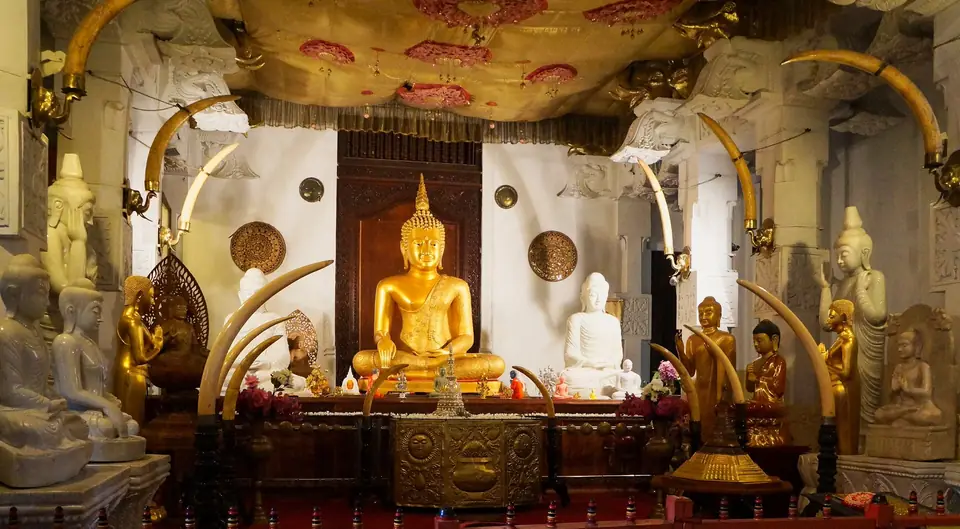
In front rises the two-storey shrine, Palle Malaya below and Udu Malaya above, with carved ivory doors and crowned by the golden canopy added in 1987 by Ranasinghe Premadasa, then prime minister. It is attributed to Vira Narendra Sinha, who reigned from 1707 to 1739, although some sources present it as the temple of Vimaladharmasuriya I rebuilt by later kings.
The 1998 explosion also revealed what its walls hid: three layers of paint, the last from around 1942, and beneath them a scene from the era of Kirti Sri Rajasinha, around 1765, with an elephant and two mahouts. Why that painting forced a revision of a widespread idea about Kandyan art is what the narration reveals amid the sound of the drums.
Seven caskets and a tooth no one sees
Relic chamber
Summary of this stop
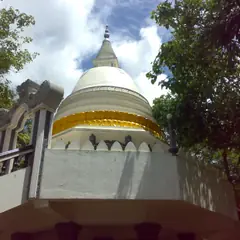
On the upper floor, the Handun Kunama is the chamber where worshippers see the golden stupa-shaped casket, not the tooth. That casket encloses six others, of gold and set with gems; the seventh, the innermost, is shaped like a corn cob and almost no one sees it. The keys are shared among the mahanayakes of Malwatta and Asgiri and the Diyawadana Nilame, the lay custodian who holds those of the outer casket and the armoured glass urn.
The British soon understood what was at stake. In May 1818, during the great rebellion, the monk Wariyapola Sri Sumangala took the relic out of the palace and handed it to Keppetipola’s rebels; when he was captured with it in November, Governor Robert Brownrigg implied that the rebellion had ended because the tooth had fallen into British hands. After inspecting it, they concluded that the discoloured object of about 5 centimetres was certainly a tooth, but more likely a crocodile’s than a human’s. Tradition answers with a cautious king, Kirti Sri Rajasinha, who is said to have enclosed it in an ivory sheath.
Devotion has not faded. In April 2025 the temple displayed the tooth for the first time in 16 years: some 450,000 people came in a single day, with queues of almost 10 kilometres, four died and more than 300 were hospitalised, mostly from heatstroke. What really lies inside the seventh casket is the question with which the route says goodbye in front of the chamber.