Royal botanic garden
Peradeniya Botanical Gardens Audio Guide (Royal Botanic Gardens, Peradeniya)
The former garden of the kings of Kandy, enclosed in a bend of the Mahaweli, which the British Empire turned into its laboratory for coffee, tea and spices. Today its trees carry the signature of a tsar, a queen and the first man to see the Earth from space.
- 120 min of audio
- Botany and colonial history
The Peradeniya Botanical Gardens occupy a bend of the Mahaweli river some 6 km from Kandy. Before it was a scientific garden it was a royal one: King Kirti Sri Rajasinha made these lands his own garden and his successor, Rajadhi Rajasinha, lived here in a residence built for him. In 1821 the British superintendent Alexander Moon recommended moving the colony’s botanic garden here, which had begun in Colombo and passed through Kalutara, and from then on Peradeniya was the nursery where Ceylon’s spices, coffee and tea were trialled.
Here every tree is a document. An ironwood planted by Nicholas II, the last tsar of Russia; a cannonball tree set in 1901 by the future George V and Mary; a Yellow Saraca planted by Yuri Gagarin in 1961. And beneath the great fig of the lawn Lord Mountbatten had his headquarters in the Second World War, while across the river the last battle between the Portuguese and the Sinhalese is remembered.
Highlights
- Spice garden — nutmeg trees planted in 1840 that still bear fruit, among cinnamon, pepper and cardamom
- Great Circle — trees planted by Nicholas II, George V, Yuri Gagarin, Akihito and Elizabeth II
- Java fig of the Great Lawn — a living umbrella on the lawn where Mountbatten had the SEAC headquarters from 1944
- Giant Burmese bamboo — canes of 30 to 40 metres whose shoots grow about 30 cm a day
- 1931 suspension bridge — 127 metres over the Mahaweli, at the end of the royal palm avenue
The history of the Peradeniya Botanical Gardens begins long before botany. These lands, wedged into a bend of the Mahaweli, were the garden of the last kings of Kandy, with their vihara, their dagoba and their orchards. When the British settled in, the colony’s botanic garden had already made two moves: it began in 1810 at Slave Island, in Colombo, and in 1813 passed to Kalutara. In 1821 Alexander Moon proposed taking it to the old royal garden, and the exact founding date is still debated: the official website gives 1821, the chronicle of the time and recent research place the opening in February 1822, and the bicentenary was celebrated on 21 February 2022.
At first it was more estate than laboratory. At its opening it measured 147 acres and held 800 coconut palms, 244 jackfruit trees, 33 kitul palms and 740 coffee bushes; when George Gardner took over as director in 1844, only 40 acres were cultivated and the land produced mainly jackfruit, coconuts and vegetables for sale. A little-known saga also dates from that period: Haramanis de Alwis, a clerk who came from Kalutara for his precision in drawing plants, started three generations of draughtsmen who produced more than 5,000 botanical plates, about 3,000 of them kept at Peradeniya.
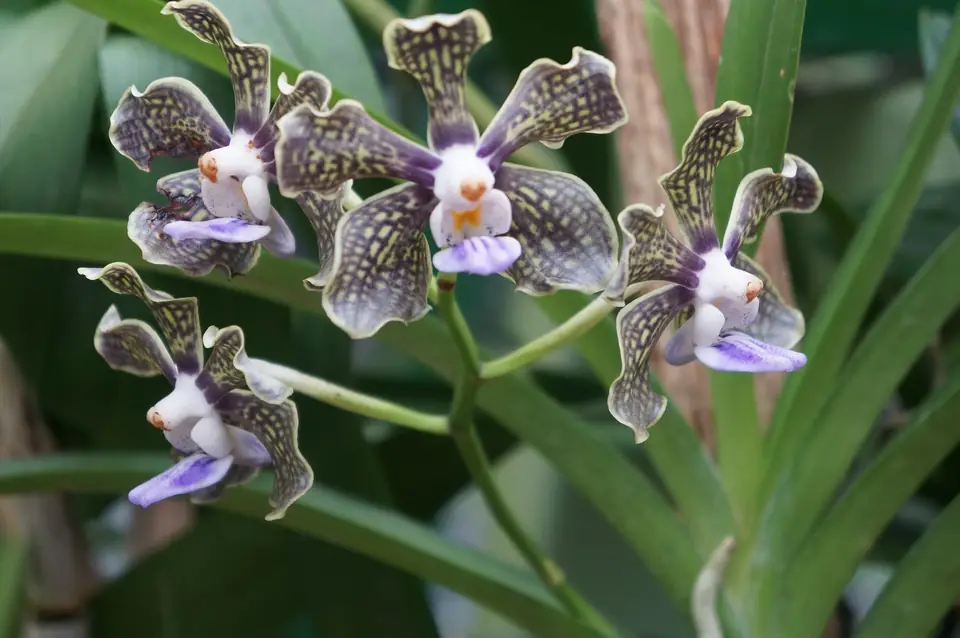
What to see at the Peradeniya Botanical Gardens runs from the row of Amherstias at the entrance to the papyrus lake, the orchid house, the palm avenues and the stand of giant bamboo by the river, where flying foxes hang from the crowns. The Moon Museum, opened in 2025, reviews in four rooms the history of the garden and of colonial coffee and tea. The audio guide’s documented route follows that thread in five stops: from the king’s garden to the empire’s nursery, from the album of famous trees to the wartime headquarters, and from the suspension bridge to the shore where a battle was fought.
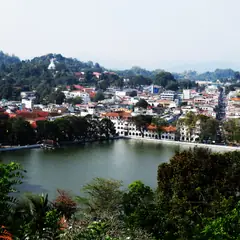
In Kandy itself, the kings’ old forbidden forest still stands at Udawatta Kele Sanctuary, and the whole city can be taken in from the hill of the Bahirawakanda Buddha.
The king’s garden beneath the Amherstias
Royal Botanic Gardens, Peradeniya
Summary of this stop
The main entrance greets visitors with a row of Amherstia nobilis, the “pride of Burma”, from whose branches hang clusters of scarlet flowers. Under that vegetal portico begins the oldest story of the place: King Kirti Sri Rajasinha, who reigned from 1747 to 1780, made Peradeniya a royal garden, and his successor Rajadhi Rajasinha lived here in a temporary residence built for him.
The grounds also had a vihara and a dagoba built under King Wimaladharmasuriya and improved by Rajadhi Rajasinha. The British destroyed them on occupying Kandy in 1815, although a monk went on living there until Alexander Moon formed the garden. Among the orchards the new garden absorbed was Kandewatte, property of the Natha Devale, occupied by the parasol-bearer of the Perahera and obliged to hand over 30 coconuts a year to the Temple of the Tooth.
Thus the garden’s British history begins with a demolition and with a tribute of coconuts that stopped being paid. What remains of that king’s garden beneath the colonial layout is what the narration reveals at the entrance itself.
1840 nutmeg trees that still bear fruit
Spice garden
Summary of this stop
To the right of the entrance opens a shaded grove smelling of cinnamon, pepper, cardamom and allspice. Nutmeg trees grow among them, and some of the oldest were planted in 1840 and still carry nutmeg almost two centuries later.
This corner sums up what Peradeniya was for: a garden that travelled from Colombo and Kalutara to the king’s land to trial the crops that drove the empire’s trade. When a blight swept through Ceylon’s coffee plantations, Assam tea seeds arrived here, and James Taylor, the pioneer of the island’s tea plantations, received his first plants from the garden.
From these shadows, then, came a good part of the tea landscape that now covers Sri Lanka’s mountains. How a spice garden came to change the economy of the whole island is the story the audio guide tells among the nutmeg trees.
A tsar, a king and Gagarin planting trees
Great Circle commemorative trees
Summary of this stop
The Great Circle is an album of world history written in trunks and plaques. Here rises the great Ceylon ironwood planted by Nicholas II, the last tsar of Russia, which since 2011 has carried a new plaque installed by the ambassador of post-Soviet Russia. Nearby is the cannonball tree planted in 1901 by the future King George V and the future Queen Mary, its spherical fruits hanging directly from the trunk.
On 9 December 1961, during his tour of Ceylon, Yuri Gagarin planted a Yellow Saraca here, a relative of the ashoka under which, according to Buddhist tradition, the Buddha was born. It is said the tree suddenly fell ill after the cosmonaut’s untimely death and nearly died, but recovered and is still growing.
The cannonball tree also preserves a custom that puzzles. According to a widespread popular belief, its pink, fragrant flower is offered in temples as that of the sal, the tree of the Buddha’s birth and death, although it is a South American species that entered the island precisely through this garden, in 1881. Where the true sal trees bloom today, and why almost nobody looks at them, is the twist the narration keeps for this circle.
The fig that watched the war go by
Great Lawn Java fig
Summary of this stop
In the centre of the great lawn, beside Monument Road, a Java fig spreads its branches like a giant living umbrella. Today families and schoolchildren are heard in its shade, but this grass had another life: from April 1944 Lord Louis Mountbatten set up in the garden the headquarters of South East Asia Command, the SEAC.
General Aung San, father of Aung San Suu Kyi, came to his office at Peradeniya to negotiate Burma’s independence. The date of that visit is unclear: it is sometimes dated to 1947, although the SEAC was dissolved in 1946, and the talks between the two in Kandy are usually placed in September 1945.
Some years later came a war for the cinema: the garden was a filming location for “The Bridge on the River Kwai”, the 1957 film whose bridge was built and blown up at Kitulgala. Which scenes were shot among these trees is part of what the audio guide tells under the fig.
The bridge toward the Gannoruwa shore
Mahaweli suspension bridge
Summary of this stop
At the end of the royal palm avenue, some 1.2 km from the entrance, the 1931 suspension bridge crosses the Mahaweli: 127 metres held up by two pairs of steel pylons toward the Gannoruwa bank. Along the way, River Drive passes cabbage palms over 21 metres tall and the stand of giant Burmese bamboo, with canes of 30 to 40 metres.
The opposite bank, so quiet, holds a dark episode recorded by documented tradition. In March 1638 the Portuguese captain-general Diogo de Melo de Castro burned an evacuated Kandy; on the retreat, his army camped by the river without water, with the roads cut by Rajasinha II’s soldiers. On 28 March, under rain that put muskets and cannon out of action, the Kandyan army fell on the column at Gannoruwa. De Melo died and only thirty-odd Portuguese survived as prisoners: it was the last battle between the Portuguese and the Sinhalese.
It is said that before the fight the king’s crown fell from his head as he passed the Dodanwela Devale, and that Rajasinha swore to offer it to the god if he won. How he kept that promise, and why from this bridge the river stops being scenery and becomes a frontier, is the story with which the route says goodbye.