Sri Lanka’s last royal palace
Royal Palace of Kandy Audio Guide
The last palace of the kings of Sri Lanka, right beside the Temple of the Tooth. Under the wooden columns of its audience hall Europe entered on its knees, in 1815 the end of the kingdom was read out, and in 2017 honour was restored to those who rebelled against it.
- 45 min of audio
- Kandyan architecture and colonial history
The Royal Palace of Kandy is the civil complex of the last Sinhalese kings, next to the Temple of the Tooth. The first palace was built in the 14th century under Vickramabahu III, Vimaladharmasuriya I extended it in the late 16th century, the Portuguese destroyed it in the time of King Senarat and Rajasinha II rebuilt it in 1634. Today it consists of the old main entrance, the Magul Maduwa or audience hall, begun around 1783, the Maha Wasala or king’s palace, now an archaeological museum, and the Palle Vahale, home of the Kandy National Museum since 1942.
At the start of British rule, the palace front exceeded 200 yards, about 183 metres, with whitewashed walls that gave it the look of a “mountain of silver”. Of all that only the main entrance still stands. The rest changed hands: the hall where the kingdom was handed over became an Anglican church and a court, the king’s palace was home to the British agents until 1947 and the carved columns of the women’s palace ended up moved to the hall to receive a Prince of Wales.
Highlights
- Magul Maduwa — the wooden audience hall where the 1815 Kandyan Convention was read
- Carved lotus capitals — the only ornament Bishop Heber found standing in 1825
- Maha Wasala — the king’s palace, occupied by Kandy’s British agents until 1947
- Palle Vahale — the palace of the king’s women, Kandy National Museum since 1942
- Copy of the 1815 Convention and Keppetipola’s flag — displayed in the National Museum
Next to the Temple of the Tooth, among whitewashed pavilions and courtyards with verandas, stands what remains of the last palace of the kings of Sri Lanka. Its history begins in the 14th century, with Vickramabahu III, and passes through an extension by Vimaladharmasuriya I in the late 16th century, a Portuguese destruction in the time of Senarat and a rebuilding by Rajasinha II in 1634. The audience hall that now gives the complex its name, the Magul Maduwa, was begun around 1783 under Sri Rajadhi Rajasinha and continued to be worked on during the reign of Sri Vikrama Rajasinha (1798–1815), the last king of Kandy.
What is seen today is, above all, what survived 1815. After the fall of the kingdom, the British pulled down a good part of the complex and modified many of the other buildings: over the royal storehouse and treasury rose their Kachcheri, today the High Court; the king’s palace housed their agents until 1947 and the audience hall served as church and court. The history of the Royal Palace of Kandy is that of a kingdom that received Europe with an exhausting ceremonial, surrendered to it in its own hall, tried its rebels there and, two centuries later, rehabilitated them in the same room.
What to see at the Royal Palace of Kandy runs from the old main gate to the Magul Maduwa, with its wooden columns and lotus capitals, and from the Maha Wasala gateway to the courtyard of the Palle Vahale, now the National Museum. The audio guide’s route, documented and checked against historical sources, covers those five points in order, from the entrance to the palace of the king’s women.
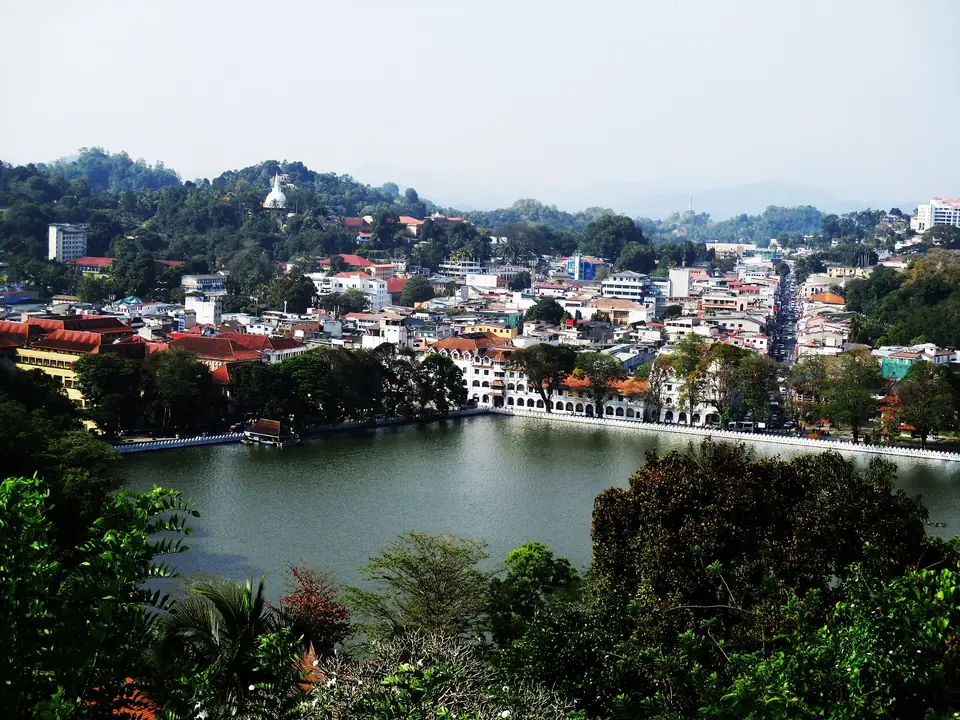
The complex shares its grounds with the Temple of the Tooth and the Natha Devale, where kings received their names, and it overlooks Kandy Lake, which the last of them ordered dug.
A mountain of silver reduced to a gate
Palace’s old main entrance
Summary of this stop
To the left of the Temple of the Tooth opens the palace’s main entrance, the only fragment surviving of a front that, at the start of British rule, exceeded 200 yards, about 183 metres. Accounts from the period, such as John Davy’s, describe thick whitewashed walls of mud or stone that, seen from afar, gave the complex the look of a “mountain of silver”. Behind that gate pile up centuries of destruction and rebuilding, from the first palace of the 14th century to the reconstruction by Rajasinha II in 1634.
Long before the British, another European army had already crossed this threshold. According to documented tradition, on 19 February 1765 the Dutch troops of Governor Van Eck entered Kandy and found the palace empty: the king had fled and the Kandyans themselves had already looted it. For three days the soldiers carried off cloth, fine furniture, curiosities and silver.
Among the booty was a great gilded silver bell, of about 210 pounds and in two pieces, which was used to house the relic of the Tooth. Van Eck gave it to the troops and from Colombo it was even proposed that it be melted down to share out its value. What became of it, and which other sacred object of the processions came from the governor’s estate, is what the narration tells at the gate itself.
The hall where Europe entered on its knees
Magul Maduwa
Summary of this stop
The Magul Maduwa is an elongated wooden pavilion, open at the sides, with rows of carved columns under a Kandyan roof. Here the king dealt with his ministers and passed judgement, which is why it was also called Maha Naduwa, the “great court”. Most sources attribute its start, around 1783, to Sri Rajadhi Rajasinha and its continuation to Sri Vikrama Rajasinha, although some references mix the name of one with the dates of the other.
Documented tradition describes a ceremonial that tested foreign ambassadors. They dismounted from their palanquins five miles from the capital, waited for permission at Gannoruwa and audiences were held at midnight or at dawn. To reach the king one had to cross chambers separated by heavy curtains drawn back one by one, in an advance of three or four hours, and the envoy approached on his knees with the governor’s letters on a silver tray on his head. The Dutch protested at the humiliation, without success; a watercolour by Jan Brandes from around 1785 shows the VOC envoys kneeling at a great distance from King Rajadhi Rajasinha.
On 2 March 1815, in this same hall and before Governor Robert Brownrigg, John D’Oyly and Kandyan chiefs such as Ehelepola and Molligoda, James Sutherland read the Kandyan Convention in English and Abraham de Saram in Sinhala; then the British flag was raised and a salvo proclaimed George III sovereign of the whole island. That is the consecrated date of the signing, although the Gazette of 6 March speaks only of a “solemn conference” and D’Oyly’s papers indicate that some signatures were collected until 18 March. The gesture of the monk Wariyapola Sri Sumangala tearing down the British flag is also officially commemorated, an episode with no contemporary document that versions place in different locations. What the people of Kandy were doing in the meantime, as the army doctor Henry Marshall left in writing, is the contrast with which the audio guide closes this stop.
Carved lotuses for a church and a court
Audience hall lotus capitals
Summary of this stop
Under the hall’s roof, the capitals of the wooden columns end in lotus motifs. In the 1820s they were all that remained of its decoration: in 1825, Reginald Heber, Bishop of Calcutta, described an Anglican confirmation held here, with seven native candidates and twenty Europeans, in a bare hall whose only ornament was those columns. In the early British years the king’s former court was a church, and later it became a court again.
As a court it lived through one of its harshest episodes. Keppetipola, leader of the Uva-Wellassa rebellion against the British, was sentenced to death in this hall along with Madugalle and beheaded in late November 1818, on the 25th or 26th depending on the source. A gazette of January 1818 had branded 19 chiefs traitors, Keppetipola among them.
The sentence was answered almost two centuries later in the same hall. In December 2016, Gazette 1998/25 annulled that of 1818, and on 1 March 2017 President Maithripala Sirisena signed in the Magul Maduwa the proclamation declaring 82 rebels sentenced to death or exiled by the British to be patriots. What links those carved lotuses with a nearby esplanade and a journey back from Scotland is what the narration reveals under the roof.
The king’s house with a British tenant
Maha Wasala gateway
Summary of this stop
At the northern end of the grounds rises the Maha Wasala, the king’s palace: a central gateway with a flight of steps, stucco and terracotta decoration and long wings with a veranda facing the inner courtyard. From its observation windows, the Siv Maduru Kawulu, the monarch overlooked the queen’s palace, the Temple of the Tooth, the city and the Udawatta Kele forest. Today it houses the archaeological museum.
The palace was not abandoned in 1815: it changed hands. John D’Oyly set up his residence there, and the successive British Government Agents of Kandy occupied it until 1947; it also lodged the Governor of Ceylon on his visits, until the King’s Pavilion was built. Around it, the British pulled down the royal storehouse, the Maha Gabadawa, and the treasury, the Aramudale, to build the Kachcheri on the site, which is now the High Court.
The throne of the kings of Kandy met an even more surprising fate. According to the minutes of the Dutch Council of 1692, it was a gift from Governor Thomas van Rhee to King Vimaladharmasuriya II: a Louis XIV-style armchair covered in gold plate, with sphinx-lions on the arms and a great sun on the back, the star from which the dynasty claimed descent. The British found it in February 1815 during the sacking of the palace and took it to England. Which ceremonies it presided over at Windsor and how many years it took to return to Kandy is what the audio guide tells in front of the gateway.
The brick pillars that betray a move
Palle Vahale central courtyard
Summary of this stop
The Palle Vahale, the “lower palace”, was built in the time of Sri Vikrama Rajasinha for the king’s women; exactly who lived there, whether the queens, the royal concubines or the monarch’s wife and children, varies by source. Around its central courtyard run verandas under a roof of Kandyan carpentry, but the supports are brick pillars. The original carved columns are in the audience hall: to receive the Prince of Wales, Albert Edward, in the 1870s (1872 or 1875, depending on the source), the British lengthened the Magul Maduwa by 9.6 metres with 16 columns torn out from here, eight on each side.
The building was a British hospital and office, housed the Kandyan Art Association from 1904 and in 1942 became the Kandy National Museum, the first branch of the national museum in Colombo. Among its pieces are a copy of the 1815 Convention, the agreement that handed the Kandyan provinces to the British, and the flag attributed to Keppetipola.
To the north, the small Meda Wasala, with its courtyard and lotus pond and a low door that closes only from the inside, was the chamber where Sri Vikrama Rajasinha kept Queen Rangammal apart. Under the four feet of her bed, four copper sheets were found hidden in holes, interpreted as protective spells. What they were meant to protect her from, and where they are kept today, is the last secret the route reveals in the courtyard of the Palle Vahale.