Buddhist complex
Bai Dinh Pagoda Audio Guide (Chùa Bái Đính)
Below, a Buddhist complex of record-setting bronzes built since 2003; above, after more than 300 steps, the caves where a physician-monk of the Lý dynasty came looking for herbs for a king. Two pagodas on one mountain that tell the Vietnamese Buddhism of yesterday and of today.
- 100 min of audio
- Vietnamese Buddhism
The old Bái Đính pagoda was founded by Nguyễn Minh Không, a Zen monk and physician of the Lý dynasty, who made the mountain's caves a place of worship; since 1997 it has been a nationally ranked historic monument. On the other side, about 800 metres away, Bái Đính Tân Tự has risen since 2003, the new complex designed by the architect Hoàng Đạo Kính: a corridor of 500 stone arhats, a tower with the bell recognised as the largest in Vietnam and halls with bronze Buddhas of up to 100 tonnes.
The new pagoda was built and is run by a private construction company, on a 70-year term, and the Vietnamese press debates whether it is devotion or business. Its giant Buddhas arrived before the walls around them, because they would not have fitted through any door; meanwhile, up the mountain, an old wooden statue is, as a witness tells it, the only one that refused to be swapped for bronze.
Highlights
- Corridor of the 500 arhats — green stone statues of about 2.5 m, hand-carved by stonecutters from Ninh Vân
- Bell tower — a 36-tonne bell and a 70-tonne bronze drum
- Pháp Chủ Hall — a 10 m, 100-tonne bronze Shakyamuni Buddha
- Old pagoda — over 300 steps up to a bright cave and a dark cave of seven chambers
- Lê Thánh Tông inscription — four characters carved above the mouth of Hang Sáng
The story of Bai Dinh Pagoda is that of two pagodas on one mountain. The old one was born in the caves of Mount Bái Đính, where Nguyễn Minh Không (1065-1141), a Zen monk and physician of the Lý dynasty, came looking for medicinal plants for the king. The new one, Bái Đính Tân Tự, began to be built in 2003 some 800 metres away, on the other side of the mountain, and has been filling up with figures: 500 stone arhats, a 36-tonne bell, a 100-tonne bronze Buddha and a 13-storey stupa of about 100 metres visible from all over the grounds.
The figures, however, do not always add up. The Vietnamese press calls it the largest pagoda in Southeast Asia, although according to Guinness the region’s largest Buddhist temple is Borobudur; the complex’s area changes from one source to another, and so does the founding date of the old pagoda. The route, researched and fact-checked against historical sources, climbs from the bronze record to the monk’s damp cave, and following it with the audio guide on the mountain itself allows Vietnamese Buddhism to be read in reverse: from the enormous to the tiny that was its origin.
Another pagoda that tucks itself into the rock is the Bich Dong Pagoda, with its cave and its bell of 1707, and to the east stretch the lagoons of Trang An and the temples of the Hoa Lu Ancient Capital, the court that moved to Thăng Long in 1010.
Bronze guardians for a 2003 build
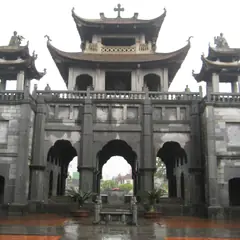
Tam Quan gate with its guardians
Summary of this stop
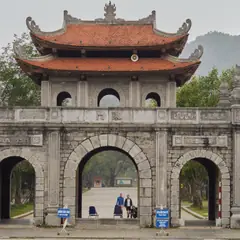
The entrance to the new grounds is the Tam Quan gate, with three timber bays, guarded by two bronze guardians of 5.5 metres and 12 tonnes: the Good and the Evil. Their size suggests centuries of history, but work began in 2003, to a design by the architect Hoàng Đạo Kính.
It was a “great undertaking” of 500 craftsmen from trade villages: carpenters from Phúc Lộc, stonecutters from Ninh Vân, bronze founders from Ý Yên and embroiderers from Văn Lâm. Behind it is the private construction company Xuân Trường, of Nguyễn Văn Trường, which on 10 April 2008 received from Ninh Bình province the investment certificate, with a 70-year term to operate the project.
That fact opens the thread of the whole visit, old versus new, and the narration at the gate poses the question the rest of the mountain answers.
Five hundred arhats with blackened knees
Corridor of the 500 arhats
Summary of this stop
From the gate, two covered galleries rise in parallel with the 500 arhats, green stone statues of about 2.5 metres and 4 tonnes, each different and numbered. Since 2004 some 200 stonecutters from Ninh Vân carved them by hand from 2,500 tonnes of local stone; as a model, the builders bought picture books of the 500 arhats from the Yanshan publishing house in Beijing and enlarged them in plaster. The corridor’s length, mind, varies depending on who measures it.
Each row is opened by a Vietnamese figure: on the left, the emperor and Zen master Trần Nhân Tông (1258-1308), founder of the Trúc Lâm school; on the right, Thích Quảng Đức (1897-1963), the monk who immolated himself in protest at religious persecution. And among so many different faces, one feature repeats on all of them.
The knees and hands are blackened. Pilgrims rub the statues for luck and stuff banknotes into their hands and cracks; by 2015 they were worn by sweat and grease, some were missing fingers and the Venerable Thích Thọ Lạc reminded people that touching them is not part of Buddhism. In the corridor, the audio guide tells how devotion is wearing the stone away.
Vietnam’s largest bell opens the festival
Bell tower
Summary of this stop
The bell tower has three tiers of roof, 24 curved eaves and a height of 22 metres. Inside hangs a 36-tonne bell, recognised as the largest in Vietnam, and beneath it rests a 70-tonne bronze drum.
Those tonnes have a function. By tradition, the Bái Đính festival begins on the first day of Tết, opens officially on the sixth day of the first lunar month and lasts until the end of the third. At the opening, palanquins carry the tablets of the spirit Cao Sơn, of the saint Nguyễn Minh Không and of the lady of the forests, and the Ninh Bình Chèo company stages two episodes from this very mountain: the rites with which Emperor Đinh Tiên Hoàng prayed for rain and the ceremony King Quang Trung held before his troops before marching on Thăng Long against the Qing army.
At the opening on 22 February 2026, in the rain, the provincial Party secretary struck the drum and the abbot Thích Thanh Nhiễu sounded the bell. Buddhism, local cults and State meet beneath this tower, and the narration explains how they fit together.
A Buddha that arrived before its walls
Pháp Chủ Hall
Summary of this stop
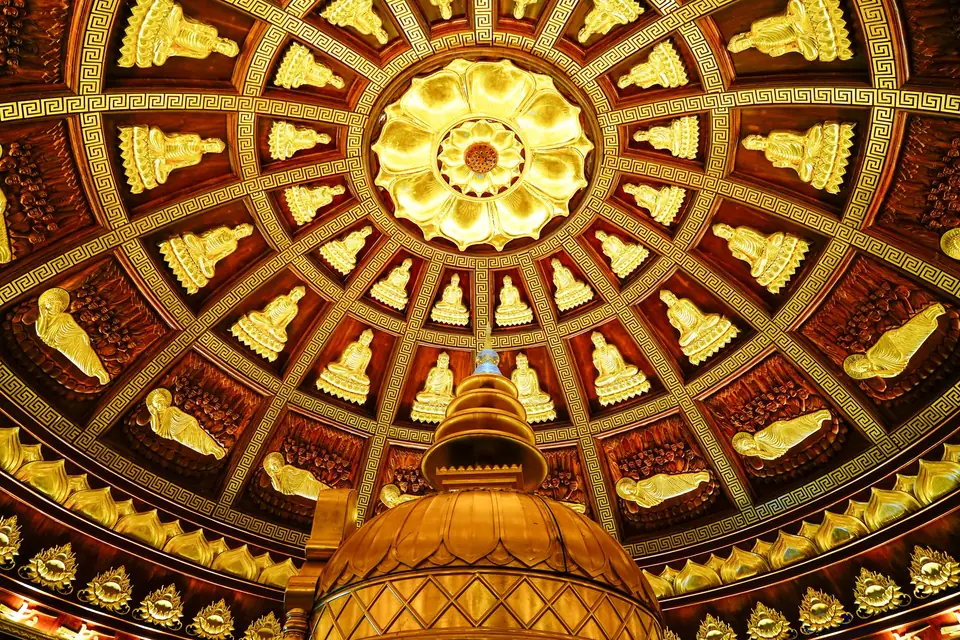
In the Pháp Chủ Hall, with a ridge 30 metres high, sits a gilded bronze Shakyamuni Buddha of 10 metres and 100 tonnes, beneath large plaques and lacquered latticework. Higher up, at 76 metres above sea level, the Tam Thế Hall, 34 metres high and 59.1 long, holds the three Buddhas of past, present and future, of 7.2 metres and 50 tonnes each.
The architecture of Bai Dinh Pagoda hides a reversed order here: the bronze statues, the work of the Ý Yên founders, were installed before the halls were built, because they would not have fitted through any door. During construction, the great Buddha stood in the open air and already drew pilgrims.
Sacredness came later, with relics. In June 2009 a procession of more than 15,000 pilgrims brought relics of the Buddha and of holy monks, and on 3 March 2010 a Buddha relic gifted from India landed at Nội Bài and was taken that same day to the complex’s stupa. In 2014, from 7 to 11 May, Bái Đính hosted the United Nations Day of Vesak, with some 10,000 people from between 90 and 100 countries. In front of the Buddha, the audio guide reconstructs how a newly built temple became a place of pilgrimage.
The medicine for a king who roared
Chùa Bái Đính Cổ
Summary of this stop
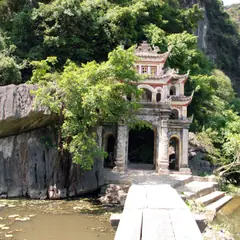
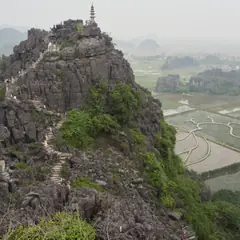
The path to the old pagoda, Chùa Bái Đính Cổ, climbs more than 300 stone steps with an ornamental gate halfway up. The change of scale is felt in the body itself: after the record bronzes, the origin is a cave hermitage, declared in 1997 a historic, cultural and revolutionary monument of national rank; in the war against France and Japan the mountain was part of the Quỳnh Lưu war zone.
Its founder, Nguyễn Minh Không, came to the mountain looking for medicinal plants for the king. Tradition gives the reason: in 1136 King Lý Thần Tông fell ill, hair grew over his whole body and he roared like a tiger, and no court physician could cure him. According to the tale, the monk, scorned by the palace magicians for his peasant clothes, pulled with two fingers a nail that no one dared remove from a column and took from a boiling cauldron the needles with which he treated the king.
The exact date the pagoda was born does not agree across sources, and the border between history and legend in the monk’s biography is still debated. On the climb, the narration separates one from the other.
Bright cave, dark cave and a poet king
Inscription above the mouth of Hang Sáng
Summary of this stop
At the top, the path forks. On the right, Hang Sáng, the bright cave of the Buddha and the spirits, 25 metres long and about 2 high; above its mouth, King Lê Thánh Tông, who climbed to the summit and left a poem in classical Chinese about the mountain, gave the four great characters carved in the rock: “Minh Đỉnh Danh Lam”. On the left, Động Tối, the dark cave of the Mother Goddess and the fairies, larger and with seven chambers.
At the back of Hang Sáng, an exit opens to a green valley with the temple of the spirit Cao Sơn. Its statue is of gilded jackfruit wood, and popular belief says that in 2007, when they wanted to remove it to put a bronze one in its place, drops like sweat appeared on its forehead and neither levers nor ropes could move it. So says Trương Đình Tưởng, president of the Ninh Bình Historical Sciences Association, who was present.
The wooden figure is still in its place, facing all the bronzes below. It is the end of the route, and the audio guide keeps for that valley the close of the thread that began at the Tam Quan gate.