Tam Cốc viewpoint
Hang Mua Audio Guide
A limestone mountain above Tam Cốc, a staircase of some 486 steps winding like a wall and, on the ridge, a stone dragon facing the valley. The name, though, comes from a 13th-century court dance.
- 60 min of audio
- Karst viewpoint
- UNESCO heritage
Hang Múa, the 'cave of the dance', is a cave at the foot of Mount Ngọa Long, known since ancient times and opened to tourism in 2000. Its history leads back to the Trần: Trần Thái Tông abdicated in 1258 and withdrew to the mountains of Trường Yên, and tradition attributes the name to the dances of the court ladies the kings came here to watch. Today the place is something else: a viewpoint about 142 m high inside the core zone of the Tràng An World Heritage site.
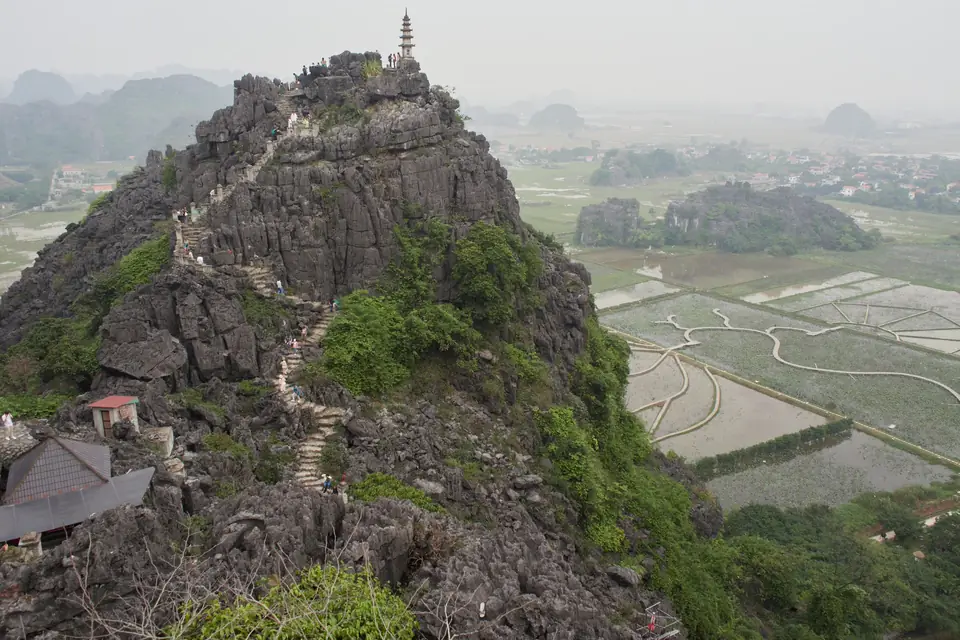
The staircase, the railings and the dragons are modern work of the tourist complex, although the press often describes them as Trần-style. That contrast between recent set and age-old landscape is the key to Hang Mua: a stage built for the photo over a view of limestone, rice and river that needs no retouching.
Highlights
- 'Great Wall' staircase — some 486 white stone steps to the summit
- Stone dragon — coiled on the ridge facing a statue of Quan Âm
- Cliff-edge stupa — a small Buddhist tower representing the elements
- Tam Cốc panorama — the Ngô Đồng river among rice fields and limestone towers
- Lotus pond — over 1 ha with a heart-shaped wooden walkway
The story of Hang Mua begins in the 13th century and leaps almost eight centuries to social media. In 1258, after the first war against the Mongols, King Trần Thái Tông abdicated at 40 in favour of his son and withdrew to the mountains of Trường Yên to found a Buddhist hermitage. According to tradition, the Trần kings came to this cave at the foot of Mount Ngọa Long to watch the court ladies sing and dance, hence the name: Hang Múa, the “cave of the dance”. The legend has no single version, and some sources move the dances to the Thái Vi hermitage or tie them to the court’s flight from the Mongols.
The place opened to tourism in 2000, but its fame came much later. In August 2018 it already ranked in the top 5 of Ninh Binh destinations in international travellers’ online reviews, ahead of names such as Tràng An, Tam Cốc or Bái Đính pagoda; some accounts even place it first on the list. It is run by a private company, which on 1 April 2026 raised the entrance fee from 100,000 to 150,000 dong, and it lies inside the core zone of the Tràng An World Heritage site, inscribed by UNESCO in 2014. It is also said that in wartime the cave served as a travelling hospital for wounded soldiers, an account that circulates with no date or specific unit.
What to see at Hang Mua, in short: a lotus pond, a modern staircase with the look of a wall, a Buddhist stupa hanging over the void and a stone dragon that commands Tam Cốc. The audio guide covers those four stops in about 60 minutes, with documented narration that separates legend from what is verified and set from what is ancient.
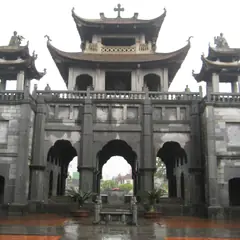
Below, the river of Tam Coc is travelled by boat between rice fields and caves, and on another nearby limestone tower the three pagodas of Bich Dong are stacked. Further southeast, in Kim Sơn, the Phat Diem Cathedral trades limestone for a Catholic church with pagoda roofs.
A lotus pond at the foot of the cave
Hang Múa
Summary of this stop
The route starts below, where the mountain meets the water. The lotus pond covers more than a hectare and is crossed by a heart-shaped wooden walkway, installed around 2019. The lotuses are not native: they are Japanese lotus, introduced on trial by the local authorities for tourism, and their charm is that they bloom for months, mostly from June to August, rather than in one short season.
The cave that gives the place its name is of little interest in itself. Next to it opens a second grotto, the Tiger cave, tiny, with an altar and a tiger statue larger than life. From this point the summit looks like a tiny dot, and from that came a viral episode in June 2024: a photographer standing at the foot of the mountain tried to shoot a client posing up there, at about 142 m, and had to correct the pose over the phone. How that portrait ended up, and what social media said of the result, is told in the narration right there.
The Great Wall named after a dance
'Great Wall' staircase
Summary of this stop
The climb is a white stone staircase, already mossy, that winds up the slope like the path of a wall, hence the nickname “Great Wall of Vietnam”. Figures vary by source: 486 steps according to Vietnamese Wikipedia and the Ninh Binh tourism promotion centre, almost 500 for other outlets. On both sides of the path stand statues of nghê, the Vietnamese mythical lion, and eagles on stone pillars, alongside dragon and phoenix figures.
All that repertoire is modern, but it rests on an ancient name: that of the court dances which, according to tradition, the Trần kings came to watch on this mountain. And halfway up the stairs appears a very much alive custom: the wild goats of the limestone cliffs stroll along the steps as if they owned them and step in front of anyone carrying fruit. In spring 2026 visitors dubbed them “tourist ambassadors”, and the narration explains what happens to whoever tries to keep climbing without paying their toll.
The stupa of the four elements
Cliff-edge stupa
Summary of this stop
At the top the path forks: to the left, towards the statue of Quan Âm; to the right, towards the stone dragon. To one side stands the most photographed turret on the mountain, a small stupa hanging at the cliff edge, with a queue of visitors waiting their turn for the photo.
What almost nobody reads in it is its meaning. Each part of the stupa represents an element: the square base, earth; the round bulb, water; the cones, fire; and the parasol, wind. It is a small Buddhist map of the world read from the bottom up, and it fits the other face of the place: the mountain of the dance was also the territory of a hermit king, Trần Thái Tông, who withdrew to these mountains after abdicating in 1258.
The dragon on the ridge and the view of Tam Cốc
Stone dragon on the ridge
Summary of this stop
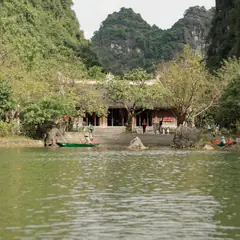
On the ridge of Mount Ngọa Long a great stone dragon coils in front of the statue of Quan Âm. It is the “tallest” dragon in Ninh Binh and, seen from below, seems to receive the sunrise and the sunset. Its body serves as a foreground for the photo of the valley: to the west, the Ngô Đồng river winds through Tam Cốc between rice fields and limestone towers, with the rowing boats that travel it; on the other side appears the city of Ninh Binh, with tall buildings and chimneys. Each May, with the golden rice harvest, this summit is one of the four high points of the “Sắc vàng Tam Cốc - Tràng An” photo tour.
That view turned Hang Mua into a photographic phenomenon, to the point that it is called “the muse of Tam Cốc”. In early 2019 social media filled with images of the summit retouched with clouds, mists and unrecognisable skies, and the matter ended in a debate among travellers. The narration at the summit offers the comparison between the internet’s muse and the real landscape.