World Heritage
Bich Dong Pagoda Audio Guide (Chùa Bích Động)
Three pagodas stacked on the slope of a limestone tower: one at the foot, another half set into a cave and a hermitage at the summit. Ninh Binh's Green Grotto is not a building, it is a climb.
- 45 min of audio
- Buddhist cave pagoda
It all began in 1428, at the start of the Later Lê dynasty, with a single small pagoda high on the mountain. In 1705 two wandering monks from Nam Định, Trí Kiên and Trí Thể, rebuilt that temple as three stepped pagodas, Hạ, Trung and Thượng, and in 1774 Lord Trịnh Sâm gave it the name Bích Động, Green Grotto. Today it is still a living monastery, a special national monument since 2012 and part of the Tràng An World Heritage site since 2014.
The lower pagoda rests on stone columns over 4 m tall carved from a single block; the middle one lives half inside the rock and half in the open air; and in the dark cave behind it hangs a bronze bell from 1707 that almost everyone passing rings three times, to be freed from an injustice.
Highlights
- Chùa Hạ — single-block stone columns, over 4 m tall
- Chùa Trung — half a pagoda inside a cave mouth
- Characters 'Bích Động' — the name of 1774 carved in the rock
- Bell of 1707 — three strikes to be freed from injustice
- Chùa Thượng — a view of five mountains like lotus petals
What to see at Bich Dong Pagoda fits in one sentence: an entire mountain turned into a sanctuary. The history of Bich Dong begins in 1428, when on the summit of this limestone mountain in Ninh Binh there was only a small pagoda. Almost three centuries later, in 1705 and under King Lê Dụ Tông, two monks from Nghĩa Hưng, Trí Kiên and Trí Thể, sworn brothers who travelled founding pagodas, stopped here, begged for alms and rebuilt the old temple as three separate pagodas, one above the other. In 1774, according to the pagoda’s own records, Lord Trịnh Sâm was so struck by the green of its mountains, caves, rivers and rice fields that he renamed it Bích Động, “Green Grotto”.
Sources do not always agree on the dates or on who gave the name, nor on which of the three pagodas is the oldest: part of the place’s charm lies in those superimposed layers of history. The architecture of Bich Dong is best understood by climbing, step by step, from the hall of columns at the foot to the hermitage at the top, and the audio guide route, researched and fact-checked against historical sources, is designed that way.
A short distance away, Tam Coc opens its boat route between rice fields and caves, and the viewpoint of Hang Mua offers another climb up the limestone, to a stone dragon. To compare scale, the Bai Dinh Pagoda adds to its cave hermitage from the Lý era a gigantic Buddhist complex built since 2003.
A bridge without a railing to the Green Grotto
Chùa Bích Động
Summary of this stop
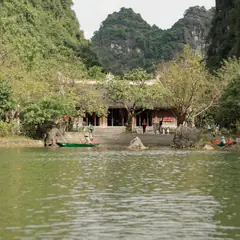
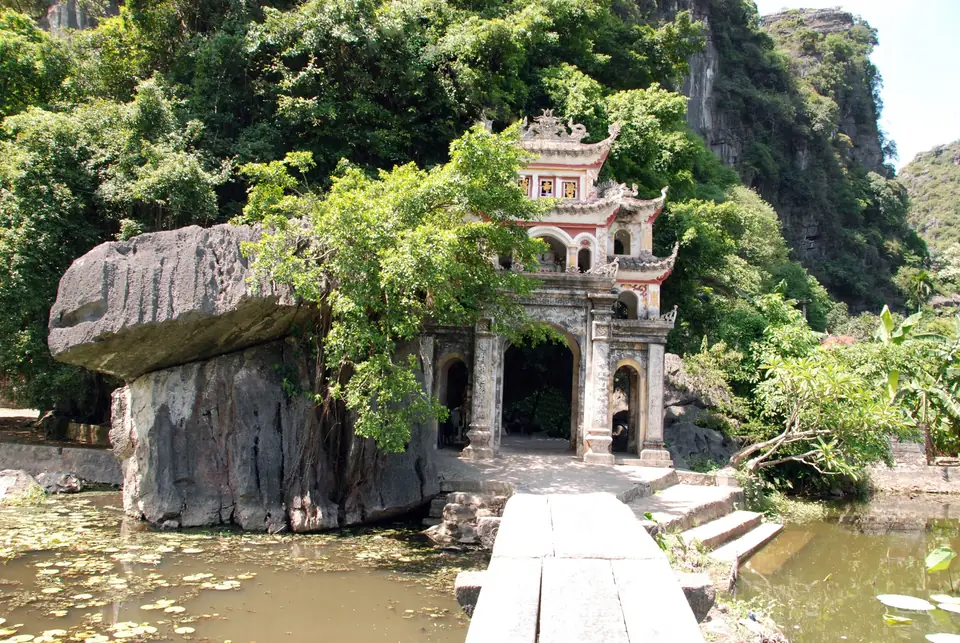
The arrival already sets the tone. A narrow stone bridge with no parapet crosses the lake that rings the foot of the mountain and leads to a gate wedged between limestone rocks. From there the sanctuary can be read at a glance: it does not spread sideways but climbs vertically up the slope.
Its fame has a name and surname. Bích Động boasts the title “Nam thiên đệ nhị động”, the second most beautiful grotto under the southern sky. The first is Hương Tích, the Chùa Hương, where Trịnh Sâm had the motto “Nam thiên đệ nhất động” carved in 1770. Why this mountain came second, and who decided the order, is one of the stories the narration saves for the foot of the bridge.
Single-block columns and one founder too many
Chùa Hạ
Summary of this stop
The Chùa Hạ, the lower pagoda, stands on a high platform with five bays and a floor plan in the shape of the character Đinh (丁). Its structure is lim ironwood, covered by two tiers of curved roof with eight slopes and corners lifted like phoenix tails. What surprises most is inside: stone columns over 4 m tall, each of a single block, without joints.
Here the story is told of how Trí Kiên and Trí Thể turned an old temple into three pagodas. According to tradition, the altar fills with guardians: the eight armoured generals on one side, the celestial officials who watch over cause and effect on the other, and at the end Nam Tào and Bắc Đẩu, keepers of the register of each person’s life and death. Beside them sit three founding masters, Chí Kiên, Chí Thể and Chí Tâm, although the origin story speaks of only two monks.
Outside, dozens of stupa tombs with inscriptions in Chinese and Sanskrit characters remember the abbots and monks who have lived here. Bích Động is still a living monastery, today led by the nun Thích Đàm Thọ.
Half a pagoda inside the rock
Chùa Trung
Summary of this stop
An S-shaped stone staircase of some 100 to 120 steps climbs to the Chùa Trung. The middle pagoda is built in the mouth of a cave: half lies inside the rock and the other half in the open air, with three bays of Buddha worship. From outside only the roof and the door show, and on crossing it the light and temperature change at once.
Above, the mountain has its own name written on it. The two large characters “Bích Động” carved in the rock wall are attributed to Nguyễn Nghiễm, a high mandarin and father of the poet Nguyễn Du, on Trịnh Sâm’s orders; some sources, however, give other dates and another hand. Above the roof, ten gilded characters, “Già Lam Thần – Đại Hùng Bảo Điện – Nam Thiên Tổ”, proclaim that all the Buddhist patriarchs of the southern country came from Bích Động. That pride, and the dispute over who named the grotto, take on another meaning in front of the rock itself.
The 1707 bell that undoes injustices
Bronze bell of Động Tối
Summary of this stop
About 6 m above the Chùa Trung opens Động Tối, the dark cave. At its arched entrance, the so-called cầu Giải Oan, hangs the great bronze bell that Trí Kiên and Trí Thể cast in 1707. Its inscription in Chinese characters reads “Khai sơn tạc thạch”: open the mountain, carve the stone.
Almost everyone who passes rings it three times. Local belief says those three strikes free the soul from what is unjust and restore justice to whoever has suffered an injustice. Inside, the cave, up to 8 m high, is filled with stalactites named after immortals, dragons, turtles and elephants. And in a small side grotto near the exit waits a detail the audio guide saves for that moment: two stones that, when struck, sound like the wooden instrument of the monks.
Five mountains like lotus petals
Chùa Thượng
Summary of this stop
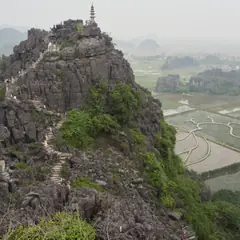
About 40 steps higher, the Chùa Thượng, dedicated to Quan Âm, stands some 60 m above the entrance courtyard and faces southeast. Here, at the top, the sanctuary was born with that single small pagoda of 1428; according to an old stele of the hermitage itself, as early as the 10th century a woman named La gave money to restore it. Underfoot, unseen, runs Xuyên Thủy động, a flooded cave of about 350 m that crosses the mountain from east to west.
The view is the reward for the climb: five isolated mountains, Ngũ Nhạc Sơn, arranged like five lotus petals around Bích Động, with the rice fields between them. Local custom gives them village names, not at all solemn, and one of them is “the Pig”. Beside the hermitage, the cistern called bể nước Cam Lộ holds water credited with the power to heal. Which of the five peaks is which is revealed in the narration, from the same terrace.