National historical-cultural relic
Phat Diem Cathedral Audio Guide (Nhà thờ chính tòa Phát Diệm)
A Catholic cathedral with curved pagoda roofs, built by hand in stone and lim ironwood on mud freshly won from the sea, by a Vietnamese priest whom some revere and others accuse.
- 60 min of audio
- Sino-Vietnamese architecture
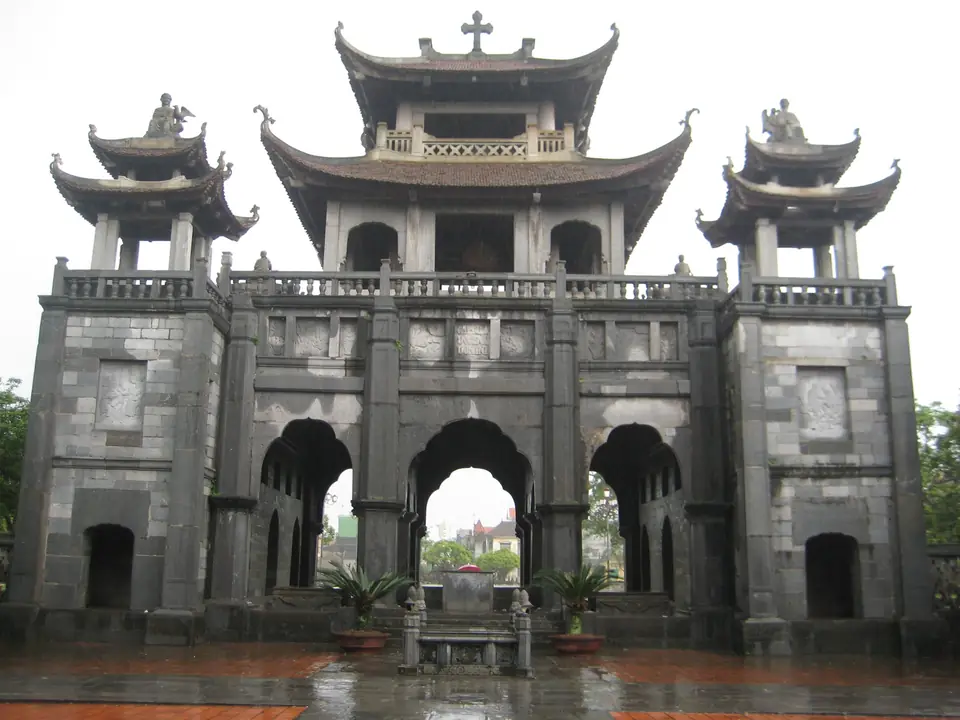
The Phát Diệm complex, of about 22 hectares on the Kim Sơn plain, was built between 1875 and 1899 under the direction of the parish priest Phêrô Trần Lục. Its architecture fuses Catholic liturgy with Vietnamese pagoda forms: a three-storey stone bell tower, a 74-metre nave held up by monolithic lim trunks, a chapel made entirely of stone and artificial grottoes. All without iron or cement, over something like a million bamboo piles.
Behind the feat lies an uncomfortable biography. The same man who asked to be buried in the middle of the path so the faithful would tread on him mobilised 5,000 Catholics in 1887 in support of the French attack on Ba Đình. And in 1951, while the town changed hands in the midst of war, Graham Greene found here the bell tower scene of The Quiet American.
Highlights
- Phương Đình — a stone bell tower of about 25 m with pagoda roofs and a bell from 1890
- Main nave — 74 m on six rows of monolithic lim columns, the central ones 11 m
- Foundations — something like a million bamboo piles, without iron or cement
- Tomb of Trần Lục — the builder who asked to be trampled
- Stone Chapel (1883) — an invocation carved in four languages
On the Kim Sơn plain, in Ninh Binh province, the ground is young: alluvial land the sea had only just given up when Phêrô Trần Lục, named parish priest of Phát Diệm in 1865, decided to build a cathedral there. Work began in 1875 and did not finish until 1899. The result is a singular Catholic complex: a church that adopts the curved roofs of the pagoda, bamboo-shaped latticework and reliefs of pine, plum, chrysanthemum and bamboo, without giving up crosses, evangelists and altars.
The story of Phat Diem Cathedral is not limited to its architecture. Its builder, whom everyone calls by a number, still divides opinion between veneration and the accusation of collaborating with the French conquest. Its walls saw a bishop with his own army govern, inspired Graham Greene and withstood the bombs of 1972. Since 1988 the complex has been a national historical-cultural relic. The audio guide route, researched and fact-checked against historical sources, goes from the pond at the entrance to the small chapel in the northwest, and each stop reveals a different layer of that history.
The province’s other religious face is at the Bai Dinh Pagoda, between a cave hermitage of the Lý era and a gigantic Buddhist complex, and the 17th-century temples of the Hoa Lu Ancient Capital show traditional Vietnamese architecture on its own ground.
Pagoda roofs on land stolen from the sea
Pond with the Sacred Heart statue
Summary of this stop
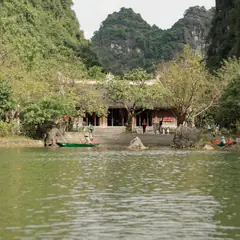
From the south bank of the large rectangular pond, with its islet and the white statue of the Sacred Heart, the whole complex can be read: a stone bell tower that looks like a pagoda, and behind it the bulk of the main church with its curved eaves. On a flat plain, that silhouette is the signature of a Vietnamese priest who between 1875 and 1899 raised some 22 hectares of temples on what had shortly before been marshland.
What astonishes is how the material arrived. The lim timber came from Nghệ An, Thanh Hóa and Sơn Tây; the stone, from the Thiện Dưỡng mountains, 30 km away, and Nhồi, 60. Trunks of up to 7 tonnes and slabs of up to 20 travelled on rafts that waited for high tide to run aground on the shore, hundreds of them in a line. The narration reconstructs that scene at the very place where the water still marks the entrance axis.
The bell tower and Greene’s scene
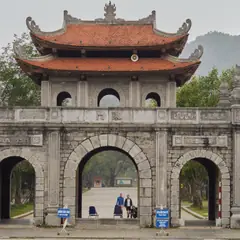
Phương Đình, the stone bell tower
Summary of this stop
The Phương Đình, the “square house” of 1899, is about 25 metres tall and three storeys of stone. At the corners the four evangelists stand guard; at the top hangs a bell of about 2 tonnes cast in 1890, hauled up an earth ramp. That same earth was later spread around the cathedral and raised the ground by a metre. According to tradition, the great slab of the central opening comes from the Tây Giai citadel in Thanh Hóa, where it would have been the royal bed of the Hồ dynasty.
Until June 1951, Phát Diệm was in practice governed by its bishop, Lê Hữu Từ, who had his own army. That year Graham Greene visited twice. By his own account, on the second, in December, the Viet Minh had entered the town taking advantage of the feast of Our Lady of Fatima and French paratroopers were retaking it street by street. The mortars over rice fields and church towers ended up as the backdrop of the bell tower scene in The Quiet American. What Greene saw in a nearby canal, and never wanted to soften, is told at the foot of the tower.
The tomb that wanted to be trampled
Tomb of Trần Lục
Summary of this stop
In the courtyard between the Phương Đình and the main church, flanked by balustrades of turned stone, a tomb surrounded by a fence holds Trần Lục, who died on 6 July 1899. He asked to be buried in the middle of the entrance path, so people would tread on his tomb; the faithful did not dare and moved it off the path.
Almost nobody calls him by his name. Local custom, recorded as a documented tradition, knows him as “cụ Sáu”, the venerable Six, and the French as “Père Six”: a nickname from his deacon years that would have ended up as a false name to dodge persecution. But the same figure has a shadow. In January 1887 he mobilised 5,000 Catholics in support of the French attack on Ba Đình, a focus of the Cần Vương uprising, and Vietnamese chronicles accuse him of collaborating with the conquest. Here the visit pauses on that debate, without settling it in one stroke.
A lim forest raised in three months
Lim columns of the main nave
Summary of this stop
The main church, dedicated to Our Lady of the Rosary and inaugurated in 1891, went up in just three months of that year, after ten of gathering materials and consolidating the ground. Beneath the floor some million bamboo piles were driven, spliced to depths of 20 or 30 metres, and layers of earth and stone were tamped down with rammers and buffaloes. No iron or cement in the entire complex.
Behind the five-arch facade, the 74-metre nave rests on six rows of monolithic lim trunks; the 16 central ones measure 11 metres. At the far end, an altar of a single stone slab and wood lacquered in red and gold. Sources do not agree on the exact number of columns or their weight. What is on record is that on 15 August 1972 a string of eight American bombs fell between the Nhà Chung and the pond: 52 of the 56 side doors were broken and the restoration took five years of manual work. The real extent of that damage is still told in very different ways, and the narration explains why.
The real Stone Church
Stone Chapel
Summary of this stop
Many visitors call the great cathedral the “Stone Church”, but for the people of Phát Diệm the Nhà thờ Đá is another one: the small chapel of the Immaculate Heart of Mary, in the northwest, dedicated in 1883 and the first temple of the complex. It measures 15.3 by 8.5 metres and 6 high, and floor, columns, beams, walls, latticework, towers and altar are all of stone. Inside, an invocation to the Heart of Mary is carved in Vietnamese, classical Chinese, French and Latin.
To the north appears the work with which everything began in 1875: an artificial mountain of stone, the Núi Táng Xác, raised to measure how much the newly formed ground was sinking. Since 1954 it has been called Núi Sinh Nhật, the Bethlehem grotto, and it is the setting of the Phát Diệm Christmas, the biggest community event in Kim Sơn. The popular nickname the main church receives, which changes how the complex is seen, is saved for the end of the route.