Imperial capital
Hoa Lu Ancient Capital Audio Guide (Cố đô Hoa Lư)
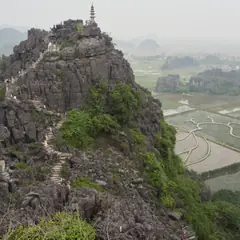
A valley closed in by limestone peaks was, between 968 and 1010, the fortress capital of the first independent Vietnamese state. Beneath its 17th-century temples lie the foundations of the palace of the Đinh and Lê kings.
- 75 min of audio
- 17th-century temples
In 968 Đinh Bộ Lĩnh subdued the 12 warlords, proclaimed himself emperor, named the country Đại Cồ Việt and set the capital at Hoa Lư, his birthplace. For 42 years three successive dynasties ruled here: Đinh, Early Lê and Lý. The city had no square enclosure in the Chinese manner: ten stretches of earthen wall about 10 m high closed the gaps between the crags, which did the rest of the work.
The quiet valley of rice fields and ponds holds a story of a cauldron and tigers, of a king murdered in his sleep after a banquet and of a prince who left carved in stone the confession of having had his brother killed. In 1010 the court gave it all up and left to found Thăng Long, the future Hanoi, taking even the names of Hoa Lư with it.
Highlights
- Dragon beds — two green stone blocks with dragons that have human arms, a national treasure since 2017
- Nhất Trụ sutra pillar — 4.16 m and 4.5 t, erected in 995 on the spot where it still stands
- 10th-century palace foundations — about 3 m below today's ground, with stamped bricks
- Earthen walls — ten stretches of up to 500 m joining the limestone peaks
- Lê Đại Hành temple — the statue of Queen Dương Vân Nga turned towards the south
The story of Hoa Lu fits into 42 years and a single valley. In 968 Đinh Bộ Lĩnh, after subduing the 12 warlords, proclaimed himself emperor and chose as his capital his birthplace, a landscape of limestone peaks that was already half a fortress. Hoa Lư is often presented as the first capital of Vietnam, a primacy that needs qualifying: there had been centres of power at Mê Linh, Cổ Loa or Long Biên before, and what is born here is the capital of the first centralised, independent feudal state. Until 1010 the Đinh, Early Lê and Lý dynasties followed one another here.
What can be seen today is two 17th-century temples, a pagoda with a stone pillar from 995 and an archaeological pit that lets visitors peer down to the level of the 10th-century palace. What cannot be seen is everything else: a cauldron of oil in the audience courtyard, a regicide, a fratricide who prayed for his victim and a queen who was the wife of two kings. The story of Hoa Lu, researched and fact-checked against historical sources, unfolds stop by stop in a 75-minute route with the audio guide.
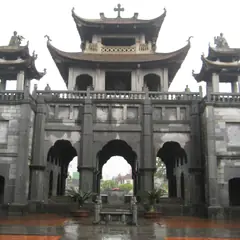
The range that closed the capital to the south is today Trang An, travelled by boat, and on Mount Đính, to the west, the Bai Dinh Pagoda keeps a cave hermitage from the Lý era. And the Phat Diem Cathedral puts traditional Vietnamese architecture at the service of another faith, with curved pagoda roofs over a church of stone and lim ironwood.
The North gate, locked with a key
Đền Vua Đinh Tiên Hoàng
Summary of this stop
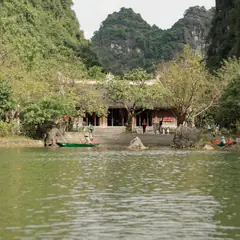
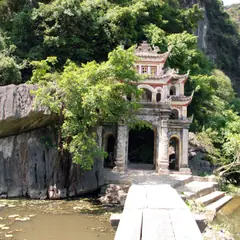
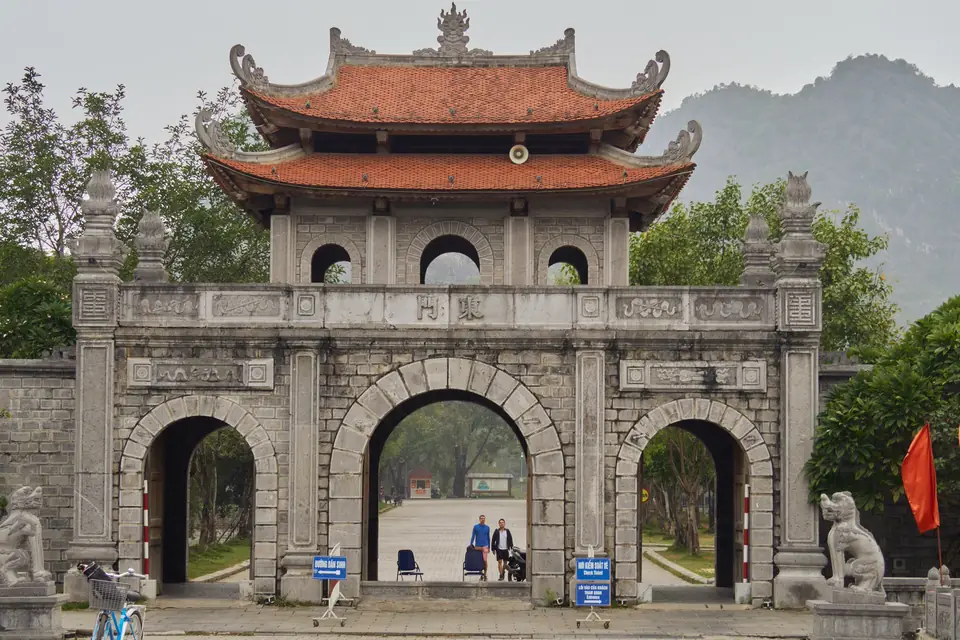
The route starts in front of the crescent-shaped lagoon, with its water lilies and the masonry screen that opens the axis of the Đinh Tiên Hoàng temple. Above the gateway, four characters, “Bắc Môn Tỏa Thược”, call for the North gate to be locked with a key, and the reflection of the crags in the water explains why a king in 968 entrusted his capital to this valley: the mountains served as walls.
Where the rock opened, ten stretches of earth between 65 and 500 m long, about 10 m high and 15 m thick closed the way. They were raised on marshy ground with layers of plant stalks and wooden piles, a technique that the 2025 excavation of the Den wall dated to the 10th century.
The paradox is that no enemy army ever put them to the test. The fleet of over a thousand ships with which Ngô Nhật Khánh and the king of Champa were to attack the capital ended up sunk by a storm, and in 981 the armies of the Song dynasty were stopped in the north of the country. What that locked gate says about its builders is better understood by listening in front of it.
Dragons with a dancer’s hands
Green stone dragon beds
Summary of this stop
The Đinh Tiên Hoàng temple is not from the 10th century: it was built in the 17th century on the site of the main palace. Its great treasure is at ground level. Two long sàng, dragon beds carved from single blocks of green stone and declared a national treasure in 2017, show dragons with human arms instead of eagle claws. The one at the outer gate, 1.87 x 1.27 m and about 1.5 t, has the slender fingers of a dancer; the one in the dragon courtyard, of about 2 t, has a six-fingered hand.
Both are flat and have a rim on all four sides that holds rainwater, so after each summer storm the dragon lies under a sheet of water. The dragon platforms of Chinese palaces, sloped along the staircase, do nothing of the kind.
On this same site, according to the chronicles, Đinh Tiên Hoàng had a great cauldron installed and tigers kept in cages, with a decree that whoever broke the law would be thrown into the boiling oil or to the beasts. The chronicles record no specific case, and the usual reading is that it was mostly a measure of intimidation. Tradition adds the legend of the boy Đinh Bộ Lĩnh chased by his uncle and saved by a yellow dragon, a flight that, it is told, gave its name to a river, a mountain and a hill.
The fratricide and his brother, on the same altar
Đinh Tiên Hoàng shrine
Summary of this stop
In the shrine, the king’s bronze statue stands on a monolithic pedestal of green stone, flanked by those of his sons Đinh Liễn, Đinh Hạng Lang and Đinh Toàn and by the altar of the four generals. The chronicles place the end here: in 979 Đỗ Thích, a palace official, killed Đinh Tiên Hoàng, who lay asleep drunk in the courtyard after a banquet, and his eldest son Đinh Liễn. He hid for three days in a gutter and was betrayed by a court lady who saw him put out his hand to drink rainwater. The authorship is still disputed: some researchers and local traditions see him as the scapegoat of a conspiracy.
Months earlier, according to a documented tradition, Đinh Liễn had had his younger brother Hạng Lang, the boy just named crown prince, killed, and left the confession carved on sutra columns: it prays for his brother’s soul and, in the same sentence, asks to keep his rank and revenues. Today the two brothers are worshipped together at this altar, and what exactly those stones say is one of the most unsettling moments of the narration.
A queen who faces south
Đền Vua Lê Đại Hành
Summary of this stop
300 m from the Đinh temple, the Lê Đại Hành temple is smaller and keeps late 17th-century architecture, with its whole outer half added in the Nguyễn era. Beside it, a fenced pit shows the foundations of a 10th-century palace about 3 m below today’s ground. It was in 984 that Lê Hoàn filled Hoa Lư with palaces: the Bách Bảo audience hall, with columns clad in gold and silver, and the Long Lộc palace, roofed with silver tiles.
The Institute of Archaeology’s excavations, among them the 1997 one in the temple area, yielded paving bricks with lotus flowers of up to 0.78 x 0.48 m, intact cylindrical tiles and bricks stamped with the legend “Đại Việt quốc quân thành chuyên”, brick for the citadel of the Đại Việt state.
Inside the shrine waits the most human detail of the site. Dương Vân Nga, widow of Đinh Tiên Hoàng, backed Lê Hoàn’s rise to the throne and became his queen. Her statue does not face forward like the king’s, but south, towards the temple of her first husband.
A pillar from 995 still standing
Chùa Nhất Trụ
Summary of this stop
In the courtyard of the Nhất Trụ pagoda stands the sutra pillar that Lê Đại Hành erected in 995 on the same spot where it still stands: 4.16 m, 4.5 t and six pieces fitted with tenons without any binder. Its eight faces carried some 2,500 Chinese characters, still visible at the top and badly eroded below, and it was declared a national treasure in 2015. It is often called the oldest in Vietnam, although almost 20 much smaller pillars from the Đinh era have been excavated at Hoa Lư.
In 1010 Lý Thái Tổ, enthroned by the Hoa Lư court itself, moved the capital to Đại La, renamed Thăng Long. The new city inherited names from the old, among them that of this pagoda. Beside it, the small temple of Princess Phất Kim, daughter of Đinh Tiên Hoàng, keeps according to tradition the story of a marriage arranged to seal peace that ended in a flight, a knife and a revenge, the episode that closes the route.