Garden of the future
Gardens by the Bay Audio Guide
A forest of steel trees up to 50 metres tall and two glass domes on the equator, planted on land reclaimed from the sea: the garden with which Singapore set out to go from a “Garden City” to a “City in a Garden”.
- 120 min of audio
- Gardens and architecture
Gardens by the Bay covers 101 hectares beside Marina Bay, on land reclaimed from the sea in the 1970s that Marina City Park once occupied. Prime Minister Lee Hsien Loong announced the project at the 2005 National Day Rally, and the 2006 international competition was won by two British firms, Grant Associates and Gustafson Porter, with Wilkinson Eyre as architects of the domes. Bay South opened to the public on 29 June 2012.
Behind the fantasy there is a machine. Some of the Supertrees are in fact chimneys of the biomass plant that cools the domes, fed with wood and pruning waste from the island’s trees, a residue that used to end up in landfill. And under the glass of the Flower Dome, a Spanish olive tree only produced flowers and olives once a winter was manufactured for it.
Highlights
- Supertree Grove — 12 of the 18 artificial trees, 25 to 50 metres tall, covered by more than 162,900 plants
- OCBC Skyway — A 128-metre walkway hung 22 metres up between two Supertrees, above the Garden Rhapsody show
- Flower Dome — The world’s largest glass greenhouse according to Guinness, with a Spanish olive tree about 1,000 years old
- Cloud Forest — An artificial mountain covered in epiphytes and an indoor waterfall of about 35 metres
- Marc Quinn’s Planet — A giant bronze baby that seems to float above the lawn of The Meadow
Beside the financial district, on sand that was still sea in the 1970s, Gardens by the Bay spreads 101 hectares of showpiece garden at the foot of Marina Bay. Another park stood here before, Marina City Park, 26.2 hectares, opened on 30 December 1990 and closed on 1 June 2007 to make room for the Gardens. In 2004, planners and parks officials set aside 101 of the new downtown’s 360 hectares for a green lung, and at the 2005 National Day Rally Prime Minister Lee Hsien Loong presented the project as the step from the “Garden City” to the “City in a Garden”.
The history of Gardens by the Bay is that of an expensive and much-debated bet. The 2006 international design competition drew more than 70 proposals from 170 firms in 24 countries and was won by two British practices: Grant Associates, a small office in Bath, for Bay South, and Gustafson Porter for Bay East, with Wilkinson Eyre in charge of the domes. In September 2007, just after S$893 million was approved, material and labour costs rose by 34%: the opening slipped by almost two years, titanium gave way to aluminium, granite to cement, and the planned Supertrees dropped from 36 to 18. Sources disagree on what it finally cost. Bay South opened to the public on 29 June 2012.
The architecture of Gardens by the Bay is spread across artificial trees of steel and concrete, lakes that filter rainwater and two climate-controlled glass conservatories on the equator. For what to see at Gardens by the Bay, the audio guide covers the park in five stops and 120 minutes: the Planet sculpture, the Supertree Grove, the shore of Dragonfly Lake, the Flower Dome and the Cloud Forest waterfall. The thread that links them: this fantasy garden is a machine designed to the millimetre, planted on refilled sea and on very expensive land that Singapore decided not to sell.
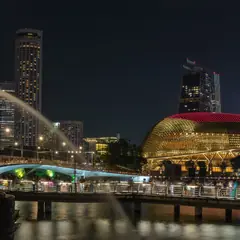
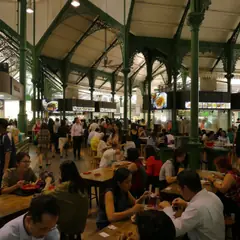
Across the bay, the Merlion spouts water from another pier of reclaimed land, and in the financial district the iron market of Lau Pa Sat awaits.
A giant baby on reclaimed land
Marc Quinn’s Planet
Summary of this stop
Visitors arriving from Bayfront station first meet Planet, a sleeping baby of painted bronze and steel, about 10 metres long and 7 tonnes, that seems to float above the lawn of The Meadow. It is the work of the British artist Marc Quinn, portrays his son and was unveiled on 18 January 2013, donated by Putra and Imelda Masagung.
Under that lawn lies sand reclaimed from the sea. The decision to devote it to plants rather than towers was no small one: at the opening on 28 June 2012, Lee Hsien Loong acknowledged that setting aside 101 hectares of prime land, which could have ended up as offices and housing, was not an easy decision, and former minister Mah Bow Tan compared it to not building homes in Hyde Park.
In front of the sculpture, the audio guide begins with that first serene gesture of the garden and with the park that had to disappear for this one to exist.
Steel trees that are also chimneys
Supertree Grove
Summary of this stop
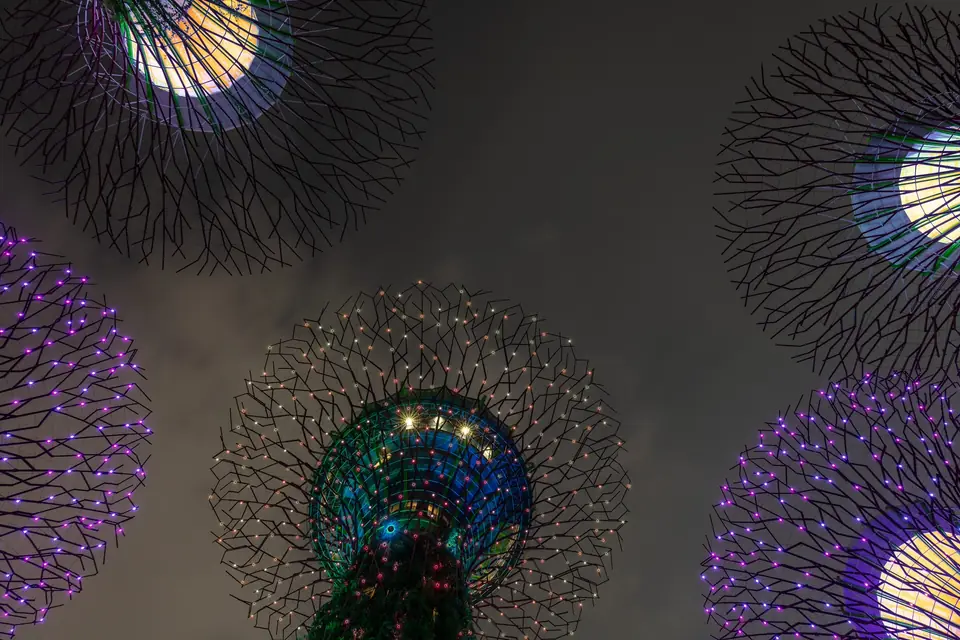
The Supertree Grove holds 12 of the 18 Supertrees, artificial trees between 25 and 50 metres tall, the tallest equivalent to a 16-storey building. They have a reinforced-concrete core and a steel frame, and carry more than 162,900 plants of over 200 species and varieties of bromeliads, orchids, ferns and climbers. Some canopies carry solar panels and others serve as air exhausts. Above runs the OCBC Skyway, a 128-metre walkway 22 metres off the ground between two 42-metre Supertrees, and every night, at 7:45 pm and 8:45 pm, the forest lights up with the free Garden Rhapsody show, which spreads the sound across 68 independent speakers to simulate musicians playing at different points.
From the ground they all look alike, but some are chimneys of the biomass plant that cools the domes. A cogeneration turbine burns wood and pruning waste from the island’s urban trees, a residue that used to go to landfill, and its ashes are reused as compost and as aggregate for concrete.
Many people see the planet Pandora from Avatar here, though the origin of these trees is a disputed story: the master plan by Andrew Grant’s team already spoke of “supertrees with a sci-fi air” inspired, according to that document, by the Valley of the Giants in south-west Australia, and it was born for the 2006 competition, years before the film’s release in December 2009. Beneath the canopies, the audio guide tells how a real forest of Australian giants ended up eclipsed by a movie.
The lake born from a landslip
Dragonfly Lake
Summary of this stop
Dragonfly Lake is ringed by reed beds and islands of aquatic plants that filter the park’s rainwater before it is released into Marina Reservoir. It was not in the plans as it looks today. To settle the sand, the contractors loaded the ground with mounds of earth and pumped groundwater from 30–40 metres down; one of the mounds slipped, Kenneth Er, the future director of operations, ran for it, and Tan Wee Kiat decided to turn the damaged area into a wetland.
With only five years to deliver a garden that looked mature, the team also rescued doomed trees from building sites across the island: cannonball trees from Upper Cross Street, Madras thorn trees from Seletar airbase and frangipanis from Bidadari cemetery, now replanted here.
The most artificial garden in the city is also home to wild neighbours. In February 2014 a pair of smooth-coated otters began visiting the Gardens and that same year raised five pups, the first known breeding of wild otters in the heart of Singapore; the park never revealed where it thought the holt was. On the lakeshore, the audio guide recounts the day those otters mingled with thousands of runners.
A Spanish olive tree that had to be given a winter
Flower Dome
Summary of this stop
At the entrance to the Flower Dome wait baobabs and bottle trees with swollen trunks. The African baobab, the largest tree in the Gardens, came from Senegal: at 12 metres tall it did not fit in a 40-foot container and travelled on an open flatbed. The dome, designed by Wilkinson Eyre and completed in June 2012, covers 1.28 hectares under a column-free glass roof of 3,332 panels and is listed by Guinness as the world’s largest glass greenhouse. To cool it, only the low strip that people walk through is air-conditioned, and the warm air is left to rise to the top.
In its Olive Grove grow olive trees brought from Spain in 2011, one of them about 1,000 years old. In 2015 one of those trees flowered and fruited for the first time, after the dome’s temperature was lowered in December 2014 to simulate winter and staff placed fans under the trees to help pollination.
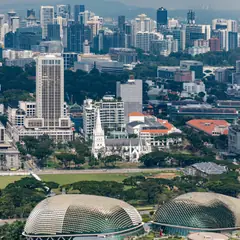
The domes shine beside the water because of a decision made in the competition: against rivals who buried them, roofed them with opaque covers or placed them in the middle of the park, the small Grant Associates team argued for taking them to the shore to gain light and visibility. Among the baobabs, the audio guide tells how it all began with a train journey and a conversation in a hotel lobby.
A mountain of mist under glass
Cloud Forest
Summary of this stop
On entering the Cloud Forest, the first thing to appear is an indoor waterfall falling from the Cloud Mountain, an artificial mountain clad in orchids, ferns and bromeliads. The official website gives the waterfall as 35 metres, though other accounts say 30 and the mountain’s figures also vary by source. Visitors go up by lift and come down along aerial walkways that wrap around it.
The dome recreates the tropical montane cloud forest, at 23–25 °C and 80–90% humidity, a highland climate manufactured a few metres above sea level. At the foot of the waterfall, the audio guide closes the tour with the idea that runs through all of it: an invented landscape that nonetheless breathes.