National monument
Sultan Mosque Audio Guide (Masjid Sultan)
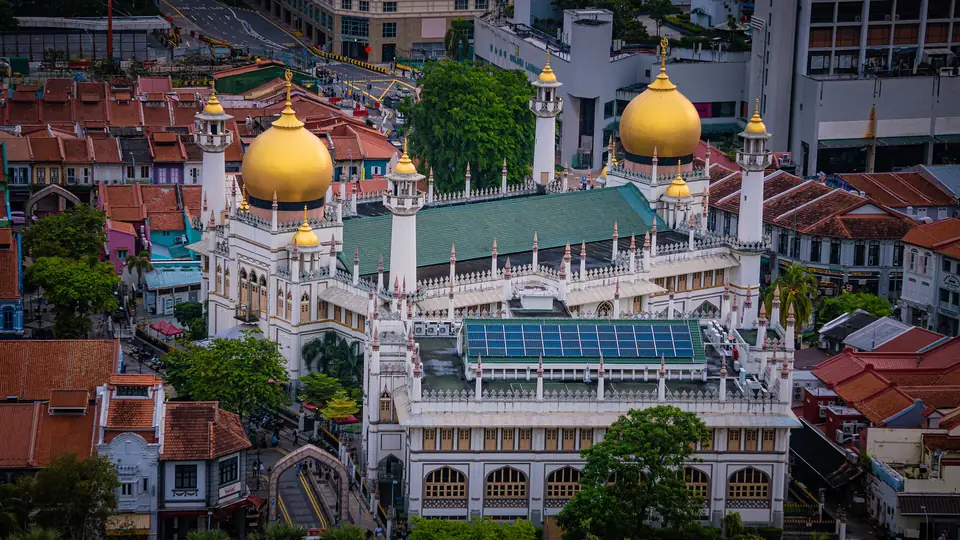
Two golden domes close off Bussorah Street in Kampong Glam: the royal mosque born of the 1824 pact with the British, which the poorest worshippers helped to build with a ring of bottle bottoms.
- 40 min of audio
- Royal mosque of Kampong Glam
The Sultan Mosque is the former royal mosque of Kampong Glam. Its site was reserved in 1824, in the agreement by which Sultan Hussein Shah of Johor ceded Singapore to the British East India Company, and Stamford Raffles promised 3,000 Spanish dollars for the building fund. The first mosque, of brick with a two-tiered roof, was finished in 1826. The present one, designed by the Irish architect Denis Santry of Swan & Maclaren, was built in phases between 1928 and 1932 without interrupting prayer, and has been a national monument since 1975.
Beneath the gold of the domes runs a dark band that almost nobody identifies at first glance: serrated glass bottle bottoms, donated by the Muslims of least means so that everyone, rich and poor, put something into the work. The same mosque that became a stopover for pilgrims bound for Mecca lived through the tensest hours of its history in December 1950, during the Maria Hertogh riots.
Highlights
- Golden domes — Two onion domes with crescent and star at the ends of the prayer hall
- Ring of bottle bottoms — A band of serrated glass at the base of each dome, contributed by the poorest worshippers
- Muscat Street facade — Arabesques, merlons and two minarets that close the view down Bussorah Street
- Prayer hall — Twelve octagonal columns and a plan turned towards Mecca, at an angle to the streets
- Mausoleum dome — The royal burial hall on the North Bridge Road side, visible only from outside
At the end of Bussorah Street, in the Kampong Glam district, the Sultan Mosque (Masjid Sultan) appears like a golden backdrop. The history of the Sultan Mosque begins in a colonial office: in 1824, Sultan Hussein Shah of Johor signed with the British East India Company the agreement that ceded Singapore, and in it he reserved a plot for a royal mosque beside his palace, the Istana Kampong Glam. Stamford Raffles promised 3,000 Company Spanish dollars to build it. The first mosque, finished in 1826, was a single-storey brick building with a two-tiered roof, the traditional Southeast Asian model. It is often presented as the oldest mosque in the city, although Masjid Omar Kampong Melaka, founded in 1820, is older.
In 1879, Sultan Alaudin Shah, grandson of the founder, handed management to a board of five Muslim trustees, and in 1914 the Straits Settlements government extended the site’s lease by 999 years. In 1924, with the century-old building in need of repair, the board commissioned a larger mosque from the Irish architect Denis Santry of Swan & Maclaren, who also designed the Cenotaph and the old Tanjong Pagar station. The economic crisis slowed fundraising and most sources place the works between 1928 and 1932, although one considers the reconstruction finished in 1928 and the cost figures do not agree either.
The architecture of the Sultan Mosque blends onion domes, Mughal-inspired cupolas, arabesques and minarets. After the war, in which a Japanese bombing damaged the mosque, it came under the Majlis Ugama Islam Singapura in 1968, with repairs paid for by the community and by a donation from King Faisal of Saudi Arabia. It was declared a national monument on 8 March 1975 and, after a 17-month restoration in 2014–2015, received the URA Architectural Heritage Award in 2016.
For what to see at the Sultan Mosque, the audio guide covers it in four stops and 40 minutes: from Bussorah Street to the Muscat Street facade, the prayer hall and the mausoleum dome on North Bridge Road. The thread that links them is a mosque born of a colonial pact that was, in reality, built and sustained by an entire community.
Another founding community built the Sri Mariamman Temple in Chinatown, and the hill of the ancient Malay kings, where Raffles set up his house, is today Fort Canning Park.
The street that waited for the ship to Mecca
Bussorah Street
Summary of this stop
The tour starts on Bussorah Street, the pedestrian street that frames the golden domes. Today it is a street of cafes and shops, but its past is different. The stretch that ends at the mosque was called Kampong Kaji, “the pilgrims’ village”: “kaji” was how the many Javanese who lived there pronounced “haji”. The street was first called Sultan Road and in 1910 took the name Bussorah, today’s Basra.
In colonial times, the mosque was a stopover for Muslim pilgrims from the region on their way to the hajj. Until the mid-1970s, Singapore was the great departure point for Mecca in Southeast Asia, and pilgrims from neighbouring countries, above all Indonesia, lodged on this street waiting for the “kapal haj”, the pilgrim ship, while the “sheikh hajis” prepared them for the journey.
Behind that golden postcard there is also a colonial pact that decided the future of the whole island. On Bussorah Street, the audio guide tells how pilgrims were seen off on departure day and why longtime residents still call the street by its old name.
Gold above, bottle bottoms below
Muscat Street
Summary of this stop
Facing the cast-iron gate of Muscat Street rises the main facade, with arabesque mouldings, a crest of merlons and two minarets on either side. Above, the golden domes shaped like onions, topped with crescent and star. And at the base of each, a dark band that can be made out from the street in daylight: a ring of serrated glass bottle bottoms.
Those bottle bottoms were donated, during the reconstruction of 1928 to 1932, by the Muslims of least means, so that no one was left out of the work. The new mosque was built in phases, without stopping prayer in the old one, and in the midst of crisis: between 1926 and 1927 no money was raised, and on 26 February 1932 it was complete apart from minor details.
The minarets hold another first. In 1936 the mosque installed a microphone connected to loudspeakers for the call to prayer, the first such installation known in a mosque. In front of the facade, the audio guide explains what worshippers thought of that invention and how far the muezzin’s voice was said to carry.
A hall skewed towards Mecca
Prayer hall
Summary of this stop
Inside, in the visitors’ area, opens the prayer hall: rectangular, two storeys high, with an upper gallery and twelve octagonal columns. Its most curious feature is not obvious until it is compared with the street: the hall is turned to face Mecca, so it lines up with neither Muscat Street nor North Bridge Road. At the front, the mihrab is framed by a lancet arch with golden floral motifs. The heritage record speaks of up to 5,000 worshippers, although the MUIS directory lowers the figure to 2,000.
Beneath this calm of carpet and wooden blinds, the mosque’s tensest hours were lived in December 1950. On 8 December, the activist Karim Ghani gave a speech here on the Maria Hertogh case, and three days later the riots of 11 to 13 December broke out, with 18 dead and 173 injured. Police vans burned beside the mosque.
Meanwhile, Muslim community leaders shouted warnings from the minarets to curb the violence. In the prayer hall, the audio guide reconstructs those days and the unusual condition set for arresting those who had hidden inside.
The tomb that is not the founder’s
Mausoleum dome
Summary of this stop
The tour ends on North Bridge Road, under the west dome. There, at the opposite end from the Muscat Street vestibule, stands the burial hall linked to Sultan Alauddin Alam Shah, grandson of the founder, and to other members of the royal family. It can be seen from outside; the hall is not open to visitors. Sources do not fully agree: some place the grave here and another speaks of a cenotaph in his memory.
Almost everyone assumes the sultan who gives the mosque its name rests under this dome. He does not. Sultan Hussein Shah lived in the neighbouring palace until 1834 and then left Singapore. His story ends far from here.
The counterpoint is set by the calendar: each year the official start of Ramadan is announced at this mosque, and during that month its surroundings turn into a bazaar. Under the mausoleum dome, the audio guide reveals where and why the founder ended up buried, and closes with the mosque that many Singaporeans regard, without any decree, as their own.