National monument
Lau Pa Sat Audio Guide
Singapore’s “old market” is an octagon of cast iron from Glasgow, raised in 1894 on reclaimed land, dismantled piece by piece for the metro and put back together, and it still feeds the financial district among the skyscrapers.
- 45 min of audio
- Victorian iron architecture
Lau Pa Sat, the former Telok Ayer Market, traces back to an order by Stamford Raffles in 1822 and is considered the first purpose-built market in Singapore. The wood-and-atap market was followed by George D. Coleman’s brick octagon, and in 1894 the municipal engineer James MacRitchie built the present one: a cast-iron pavilion brought from Glasgow, with eight radial aisles, eight large entrances and a glazed lantern at the centre. It has been a national monument since 1973.
Today office towers surround it and no trace remains of the bay on whose shore it was built: the ground it stands on is earth from hills that were blasted and tipped into the sea. In 1986 it was taken down entirely so that the metro tunnel could pass beneath, and it is the sole survivor of the five markets of the colonial centre. Every night, the street next door fills with charcoal smoke and satay tables.
Highlights
- Clock tower — Four dials, a weathervane and a 1.25 m jacquemart dressed as a Chinese labourer who strikes 23 bells every quarter hour
- Glasgow iron columns — Victorian capitals and the maker’s mark of W. MacFarlane and Co., taken down and put back up
- Central lantern — The heart of the octagon, where the cast-iron fountain stood that now graces the Raffles Hotel Palm Garden
- Satay Street — Boon Tat Street closed every night, with 9 carts grilling over charcoal and a 2007 Guinness record
- Financial district hawker centre — 54 stalls and 2,500 seats of a culture recognised by UNESCO in 2020
Among the skyscrapers of Raffles Quay stands an eight-sided pavilion, low and openwork like lace, crowned by a clock tower. It is Lau Pa Sat, “old market” in Hokkien, the former Telok Ayer Market. Its origin goes back to 4 November 1822, when Stamford Raffles ordered the fish market moved from the south bank of the Singapore River to Telok Ayer Bay. From that order came what is considered the first purpose-built market in the city, although sources do not agree on the exact year the first one opened, in the mid-1820s.
The history of Lau Pa Sat is that of three markets on the same site. The first, of wood and atap and built partly on stilts in the sea, was declared “extremely unsafe” around 1830. In the 1830s George D. Coleman replaced it with a brick octagon 38 metres in diameter, the origin of the present plan. And on reclaimed land the municipal engineer James MacRitchie raised the cast-iron building that still stands today, completed on 1 March 1894.
The architecture of Lau Pa Sat arrived by ship from Scotland: iron prefabricated in Glasgow, eight radial aisles separated by air courts, eight large entrances and a glazed lantern lighting the centre, all designed so that air circulates. In 1972 it stopped selling fresh produce to feed the new financial district, in 1973 it was declared a national monument and in the 1980s it was dismantled completely so the metro could pass underneath.
For what to see at Lau Pa Sat, the audio guide covers it in four stops and 45 minutes, from the clock tower to the satay street. The thread that links them: a tiny market among skyscrapers that once stood on the seashore, that was taken apart piece by piece and put back together, and that still does what it has always done.
The old shoreline continues to the Merlion, today planted on another landfill beside the bay; a few minutes’ walk away, in Chinatown, stands the Sri Mariamman Temple, and beyond Marina Bay, the Supertrees of Gardens by the Bay.
A clock with a bell-ringer among the skyscrapers
Clock tower
Summary of this stop
From the pavement of Raffles Quay the first sight is the clock tower: an openwork pavilion with a dial on each of its four sides and a weathervane on top. In 1991 it received a carillon of 23 bronze bells and a jacquemart from the Royal Bell Foundry of Petit & Fritsen in the Netherlands. The automaton, 1.25 metres tall, is dressed as a Chinese labourer in a conical hat and strikes the bells every quarter hour; from the street it is easier to make out with a zoom lens or binoculars.
What cannot be seen is the sea. When MacRitchie built the market, it stood by the water, on ground reclaimed from Telok Ayer Bay from 1879 and declared usable in 1890, with Market Street extended to reach it. Twentieth-century reclamation later moved it away from the shore, and today a forest of office towers surrounds it.
That ground has an uncommon origin: not beach sand, but earth from hills that were blasted away to fill the bay. Beside the tower, the audio guide tells which hills disappeared under the financial district and which of them survives only on a street sign.
Glasgow columns that travelled twice
MacFarlane iron columns
Summary of this stop
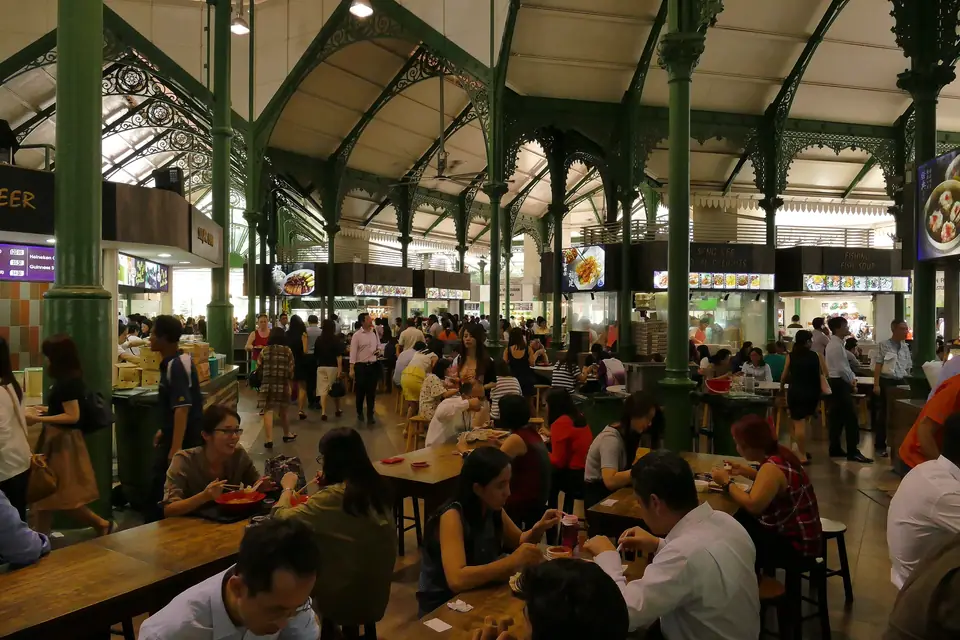
At the first columns of the radial aisle the iron stops being decoration. The slender Victorian columns with composite capitals support a roof of trusses, arches and brackets with very fine openwork. The ironwork cost £13,200 and the large load-bearing columns carry the maker’s mark of W. MacFarlane and Co. of Glasgow; sources do not fully agree on the division of roles between that foundry and P&W MacLellan, to which some attribute the shipment. In Singapore it was assembled by Riley Hargreaves & Co. for S$14,900, and the same MacFarlane foundry would make the verandas of the Raffles Hotel in 1913.
These pieces travelled twice. In 1986, by the most cited date, the monument was dismantled entirely and its pieces stored in a Jurong warehouse so the MRT tunnel works would not damage it. Once the line was finished, it was given new foundations, reassembled with funds from the Singapore Tourist Promotion Board and in 1989 was officially named Lau Pa Sat. Eight giant fans, installed in the 2013–2014 renovation, now turn slowly under the roof.
While the octagon was dismantled, an urban legend linked its eight-sided shape with the metro tunnels and with a coin. Lee Kuan Yew himself dismissed the feng shui as nonsense and the story is regarded as a baseless rumour. Among the columns, the audio guide reveals which coin it was and why the rumour caught on.
The hollow of the fountain and the old market
Central lantern
Summary of this stop
At the centre, under the glazed lantern, what is missing can be felt. Here, under the clock tower, there once stood a cast-iron fountain about six metres tall. In 1902 it was moved to the Orchard Road Market, later dismantled and vanished until 1989, when the Raffles Hotel restoration team found and authenticated its pieces. Today it presides over that hotel’s Palm Garden.
This centre is also the echo of Coleman’s octagon, twice the size of the original wooden market and formed by two concentric rings of brick pillars. In 1877 the English traveller Annie Brassey walked through it and wrote that its fish hall was the cleanest, tidiest and best-smelling she had seen, and that in the poultry section, because of the heat, everything was brought in alive, amid squawks, cackles and cock-a-doodle-doos.
The nickname “old market” is understood by contrast: “pa sat” comes from the Persian “bazaar”, through Malay “pasar”, and the “new market” was Ellenborough Market, which burned down on 30 January 1968. Under the lantern, the audio guide reviews the lineage of markets that preceded this one and why the old one is the only one of the five in the colonial centre still standing.
Charcoal satay on the old Japanese street
Boon Tat Street
Summary of this stop
As evening falls, Boon Tat Street closes to traffic and becomes Satay Street: since 1996, every night from 7:00 pm (weekends from 3:00 pm), nine carts grill over charcoal and the roadway fills with open-air tables. It is Singapore’s largest open-air satay street, and here, on 21 July 2007, 150 Kopitiam employees grilled a satay of 140.02 metres with 150 kilos of chicken, a Guinness record.
It is the continuation of what began in 1972, when the market stopped being a wet market to feed Shenton Way, Robinson Road and Raffles Place. After the S$4 million renovation completed in 2014, it has 54 stalls and 2,500 seats and receives between 15,000 and 20,000 people a day. The hawker culture practised under its roof was inscribed on 16 December 2020 on UNESCO’s Representative List of the Intangible Cultural Heritage, Singapore’s first inscription.
The street’s name, however, hides a past that was meant to be erased: Boon Tat Street was not always called that, and in 1946 it was renamed in honour of Ong Boon Tat. Amid the charcoal smoke, the audio guide closes the tour with the story of the old “Japanese street” and of the young women who worked on it.