National symbol
Merlion Park Audio Guide
A lion with a fish’s tail spouts water at the mouth of the Singapore River: it was born in 1964 as a tourism logo, carved by a sculptor and his eight children, and in 2002 had to fly over a bridge.
- 30 min of audio
- Icon and bay viewpoint
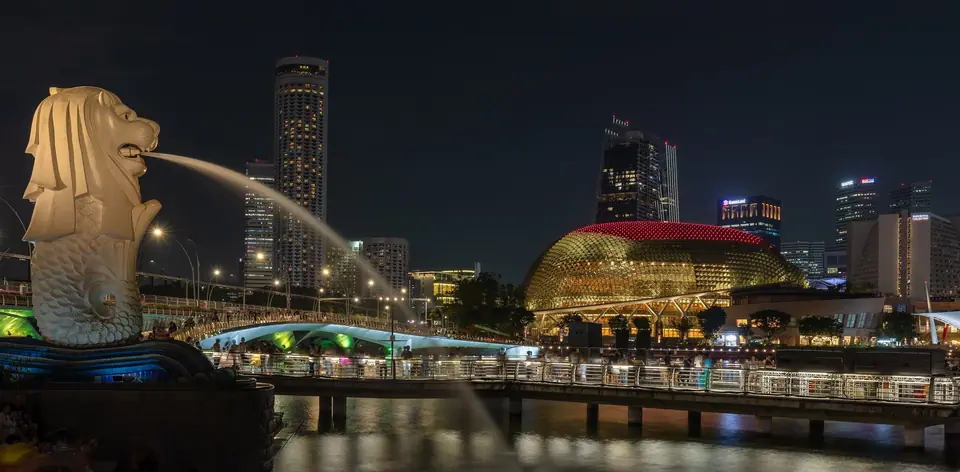
Merlion Park occupies a small promontory of reclaimed land at the mouth of the Singapore River, opposite the Fullerton Hotel. Here stands the Merlion, an 8.6-metre, 70-tonne white statue with a lion’s head and a fish’s body, which the sculptor Lim Nang Seng built between 1971 and 1972 from the logo that the zoologist Alec Fraser-Brunner drew in 1964 for the tourist board. Lee Kuan Yew unveiled it on 15 September 1972 and, exactly 30 years later, received it in this new park.
Singapore’s most photographed symbol carries an unexpected biography: a bridge blocked its view in 1997, an excavation revealed it was bigger than anyone thought, and the statue had to cross over the bridge slung from two cranes. In 2009 lightning knocked a piece off its mane, and in Japan it ranks among the “three great disappointments of the world”.
Highlights
- The Merlion — An 8.6-metre, 70-tonne white statue spouting water towards the bay, facing east
- Merlion cub — A 2-metre version with pieces of Chinese porcelain plates and bowls set into it
- Esplanade Bridge — The 1997 bridge that blocked its view and over which it flew in 2002
- Waterfront platform — The viewpoint for the classic photo of the spout, with the Fullerton and Marina Bay Sands behind
- Edwin Thumboo plaque — The poem “Ulysses by the Merlion” (1979), beside the statue
At the mouth of the Singapore River, on a pier of reclaimed land, the Merlion sends its jet of water towards Marina Bay. It is the image everyone associates with the city, and yet it has nothing of an ancient myth: it was born in 1964 as the logo of the Singapore Tourist Promotion Board, drawn by the British zoologist Alec Fraser-Brunner. The statue came later, between November 1971 and August 1972, from the sculptor Lim Nang Seng, and since 2002 it has stood in this park, opposite the Fullerton Hotel, 120 metres from its first site.
The history of Merlion Park is that of a logo turned national symbol. Authorship is shared and sources stress different people: the drawing by Fraser-Brunner, the design attributed to Kwan Sai Kheong, vice-chancellor of the University of Singapore, the carving by Lim Nang Seng with his children and, according to one source, the construction of the statue and its spout by Stanley Mok. To that biography are added a spectacular move, a lightning strike in the middle of a recession and a long debate, still open, about whether a tourist attraction can embody a country.
For what to see at Merlion Park, the audio guide covers the park in four stops and 30 minutes: the arrival from One Fullerton, the porcelain cub, the view of Esplanade Bridge and the platform over the water. The thread that links them is a spout photographed to exhaustion that was carved by a family, moved over a bridge and oriented by geomancy, and that Singapore has yet to decide whether to love.
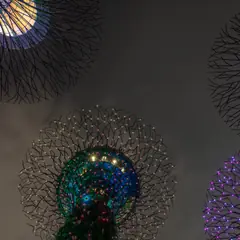
From the pier, across the bay, the Supertrees of Gardens by the Bay are in view; a few minutes away, beside the Padang, National Gallery Singapore occupies the old City Hall, and to the south the market of Lau Pa Sat recalls where the shoreline used to be.
A 1964 logo turned statue
Merlion Park
Summary of this stop
On arriving from One Fullerton the full silhouette appears: a lion’s head with a mane and a fish’s body with scales. Each half has its explanation. The head refers to the legend of Sang Nila Utama, the Sumatran prince who, landing around the early 14th century, saw a lion and called the island Singapura, “lion city”. The fish body evokes Temasek, the old name that in Javanese means “sea town”.
The legend, however, mentions no hybrid. The official sources themselves describe a “strange beast” that the prince took for a lion, and the half-lion, half-fish creature comes from the 1964 logo, registered as a trademark on 20 July 1966 and used until 1997. Before that date it is not recorded as a symbol of Singapore.
The advertising drawing ended up travelling the world. In 1987, the only time Singapore hosted Miss Universe, the contestants from 68 countries posed as a group beside the Merlion before a television audience of some 600 million viewers in 56 countries. At this first stop, the audio guide tells how a marketing commission became the face of a country.
Eight children and a porcelain cub
Merlion cub
Summary of this stop
Behind the big statue waits a miniature version: the Merlion cub, 2 metres tall and about 3 tonnes, with fragments of Chinese porcelain plates and bowls set in as part of the design. Lim Nang Seng made it alongside the main Merlion, which is 8.6 metres tall, weighs 70 tonnes and cost about S$165,000; the little one was moved to its side in 2002.
The scales have a family story behind them. Lim sculpted the Merlion with his eight children, aged between 11 and 23: the eldest climbed the wooden scaffold to work on the eyes and the youngest carved the scales and the fins of the tail, almost daily, before or after school.
The cub, moreover, exists because of a complaint. According to the family’s account, the tourist board chairman, film magnate Runme Shaw, noted that the Merlion, oriented according to feng shui, turned its back on anyone entering the park and did not allow a good photo. Lim’s response, off budget and decorated with a technique from Chinese temples, is what stands here. Next to the cub, the audio guide completes the story of its sculptor, who never got rich from his creature.
The 2002 flight over the bridge
View of Esplanade Bridge
Summary of this stop
From the park the Esplanade Bridge is in view, opened in 1997 to link the city centre with Nicoll Highway and Marina Centre. That was the problem. The Merlion had been unveiled on 15 September 1972 at the river mouth, with Anderson Bridge in the background, on the site now occupied by Waterboat House Garden, on the other side of the bridge. Reclaimed land had already left it outside the river mouth, in the 1990s salt water corroded its pump and it stopped spouting from time to time, and in 1997 the new bridge blocked its view from the bay.
Eight sites were studied, including Esplanade Park, Marina Centre and the tip of Bayfront, and a newly reclaimed promontory 120 metres from the original was chosen, which kept it at the river mouth where legend places Sang Nila Utama’s lion. The plan was to pass it under the bridge on a barge. But during the move, from 23 to 25 April 2002, the excavation turned up 0.6 metres more reinforced concrete than had been thought, and the statue had to cross over the bridge slung from two cranes, about five minutes in the air. Sources disagree on the capacity of those cranes.
The orientation was not left to chance either. According to a well-documented tradition, in 1972 a feng shui master turned the statue until he found what he called the “dragon position”, facing the world, and in 2002 it was set again facing east. In front of the bridge, the audio guide relates that gaze to the country’s fortunes and to what was left buried under the new foundations.
The spout that must never stop
Merlion
Summary of this stop
The platform that juts out over the water is the stage for the classic photo: visitors position themselves so the spout seems to fall into their mouths or hands, with the Fullerton Hotel, the towers of Raffles Place and, across the water, Marina Bay Sands behind. Behind the pose runs a belief tied to feng shui: water that flows without stopping stands for an endless flow of prosperity for the country. That is why the new park, four times larger than the original and opened on 15 September 2002 by Lee Kuan Yew, by then Senior Minister, included a double pump with one unit always on standby. The move and the park cost S$7.5 million.
The mane holds an invisible scar. On 28 February 2009, in a downpour, lightning knocked a piece off the head, which on falling punched a hole in the wave at the base. The statue had no lightning protection, was closed for a month and spouted again on 18 March 2009.
Nearby, a plaque reproduces “Ulysses by the Merlion” (1979), the poem by Edwin Thumboo that fixed the Merlion as the personification of Singapore and set off so many replies, many of them ironic, that local poets joke that nobody is a Singaporean poet until they have written their “Merlion poem”. The symbol is still debated: in Japan it appears alongside the Little Mermaid and Manneken Pis among the “three great disappointments of the world”, and in local slang “merlion” means to vomit. On the platform, the audio guide closes with what the city debated doing about the wounded head before patching it up.