National monument
Sri Mariamman Temple Audio Guide
Singapore’s oldest Hindu temple, founded in 1827 in the heart of Chinatown by a Tamil pioneer who arrived with Raffles: its five-tier tower covered in gods gave Pagoda Street its name and its courtyard turns into a bed of embers every year.
- 30 min of audio
- Hindu temple
The Sri Mariamman Temple began in 1827 as a structure of wood and attap, palm leaves, built by Naraina Pillai, the first Indian immigrant recorded on the island. Around 1843 it was rebuilt in brick with Indian convicts and craftsmen from Madras and China, and in 1862–1863 craftsmen from Nagapattinam and Cuddalore built the structure that forms the base of the present temple. In 1973 it was declared a national monument, the sixth on Singapore’s list.
Behind the polychrome facade lies a very earthly history. The temple housed newly arrived immigrants, married and registered a whole city, and defended its fire-walking in the courts when the colonial police tried to ban it. More than a century later, the goddess’s gold was at the centre of a court case that ended with a priest sentenced to six years in prison.
Highlights
- South Bridge Road gopuram — A five-tier entrance tower covered in polychrome sculptures of gods and guardians
- Bell-studded doors — A great wooden door studded with golden bells that worshippers ring on entering
- Sinna Amman — The small goddess installed in 1827, at the feet of the larger image of Mariamman
- 1831 tablet — A stone slab recording the land donated to extend the compound
- Theemithi courtyard — Setting of the fire-walking that the temple has hosted since 1840
On South Bridge Road, in the heart of Chinatown, the Sri Mariamman Temple is Singapore’s oldest Hindu temple. Its story begins in May 1819, when Naraina Pillai, a former East India Company clerk in Penang, disembarked from the Indiana alongside Stamford Raffles. He was the first Indian immigrant recorded on the island, and in 1827 he built here a first temple of wood and attap dedicated to Mariamman.
The history of the Sri Mariamman Temple is that of a building rebuilt several times without losing its centre. Around 1843 the wooden temple gave way to a brick one, built by Indian convicts and craftsmen from Madras, with Chinese craftsmen also on the job; in 1862–1863 craftsmen from Nagapattinam and Cuddalore built the structure that is the base of the present one. In colonial times it was also a shelter for newly arrived immigrants and a register of Hindu weddings and deaths. The Preservation of Monuments Board declared it a national monument in 1973, the same year as the Chinese temple Thian Hock Keng.
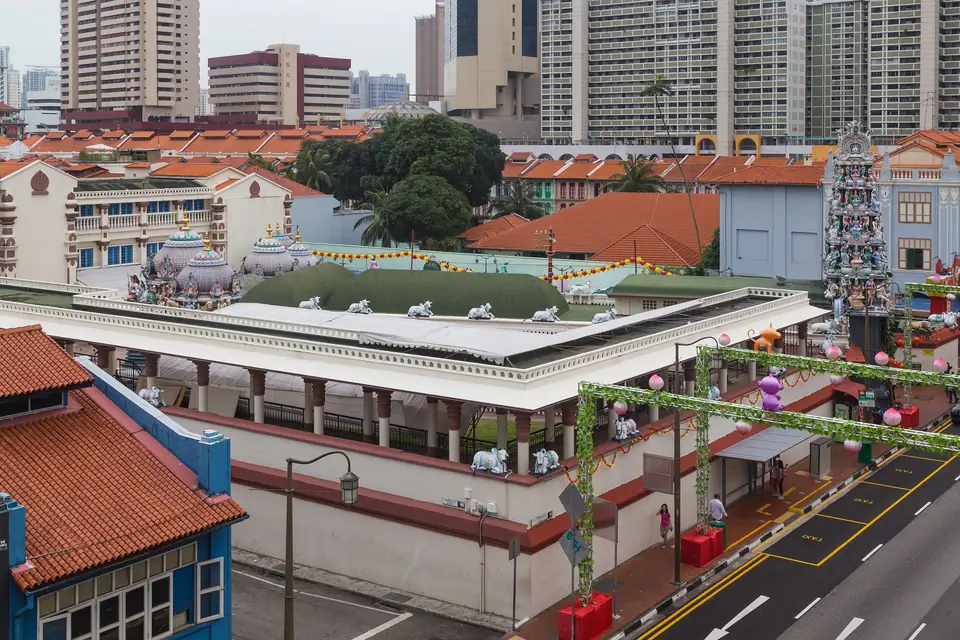
The architecture of the Sri Mariamman Temple can be read from the street: the five-tier gopuram, covered in polychrome sculptures, the sacred cows on the wall, the coloured domes marking each shrine and, inside, frescoed ceilings repainted before each consecration. The latest, in February 2023, drew about 20,000 people after a S$3.5 million restoration.
For what to see at the Sri Mariamman Temple, the audio guide covers it in four stops and 30 minutes, from the tower on the facade to the fire courtyard. The thread that links them: this temple was at once a gateway, a civil registry and the stage of a rite the colony tried to extinguish, and its tower ended up naming the street next door.
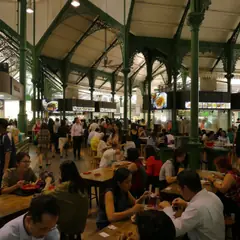
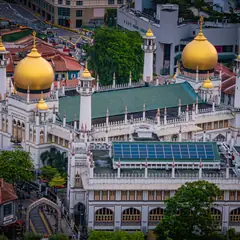
A few minutes’ walk away, the iron market of Lau Pa Sat completes the stroll along the old Telok Ayer shoreline, and in Kampong Glam the Sultan Mosque tells the story of another of the city’s founding communities.
The pagoda that was not a pagoda
South Bridge Road gopuram
Summary of this stop
Facing South Bridge Road rises the gopuram, the five-tier entrance tower covered in gods, mythical animals and guardians. Each tier is slightly smaller than the one below, a trick that exaggerates the height. It was not always so: the original three-tier tower was slimmer and almost undecorated, and it was replaced by the present one between 1925 and 1936, although sources disagree on the exact dates. The profusion of polychrome plaster figures that covers the tower today arrived in the 1960s.
The tower named the neighbourhood. The two streets flanking the temple are called Temple Street and Pagoda Street, and the latter owes its name to the fact that the Chinese population thought the gopuram looked like a pagoda. In Hokkien the street had another name, which placed it “behind the Kling place of worship”.
Among the facade’s figures there were for decades some unexpected guardians, removed in the 1971 works and replaced by figures in traditional Indian dress. In front of the gopuram, the audio guide tells who stood guard at the base of the tower and why their absence is also part of the facade.
Bells, a tablet and a walkway after the fire
Bell-studded wooden doors
Summary of this stop
Under the tower opens an enormous two-leaf wooden door studded with a grid of golden bells, which worshippers ring on passing; shoes are left beside it, because the compound is visited barefoot. The plot behind was not the first choice. A first site on Telok Ayer Street was rejected for lacking fresh water nearby for the rites, and sources differ on whether Naraina Pillai himself or the Hindu community discarded it; a second, beside the Stamford Canal, was reserved for other uses. The present one was granted in 1823, within the first plan of the city, by Philip Jackson.
Inside the compound a stone tablet with an inscription still stands, recording the land donation of March 1831, when the Indian landowner Seshasalam Pillai gave the plot that enlarged the temple. And between the tower and the shrine runs a covered walkway with its own history: the attap one that preceded it burned in 1910, and in 1915 the new one was commissioned from the firm Swan & Maclaren.
Beside the doors, the audio guide reconstructs how a pioneer who arrived with Raffles ended up looking for fresh water for a goddess, and what remains in stone of that plot.
A small goddess and her pawned jewels
Mariamman shrine
Summary of this stop
The mandapam, the main hall, is long and flanked by square columns; on its frescoed ceilings appear a great mandala and panels with Ganesha and Saraswathi. At the far end, facing the entrance, the image of Mariamman with a trident has been lit since 2023 by oil lamps instead of electric ones. At her feet is the Sinna Amman, the “small goddess”, the tiny image that Naraina Pillai installed in the wooden temple of 1827 and which has survived every rebuilding.
That shrine also keeps a dark episode. In the sanctum’s safe are kept about 255 gold jewels with which the deities are adorned at major ceremonies. From 2016, the priest who held the keys began taking them to pawnshops and retrieving them before each audit; in 2023 he was sentenced to six years in prison. All the jewels came back and the temple lost nothing.
In front of the main shrine, the audio guide tells how a pandemic and an excuse about a forgotten key exposed the case.
The fire courtyard that won a lawsuit
Draupadi shrine and Theemithi courtyard
Summary of this stop
In front of the shrine of Draupadi, the second in importance, with the five Pandavas at her side, stretches the courtyard where a pit of embers is dug every year. Since 1840, by the most cited date, the temple has hosted the Theemithi: each October or November worshippers walk 4 km in procession from the Sri Srinivasa Perumal Temple on Serangoon Road, and the men cross a bed of embers of about 5.5 metres barefoot before stepping into a pit of milk, in honour of Draupadi. Today only men walk on the fire, but in Singapore women did too until the early 20th century.
The rite came close to being banned. In October 1893 the colonial police sought an injunction after learning that a devotee had fallen into the pit, and the temple responded by hiring Walter John Napier, co-founder of the law firm Drew & Napier, who won by defending the right of Hindus to practise their rites without government interference. Today the pit’s safety is in the hands of volunteers.
This courtyard also sums up the temple’s role in the colonial city: newly arrived Indian immigrants were lodged here, and only its priests could conduct Hindu weddings in Singapore. In the fire courtyard, the audio guide closes the tour with the lawsuit that saved the Theemithi and with what those who now look after the embers have to say.