Colonial market of 1926
Bogyoke Aung San Market Audio Guide
A bazaar from 1926 that has carried three names, a Scottish commissioner's, the Japanese occupation's and the father of independence's, without ever ceasing to be the place where Yangon has haggled for a hundred years.
- 60 min of audio
- Colonial architecture
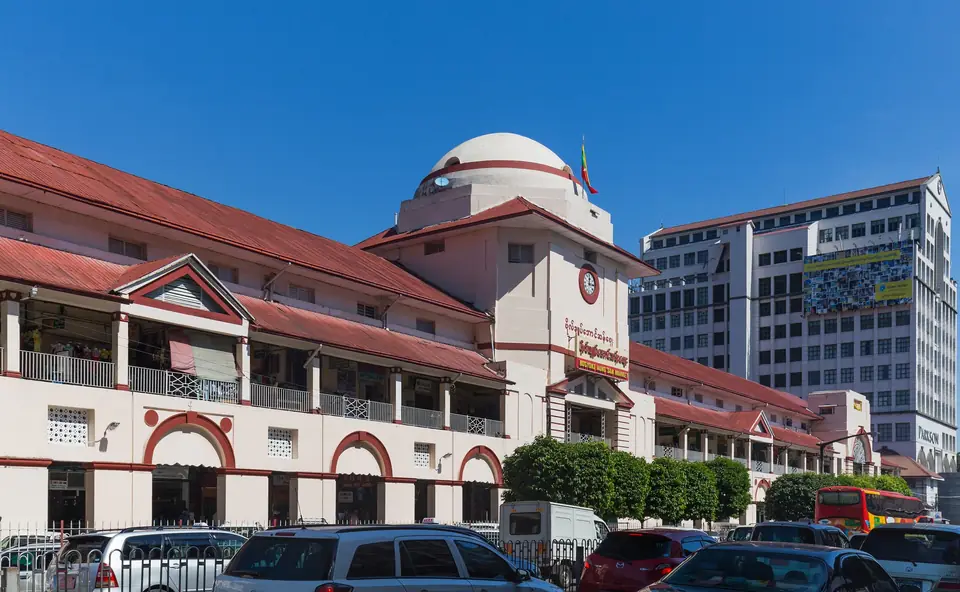
Built in 1926 by the Rangoon Municipality on a site of former entertainment halls, Bogyoke Market keeps its colonial façade of iron arches, dome and loggias facing Bogyoke Road. Behind it opens a small city of seven parallel halls, cobbled lanes and more than 1,800 shops selling jade, silk, cotton, antiques, paintings and crafts. It is on the municipal heritage list and since 2017 has borne one of the Yangon Heritage Trust's blue plaques.
Its history is read in its names: Scott Market after a commissioner who did not want the honour, Yan Naing Zei during the Japanese occupation and Bogyoke Aung San after independence, although many locals still say Scott's. And in its stalls the country's politics have been read too: the portrait of Aung San Suu Kyi went from unthinkable to bestseller and back to dangerous in little more than a decade.
Highlights
- 1926 façade on Bogyoke Road — two-storey arcade, dome and iron arches
- Three names in a century — Scott Market, Yan Naing Zei and Bogyoke Aung San
- Seven halls and cobbled lanes — balconies crossing from one section to another
- Western jade wings — gems, rubies and silver among more than 1,800 shops
- Roof tiles stamped Marseille and Mangalore in the east section
Few buildings in Yangon sum up Burma’s last century as well as its great market. In 1926 the Rangoon Municipality, predecessor of today’s Yangon City Development Committee, built a new municipal market where the colonial city’s entertainment halls had stood and christened it Scott Market. Since then it has changed names with the flags, but not its trade: today more than 1,800 shops of jewellery, antiques, paintings, silk, cotton, crafts and food operate in it, spread across 21 sections.
Anyone asking what to see at Bogyoke Market will find much more than a souvenir bazaar. The architecture of Bogyoke Market combines a colonial skin of iron arches with parallel halls, cobbled lanes uncommon in Yangon and extensions that imitate the original design. Its history includes municipal votes, the Japanese occupation, independence, the black market in foreign currency and the blue plaque that recognised it as heritage in 2017. The full tour, documented, researched and checked against historical sources, is best enjoyed walking among its halls with the audio guide.
The market’s name refers to Aung San, assassinated in 1947 at the Secretariat; about 700 metres away is Sule Pagoda, and the Chaukhtatgyi Buddha Temple completes the day in the north of the city.
A cinema, an iron façade and a Burmese blessing
Bogyoke Aung San Market
Summary of this stop
Facing Bogyoke Road rises the main hall, separated from the street by a fence and a narrow car park. It keeps the colonial skin of 1926: an open two-storey arcade, a dome, first-floor loggias and a series of ornamental iron arches along the façade. Just to the west looms the great brick Anglican Holy Trinity Cathedral, another piece of that British Yangon.
What the façade does not tell is what stood here before. This site held the colonial city’s entertainment halls, among them a cinema called the Cinema de Paris. In 1926 the Municipality replaced it with the new great market, dedicated to the municipal commissioner Scott.
Beside the main entrance, a blue plaque from the Yangon Heritage Trust, the city’s 16th, records that the market is on the Yangon City Heritage List. Its unveiling, in January 2017, took an unexpected turn for a custom of London origin: according to the account of that day, the gesture used to wish the old market good fortune was purely Burmese, and that detail is revealed by listening to the narration right there.
Scott, Yan Naing and Aung San: a market with three names
Central hall of iron arches
Summary of this stop
The axis of the central hall is a long aisle under a high arched iron roof, full of small stalls of souvenirs and crafts. Beneath the echo of haggling lies the story of a disputed name. Gavin Scott, municipal commissioner of Rangoon from 1922 to 1930 and at the end of 30 years of career administering the city, did not want the market to carry his name; the Rangoon Corporation rejected the alternative “Municipal Zegyi” and voted for his name unanimously. Some websites still attribute the name to Sir James George Scott, the British administrator and writer who introduced football to Burma, although sources based on B. R. Pearn’s History of Rangoon and on the Rangoon Gazette point to Gavin Scott.
In 1940 the young nationalist U Ba Hlaing proposed calling it Mingala Market, “auspicious” in Pali, because Burma’s public institutions ought to have Burmese names; the Public Health and Markets committee rejected it by three votes to two. During the Japanese occupation (1942–1945) it was renamed Yan Naing Zei, and after independence in 1948 it received the name of General Aung San, although many locals still say Scott’s.
The Japanese-era name was no accident: it honoured Bo Yan Naing, one of the Thirty Comrades who trained with Aung San to drive out the British, a hero of the battle of Shwedaung in 1942. Years later, that comrade-in-arms would end up in the jungle, leading a guerrilla force against the regime of another of the Thirty Comrades. How those two biographies cross beneath these arches is one of the episodes the audio guide holds.
Jade, cobblestones and a clandestine bank
Cobbled jewellery lanes
Summary of this stop
Beyond the façade, the market is organised like a small city: seven parallel halls separated by cobbled lanes, a paving uncommon in Yangon. In some stretches, balconies on the upper floor cross over the lanes and make it possible to pass from one section to another without going down to the street.
The 21 sections are arranged, roughly, by product. The western wings belong to jewellery and gems, with displays of rubies, silver and, above all, Burmese jade, omnipresent in every case.
Among those display cases another, less visible business ran for years. According to a well-documented custom in the city, the market was one of Yangon’s places to change dollars on the black market, at rates better than the official ones, and who offered the best price for large bills is a wink the narration reveals in the lane itself.
Marseille tiles and green sheeting: a hundred years of growth
Stamped tiles in the east section
Summary of this stop
On the east edge, beside Parkson, a lane preserves structures that look like the original pavilions. There the roof tiles betray the imperial network that built the market: some came from Marseille-Saint André, in France, from the house of Guichard-Cauvin, and others from the Basel Mission of Mangalore, in India, with the stamp “Patent 1865”.
The market never stopped growing. In the 1990s a new wing was added across Bogyoke Market Road, and towards the interior the extensions of corrugated sheeting painted green imitate the iron arches of the original façade; further back, the rusted sheeting is covered with blue tarpaulins.
From 7 to 11 October 2026 the market celebrated its centenary with a five-day festival, more than 100 stalls, a thanaka exhibition and a puppet theatre. What those tiles say about how a Burmese market was built from the pieces of half an empire is the close of the tour.