Heart of colonial Yangon
Sule Pagoda Audio Guide
A golden eight-sided stupa planted in the middle of a roundabout: from it the British laid out modern Yangon, and around it the city came out to protest in 1988, 2007 and 2021.
- 30 min of audio
- 15th-century Mon stupa
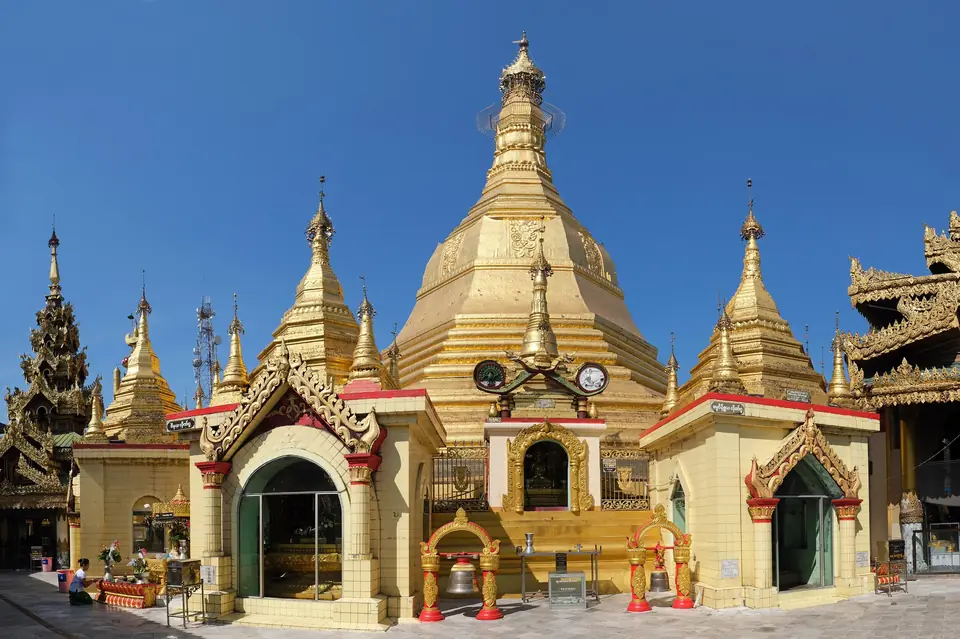
Sule Pagoda is one of the oldest stupas in Yangon and, at the same time, the zero point of its modern layout. Tradition attributes to it a hair of the Buddha, the Mon-style chedi owes its present size to Queen Shin Sawbu in the 15th century, and in 1852 Lieutenant Alexander Fraser chose it as the centre of the street grid the British laid out on the marshy bank of the Yangon River.
Few pagodas live so close to the street: traffic circles around it, watchmakers, locksmiths and fortune-tellers work at ground level, and the roundabout around it has been the stage of Burma's great protests. Above, a moustached guardian spirit receives promises from traders who pay for his favours in longyi and jackets.
Highlights
- Octagonal Mon-style stupa — about 44 m, with eight sides from base to bell
- Centre of the colonial grid — chosen in 1852 by Lieutenant Alexander Fraser
- Square of protest — 1988, 2007 and 2021 on the same roundabout
- Ring of shops — watchmakers, locksmiths and astrologers at the foot of the chedi
- Sule Bo Bo Gyi — the guardian spirit paid in longyi and jackets
Sule Pagoda is not in the middle of the traffic by chance. Its Mon name, Kyaik Athok Ceti, means “stupa where a sacred hair is kept”: it is said to hold a hair of the Buddha given to the merchants Tapussa and Bhallika, the same relic that tradition shares with Shwedagon. How many centuries old it is remains a matter of debate: Buddhist tradition places its founding in the Buddha’s lifetime, more than 2,500 years ago, and other versions take it back to the Mon period of the 10th century. What is documented is that the Mon queen Shin Sawbu, who reigned from 1453 to 1472, enlarged the chedi to its present size. Even the origin of the name “Sule” is disputed: some derive it from su-way, “to gather”; others from brambles or from the Pali cula ceti, “small pagoda”.
To understand the history of Sule Pagoda one has to look beyond its gold. In 1852, after the Second Anglo-Burmese War, the British made it the axis of a new city; after 1988 the military junta built footbridges over its junction; and in 2007 and 2021 the roundabout filled with crowds again. The audio guide walks the pagoda from the outside in, from a footbridge over the avenue to the stupa platform, in narration documented and checked against historical sources.
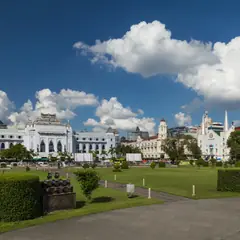
The roundabout borders Maha Bandula Park, the former Fytche Square, and following the colonial grid towards the river leads to Botahtaung Pagoda, another of the city’s Mon stupas.
The pagoda Fraser made the centre
Anawrahta Road footbridge
Summary of this stop
The tour begins on top of the Anawrahta Road footbridge, the best frontal view of the Sule. From here the plan makes sense: after the war of 1852, Lieutenant Alexander Fraser of the Bengal Engineers chose the pagoda as the heart of the new street grid. The avenue that bore his name, Fraser Street, is today’s Anawrahta Road. The Montgomerie-Fraser plan declared urban land government property and divided it with 30.5-metre streets into blocks of 244 by 259 metres; Commissioner Arthur Phayre ordered earlier property titles not to be recognised.
Another version circulates in Burmese popular memory: that it was Queen Victoria who forbade the demolition of the Sule and ordered the layout to go around it. Studies of the 1852 plan record no intervention by the queen and attribute the design to Montgomerie, Fraser and Phayre’s policy.
The footbridge itself has a history. It was built under the plans of the SLORC, the military junta after 1988, designed so that soldiers could fire from above. In 2007, some of the most powerful images of the Saffron Revolution were taken from these same bridges. How that double life of the bridge fits with the street it overlooks is something the narration reveals on the spot.
1988, 2007, 2021: always this roundabout
Yangon City Hall
Summary of this stop
From the corner by the City Hall, facing the pagoda, the junction shows its neighbourhood: a church, a mosque, the City Hall at the northeast corner and, at the southeast, Maha Bandula Park with the Independence Monument. It looks like just another downtown junction, but it is the main square of Burmese protest. On 3 August 1988, between 5,000 and 10,000 young people with scarves over their faces marched from Shwedagon and dispersed before the Sule. On 8 August, the pagoda and the City Hall awoke guarded by armed soldiers; the crowd, of more than 5,000 people, did not disperse at nightfall, and residents of the City Hall reported people wounded by gunfire.
On 24 September 2007, up to 100,000 people marched through Yangon with the Sule and Shwedagon as their centre. Two days later, around three in the afternoon, security forces opened fire on monks at the Sule while the city’s mobile phones were cut off. The death toll of that crackdown is still contested: nine according to state media, some two hundred according to witnesses. In February 2021, in the largest protest against the military coup, marches from different neighbourhoods converged on this same roundabout, and on the 17th the member of parliament Sithu Maung spoke here before tens of thousands of people.
The stop also holds the darkest episode: the camera of the Japanese video journalist Kenji Nagai, killed on 27 September 2007 when troops opened fire on demonstrators around the Sule; sources disagree on the exact spot. The camera vanished with his last images and resurfaced sixteen years later, in 2023, after a secret journey out of Myanmar. What that tape contains, and the last sentence he left recorded, can be heard on site.
Fortune-tellers and watchmakers on a trimmed island
Ring of shops at the base
Summary of this stop
At the entrance gate one crosses a threshold between the colonial city and the precinct that, according to tradition, keeps a hair of the Buddha. In 1852 the Sule stood on an island in the marshy bank of the Yangon River, joined to the city by a small bridge; sources disagree on whether it was of wood or stone. The British drained those banks to build today’s centre, relocated 50 monasteries from the surroundings and trimmed the pagoda’s mound down to a small hill.
Today that hill rests on a ring of brick premises, where there used to be an iron fence, and the stupa seems to float on a crown of shops. Astrologers and palm readers work there, keys are cut and passport photos taken. A watchmaker with a workshop at the base sums it up this way: there are always people and good karma. The flowers, fruit and gold leaf that devotees offer above are bought in these same shops, and the audio guide tells how that neighbourliness between faith and trade fits into the pagoda’s daily life.
Eight sides of gold and a moustached grandfather
Golden octagonal stupa
Summary of this stop
On the platform appears the golden stupa, a Mon-style chedi of about 44 metres whose octagonal plan, with sides of 7.3 metres, is kept from base to bell, something exceptional among Yangon’s pagodas. Apart from Shin Sawbu’s stupa, almost nothing in the precinct is more than a little over a century old. Around it hang ten bronze bells of different sizes and periods, with the names of their donors and the date of the offering engraved.
The gold is renewed every five years. In the renovation from December 2015 to March 2016, craftsmen on bamboo scaffolding covered the tower with several hundred solid gold plates, worth about 1,100 dollars each, and thousands of gold leaf sheets paid for by devotees.
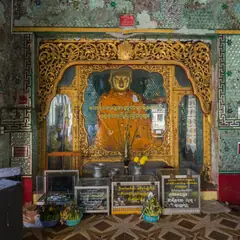
The close comes with the most vibrant ritual of the precinct: Sule Bo Bo Gyi, the statue of the guardian spirit, an old man with a moustache and a thoroughly human look. Many consider him the owner of central Yangon; traders and people in trouble make him a promise before a venture and, if it goes well, offer him a paso, the Burmese men’s longyi, a jacket, a scarf or money. His caretakers warn that he protects above all those who keep the five precepts. Before the war a love song dedicated to him even became popular, and its lyrics are one of the secrets the narration saves for the end.