Colonial history
Secretariat Audio Guide
From this red-brick palace the British Empire governed Burma; in its rooms Aung San was assassinated in July 1947 and, less than six months later, in its courtyard the flag of an independent country was raised.
- 40 min of audio
- Victorian architecture
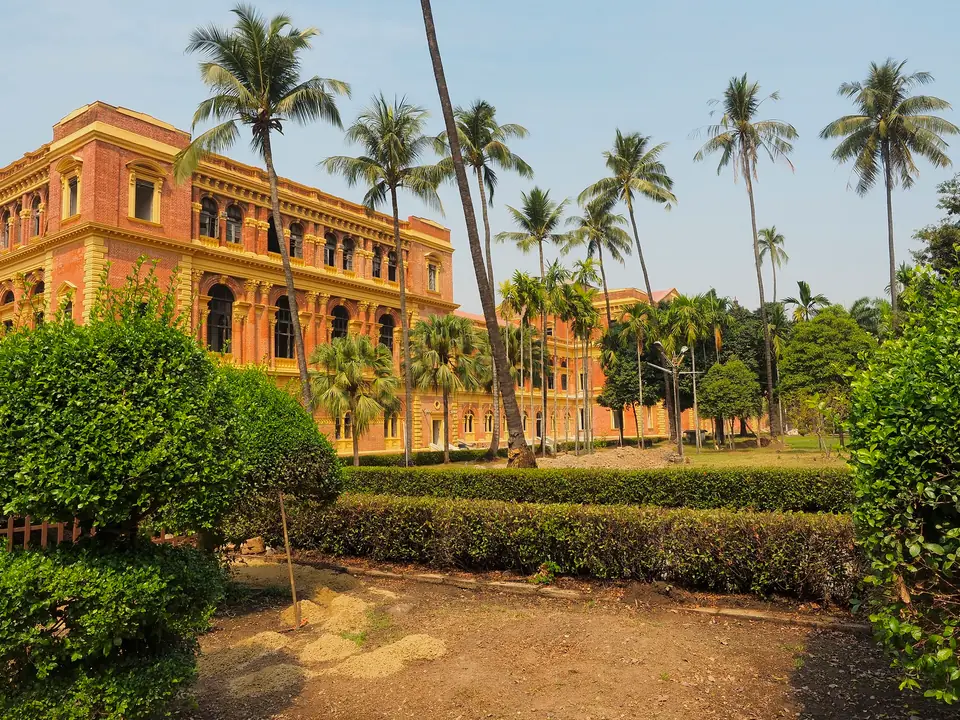
The Secretariat fills an entire block of central Yangon. It was built in phases between 1889 and 1905 to plans by the engineer Henry Hoyne-Fox, when the annexation of Upper Burma overwhelmed the colonial bureaucracy. Victorian red-brick façades, cast-iron stairs brought from Glasgow with Burmese teak and tiles shipped from Marseille tell of the ambition of an empire that wanted to govern the whole country from here.
The same building that saw Burma's first prime minister take office in 1937 was the scene of the 1947 assassination: the Executive Council room, now a Buddhist shrine, still has the bullet holes. Closed for decades by the military junta and almost abandoned after the capital moved, the complex opens every 19 July, Martyrs' Day, while the whole city stops at 10:37.
Highlights
- Executive Council Room — the room where Aung San fell, with bullet holes and a Buddhist shrine
- Double spiral staircase — Glasgow cast iron and teak beneath the light of a lost dome
- Courtyard flagpole — the Union Jack came down at 4:20 on 4 January 1948, an hour chosen by astrologers
- Towers that survived the 1930 earthquake, which brought down the main dome
- Bo Aung Kyaw Street — named for the student who died after the 1938 blockade
Few buildings condense so much of a country’s history into so little time. In Yangon’s Secretariat, the immense Victorian red-brick complex built between 1889 and 1905, the British Empire administered Burma for decades. Here Ba Maw, the country’s first prime minister, took office in 1937; here, on 19 July 1947, armed men burst into a meeting of the Executive Council and killed Aung San; and here, on 4 January 1948, the Union Jack came down from its pole to make way for the flag of the Union of Burma.
Anyone looking for what to see at the Secretariat will find much more than a colonial façade: an architecture of Glasgow iron, Burmese teak and Marseille tiles marked by an earthquake, a room turned into a shrine that still keeps its bullet holes and a courtyard where the end of an empire was written. After independence it was the seat of government and, from 1962, of Ne Win’s junta, which closed it to passers-by; afterwards it was left almost abandoned. Its history, documented and checked against historical sources, unfolds stop by stop in the audio guide, taking in the complex from the street to the courtyard.
The independence sealed in this courtyard has its obelisk in Maha Bandula Park, about 700 metres away, and Aung San’s title, “Bogyoke”, gives its name to Bogyoke Aung San Market.
A colonial giant settled on mud
Red-brick south façade
Summary of this stop
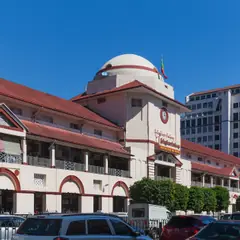
Facing Maha Bandoola Road stretches the south façade: two storeys of red brick with artificial-stone trim and lime stucco, and central and end blocks rising to three. Its origin is almost administrative: after the annexation of Upper Burma in 1886, the colonial bureaucracy overwhelmed the old Secretariat on Strand Road and another had to be built to the measure of the new territory. The plans bear the signature of Henry Hoyne-Fox, a Public Works engineer; sources do not fully agree on the exact start and end dates of the work.
Behind the bricks lies a family story. Construction was begun by a contractor of North Indian origin who died in a train accident in 1894, and finished by his son, Baboo Naitram Rambux, who inherited the business and the commission.
The south wing, the first to go up (1889–1893), was set on waterlogged ground stabilised with enormous timber logs. More than a century later, the ground still shows signs: in the monsoon large puddles form and in places the building looks slightly out of level. What those unevennesses say about the whole is best understood in front of the façade, with the narration of the first stop.
Bo Aung Kyaw Street and the 1938 student blockade
Bo Aung Kyaw Street
Summary of this stop
The west side of the complex is flanked by a street named for a student. In 1937, when the Government of Burma Act separated Burma from British India, the Secretariat was where Ba Maw took office as prime minister: a first taste of self-government in the very heart of the colonial administration.
Barely a year later, on 20 December 1938, more than ten thousand students surrounded the building and blocked its entrances. Around one in the afternoon the office had to close, and a mounted police charge left more than 200 injured. One of them, the student leader Aung Kyaw, died two days later from the beating.
He received the title “Bo”, and the street that now skirts the Secretariat bears his name. Very little time separates the swearing-in from the mounted charge, and the audio guide walks through that contrast from the very pavement where it happened.
Glasgow iron beneath a dome that no longer exists
Double spiral staircase
Summary of this stop
In the cylindrical drum of the south wing’s central tower winds a double spiral staircase of cast iron and teak, with floral-motif handrails. The balustrades came from Glasgow and were combined with Burmese timber; today it is lit by an open skylight where a brick dome once rose.
That overhead light is the mark of the magnitude 7.3 earthquake of 5 May 1930, which damaged the Secretariat more than any other official building in Yangon: it cracked the pillars holding up the main dome, and neither the dome nor a good part of the towers could be saved. The exact count varies by source, as does the location of the fallen dome, but the surviving corner towers and the gaps of those that are missing are an absence that can be read from the courtyard.
A disputed story also hangs over the staircase: it is said that the assassins of 1947 went up this double-spiral stair, although recent visits point to another, the grand main staircase, as their escape route. Which version holds up better is one of the questions the audio guide poses at the foot of the steps.
The Executive Council Room, where Aung San was assassinated
Executive Council Room
Summary of this stop
In the west wing is the Executive Council Room. On 19 July 1947, around 10:37, a group of armed men in military uniform burst into the Executive Council meeting and killed Aung San, aged 32, and others present; sources differ on the number of victims. The former prime minister U Saw was convicted as the instigator and hanged in Insein prison in 1948, although the intellectual authorship of the crime remains a matter of debate.
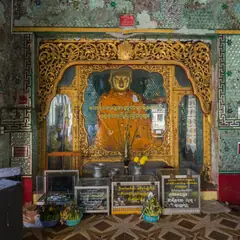
The room keeps bullet holes and now houses a Buddhist shrine; the exact spot of the killing has been known since 2016. Among the memories of that morning is a documented testimony: that of a 24-year-old clerk who had gone down with a friend to a nearby tea shop and, on hearing the shots, ran back up to the room. He told it in 2015, at the age of 93.
What he saw on the steps and behind the door is heard at the fourth stop, in front of the same room, where the scene loses the distance of books.
The dawn the Union Jack came down
Courtyard flagpole
Summary of this stop
In the U-shaped courtyard, before the Parliament Building, seat of the first parliament of independent Burma, stands the flagpole. On 4 January 1948, at 4:20 in the morning, an hour chosen by astrologers, the Union Jack came down to the strains of God Save the King and the flag of the Union of Burma was raised.
A few metres from the mast, a small brick monument remembers the seven ministers assassinated in 1947. That July morning two men who were not ministers also died: the secretary Ohn Maung and Ko Htwe, bodyguard of the minister Abdul Razak.
Between the flagpole and the memorial lie only a few steps and less than six months of history. The audio guide places both scenes in the same courtyard where they happened.
Rescued façades and the minute of horns on 19 July
North-front buildings
Summary of this stop
Along the north side stand the old two-storey staff blocks. They were roofless and in ruins; today they keep their façades with new interiors. Their decay has a history: from 1962 the compound was the seat of Ne Win’s junta, which closed it to passers-by, and in 1972 it was renamed the Ministers’ Office. With the capital’s move to Naypyidaw in 2005 it was left almost abandoned, Cyclone Nargis damaged several roof sections in 2008 and in 2015 Anawmar Art Group obtained a 50-year lease to restore it.
Every 19 July, Martyrs’ Day, Aung San’s office and the room of the assassination are opened to the public. On the 70th anniversary, in 2017, 42,101 Burmese and 205 foreigners came, and the labelled chairs of the martyrs, pens, watches and original cigarette packs were displayed.
On that same day, at 10:37, Yangon stops: sirens sound, cars brake and drivers sound their horns for a minute. It is a living ritual with a history of its own of silences and disobedience, and the audio guide’s last stop tells how a minute of noise came to be a political gesture.