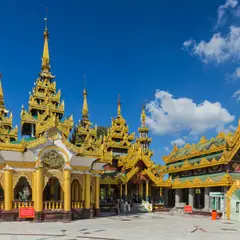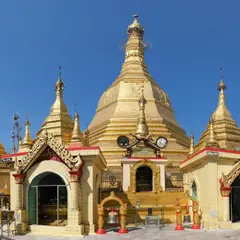
Buddhist pagoda
Botahtaung Pagoda Audio Guide
A golden stupa beside the Yangon River that the bombs of 1943 reduced to ruins and that was reborn hollow: inside, a labyrinth of gold and glass leads to a hair attributed to the Buddha.
- 40 min of audio
- Stupa that can be entered
Botahtaung Pagoda stands on the rise of the riverbank where, as its name says, a thousand officers received the Buddha's relics brought from India. Kings such as Tabinshwehti and Singu repaired it over the centuries, until in November 1943 the RAF, bombing the Japanese-held port, left it in blackened ruins. It was rebuilt in reinforced concrete from the very day of Burma's independence, in 1948, to the original design and its 40 metres of height.
What is unusual about its architecture is that this stupa is not solid: one walks into it. A zigzag corridor of glass mosaic and gold leaf leads between display cases holding the treasure found under the rubble to the hair chamber. Outside, in the precinct, another story waits: that of a woman from Mogok revered as the pagoda's guardian, whose statue a dictator had handcuffed every night.
Highlights
- Hollow stupa — an interior labyrinth of glass mosaic and gold leaf
- Treasure of 1948 — about 700 images of gold, silver, brass and stone found in the ruins
- Golden chamber — a hair attributed to the Buddha in a reliquary of ivory, gold and diamonds
- Mya Nan Nwe shrine — the guardian whose statue was handcuffed every night
- King Mindon's bronze Buddha — cast in 1859 and returned by Britain
Almost all of Burma’s stupas are solid and closed: they are circled and revered from outside, but nobody goes in. Botahtaung Pagoda is the exception, and its history explains why. On this bank of the Yangon River stood a Mon stupa that, according to tradition, had kept relics of the Buddha since remote times; the date of its founding is still debated, between the roughly 2,500 years of local belief and the roughly 1,500 that place it in the time of the Mon king Sihadipa of Thaton. On 8 November 1943, a RAF bombing raid on the neighbouring docks destroyed it completely.
From those ruins came a buried chamber, a stone casket that nobody dared open and some 700 images of gold, silver, brass and stone. The pagoda rebuilt between 1948 and 1954 (the site’s brochure gives 1953 as the end) repeats the original design, but is made of reinforced concrete and hollow: a golden labyrinth walked from the inside to the hair chamber. The history of Botahtaung Pagoda, its architecture and the figures who inhabit it, from kings to dictators, take on another dimension when heard on the spot with the audio guide, documented and checked against historical sources.
The city’s other great relic stupa, Shwedagon Pagoda, holds eight hairs of Gautama, and a little over a kilometre and a half away, in the heart of the British grid, stands Sule Pagoda.
A thousand officers, eight hairs and a bomb on the quay
Botahtaung jetty
Summary of this stop
The tour starts in front of the Botahtaung jetty, the ferry quay where sacks of rice are still unloaded, with the golden stupa standing clear across Strand Road. From here the name makes sense: Botahtaung means “a thousand officers”, recalling the guard of honour that, on this rise beside the river, received the Buddha’s relics brought from India. Before that Burmese name there was another, Mon one, Kyaik-de-att, which roughly means “the pagoda of the hill where those who sang pleasant songs lived”.
The pagoda’s tradition goes further: it tells that the merchants Tapussa and Bhallika landed with eight hairs of the Buddha and that the king and the people venerated them here for seven months, before Shwedagon existed. That is why the pagoda boasts the title Hsandaw-Oo, “the first hair”. How many hairs it came to keep is a disputed matter, and in that dispute appears an impatient king with a memorable phrase.
This same port bank was also its undoing: in 1943 the RAF bombed these docks to disable a port in Japanese hands, and the pagoda ended up as blackened ruins. How the name, the legend and the bomb tie together at one point on the river is what the narration reveals on the spot.
Golden stakes on independence day
Botahtaung Pagoda
Summary of this stop
Facing the stupa, the 40-metre golden zedi rises over a square base 29 metres on a side, topped by a hti of unconventional design. Before the bombs, the stupa had been repaired again and again: among those who restored it are the Toungoo king Tabinshwehti, King Singu, the governor of Shwekyin in Bodawpaya’s time and U Khaing, governor of Yangon in Bagyidaw’s time.
The reconstruction had a date charged with symbolism. On 4 January 1948, the very day Burma became independent of the United Kingdom, the Rehabilitation Committee drove in golden stakes as the first step of the work, headed by Sir U Thwin and with the participation of Prime Minister U Nu. The new pagoda reproduces the original design, 131 feet 8 inches high, but in reinforced concrete, and was to be ready before the Sixth Buddhist Council, held in Burma in 1954.
What shines on the bank today is at once an ancient monument and the founding gesture of a newborn country, a double reading that the audio guide unpacks in front of the stupa itself.
The Green Princess handcuffed every night
Mya Nan Nwe shrine
Summary of this stop
To the left of the precinct, a shrine crowded with offerings and worshippers, many of them Thai, surrounds the image of Mya Nan Nwe. Born in Mogok in 1897, she settled in 1942 on the pagoda’s street, visited it daily and helped rebuild it after the war. Since 1990 she has had a shrine of her own, where she is venerated as a nat and naga guardian of Botahtaung; it receives some 700 worshippers a day and between 1,000 and 3,000 at weekends.
Legend has it that her story is framed by two dreams. In the first, an old man dressed in white told her to go to Yangon. She always dressed in green, and she was called the Green Princess. The second dream, they say, was not hers, but a general’s.
What is documented is already unsettling: while he ruled, the military dictator Than Shwe ordered her statue in this shrine handcuffed every night. What the most powerful man in the country feared from a figure dressed in green is the story heard in front of her hands.
A golden labyrinth inside the stupa
1948 treasure display cases
Summary of this stop
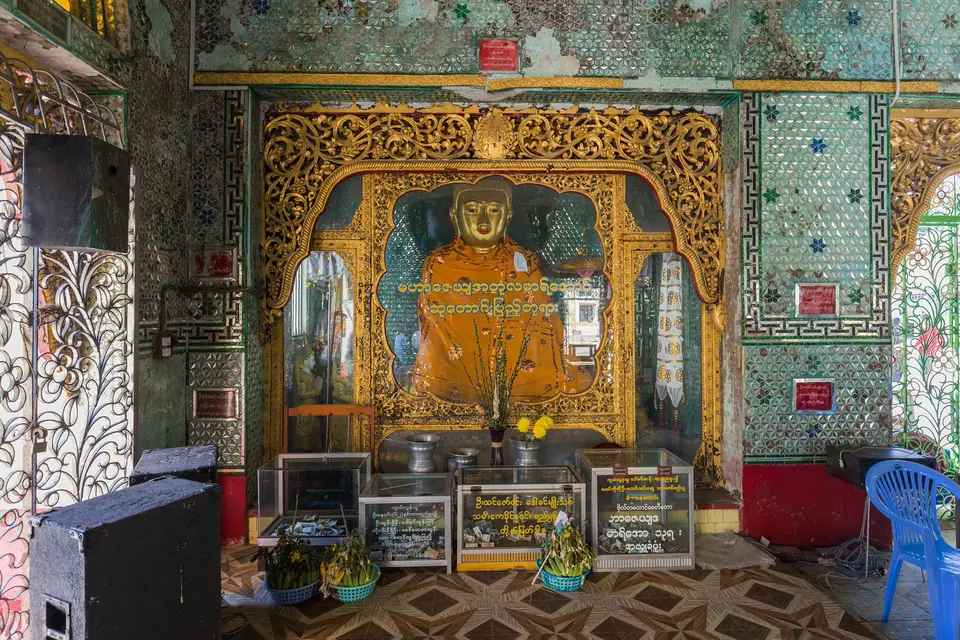
Entering a stupa is a rare experience in Burma, and Botahtaung offers it thanks to the massive use of reinforced concrete in its reconstruction. Inside, a zigzag corridor with walls of glass mosaic and gold leaf winds between angular chambers and the odd dead end. In its built-in display cases are shown Buddha images of gold, silver, bronze and alabaster, terracotta plaques and other objects found after the bombing.
That treasure came from a buried chamber that appeared when the rubble was cleared, about 0.9 metres deep: a space of about 6 by 6 metres and 1.8 high, shaped like a giant pot placed upside down. At the centre, sunk in mud filtered down over centuries, waited a stone casket in the shape of a pagoda, 58 by 99 centimetres, guarded by nat figures carved in laterite. The exact date of the find varies by source.
What followed was a long wait: the Rehabilitation Committee met several times without daring to open the casket, while pilgrims from all over Burma could only imagine its contents. In the end 15 great monks were summoned. What they advised, and what was seen afterwards, is the turning point of the tour.
A hair among caskets and leaks
Stone casket and golden hair chamber
Summary of this stop
At the entrance to the central chamber one now sees the stone casket that kept the hair for centuries. Inside, walls and ceiling covered in gold surround an ivory reliquary set with gold, diamonds and precious stones. When the casket was opened before the Committee and the public, a succession of containers fitted one inside another appeared, from the gilded stone to a small pagoda of pure gold on a silver tray, down to a tiny gold cylinder holding two relics the size of a mustard seed and a hair attributed to the Buddha, rolled up and fixed with a little lacquer.
Among the finds there was also a terracotta plaque with characters close to the ancient Brahmi of southern India. The chief archaeologist U Lu Pe Win read it as the script of the ancient Mon, and the plaque became proof that they were the ones who built the pagoda, although it offers no precise date.
The relic that withstood the bombs was not safe from a leak: in 2018 the casket had to leave its chamber so the roof could be repaired, and its journey across Yangon, among processions and the concern of conservationists, is the episode with which the audio guide closes the tour.