Sacred heart of Myanmar
Shwedagon Pagoda Audio Guide
A 99-metre golden bell on Singuttara Hill holds eight hairs of the Buddha. At its foot, kings, occupiers and protesters have climbed for six centuries to say what mattered.
- 90 min of audio
- Golden Buddhist stupa
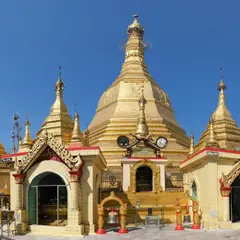
Shwedagon is the most sacred pagoda in Myanmar because its stupa enshrines relics of the four Buddhas of the present era: Kakusandha's staff, Koṇāgamana's water filter, a piece of Kassapa's robe and eight hairs of Gautama. The royal chronicles first mention it in 1362/63, when King Binnya U raised it to 18 metres; earthquakes, devout queens and building kings later took it up to the 99 metres that are now circled barefoot, clockwise, on a marble terrace.
Beneath the gold lies another story. In 1608 a Portuguese adventurer carried off the largest bell the pagoda ever had and sank it in the river, where it still lies; the British occupied the hill for 77 years and barred the Burmese from the west stairway; and in 1988 Aung San Suu Kyi spoke at its foot to some 500,000 people, on the very spot where her father had demanded independence in 1946.
Highlights
- Golden stupa — 99 m above Singuttara Hill, holding eight hairs of the Buddha
- Diamond hti — a gold orb set with 4,351 diamonds and a 76-carat one at the tip
- Planetary posts — eight Buddhas, one for each day of the Burmese week
- Maha Gandha Bell — 23 tonnes raised from the river with bamboo poles
- Dhammazedi Inscription — the pagoda's history in Pali, Mon and Burmese (1485)
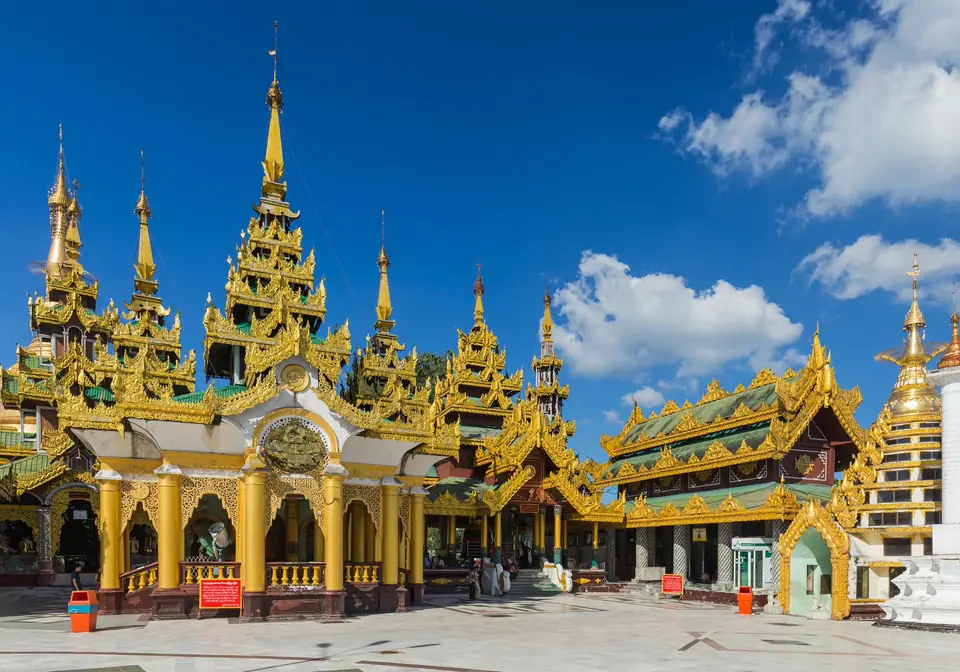
Few structures in the world pack so much gold and so much history into so little space. Shwedagon Pagoda stands on Singuttara Hill, 51 metres high, and its tip reaches 170 metres above sea level. Its silhouette weighs so heavily on Yangon that planning rules cap building heights at 127 metres above sea level, 75% of the pagoda’s elevation. Anyone asking what to see at Shwedagon will find far more than a golden stupa: a marble terrace walked barefoot, ringed by pavilions, bells, images of the Buddha and worshippers pouring water over the posts of their birth day.
The history of Shwedagon begins in legend and in debate. Devotional memory gives it more than 2,500 years and places its founding in the Buddha’s lifetime; the historian Than Tun dates it between AD 401 and 500, archaeologists place it between the 6th and 10th centuries, and the royal chronicles do not mention it until 1362/63. Since then the pagoda has grown from 18 to 99 metres, has survived at least 12 serious earthquakes, and has been a British fortress, the place where the 1920 university strike was planned, and a platform for the independence struggle. The audio guide, documented and checked against historical sources, takes in the whole stupa in five stops, from the south stairway to the viewpoint over the river.
In Yangon, the other stupa holding a hair attributed to the Buddha is Botahtaung Pagoda, beside the river, and about two kilometres to the northeast, in Bahan, lies the Chaukhtatgyi Buddha Temple.
The bare feet that won a political battle
South entrance chinthe
Summary of this stop
The visit begins at the south entrance, where two chinthe, dragon-lions about 18 feet tall, guard the main stairway. From here the climb is barefoot along a covered arcade lined with stalls of flowers, Buddha images and incense, an ascent that today looks like pure religious custom.
It was not always so for everyone. In February 1918 the cartoonist U Ba Gale published in the magazine Thuriya a drawing of Shwedagon’s trustees carrying British visitors on their shoulders so they would not have to take off their shoes. The following year, in 1919, the British government banned footwear in pagoda precincts, with one exception reserved for officials on duty. What the narration says on the spot makes that first barefoot step carry considerably more meaning.
The legend of the hairs and the ogre who remembered
Shwedagon Pagoda
Summary of this stop
On reaching the south side of the stupa, the golden mass fills the whole field of vision. Its octagonal base is ringed by eight planetary posts, one for each day of the Burmese week, which has eight because Wednesday is split at six in the evening and its night belongs to Rahu. Each post has its Buddha and its animal (garuda, tiger, lion, tusked elephant, tuskless elephant, rat, guinea pig and naga), and worshippers pour water over the image of the day they were born: a living ritual in plain sight of anyone circling the stupa.
What this golden bell holds has its own legend, a documented tradition telling how two merchants, Tapussa and Bhallika, lost four of the Buddha’s eight hairs to robbers along the way, and how King Okkalapa, on opening the casket, found eight again. It remained to be decided where to bury them, and not even the king of the gods could name the exact spot. The answer came from the least expected quarter: a repentant former man-eater, the same one who gives his name to another Yangon pagoda.
And on the southern edge of that same bell something hard to believe happened: on 2 March 1903 a young tigress climbed onto the pagoda and crouched there until British soldiers shot her down. The episode inspired songs and a hugely successful play.
Bamboo against the occupier and a speech that silenced a festival
Maha Gandha Bell
Summary of this stop
At the northwest corner of the terrace hangs the Maha Gandha Bell, also called the Singu Min bell: some 23 tonnes, donated by King Singu in 1779. In 1825, during the First Anglo-Burmese War, the British tried to ship it to Calcutta, but it fell into the Yangon River and they could not recover it. According to the most widespread version, disputed by another account of the time, it was the Burmese who raised it, lashing hundreds of bamboo poles beneath it, and returned it to its place.
This terrace served as a barracks for generations. In April 1852 British troops occupied the hill again and kept it under military control for 77 years, until 1929; the west stairway was closed to the Burmese until it reopened on 2 March 1930. At the foot of that stairway lies the open ground where, on 26 August 1988, Aung San Suu Kyi spoke to some 500,000 people and called the crisis the “second struggle for national independence”.
That speech had consequences that lasted for decades: the authorities placed the pagoda under strict control, and Shwedagon’s great annual festival, the largest pagoda festival in the country, stopped being held “for security reasons” until its return in 2012. What it meant for a whole generation is told at this stop.
A queen weighed in gold and a Buddha with animal eyes
Dhammazedi Inscription
Summary of this stop
At the northeast corner stands the inscription of 1485, from the reign of Dhammazedi: a stele that tells the history of Shwedagon in three languages, Pali, Mon and Burmese, and lists repairs since 1436. It stood at the top of the eastern stairway before arriving here, and it is the best doorway to understanding Shwedagon’s architecture and how it grew.
From the 18 metres given by Binnya U in the 14th century the stupa rose to the 40 reached under Queen Shin Sawbu, who abdicated in 1460 to live beside the pagoda, enlarged and paved the terrace, and had her own weight in gold, 25 viss, beaten into gold leaf to cover the stupa. It was the first of the gold donations that monarchs and worshippers have kept up ever since.
Very close by, south of the Naungdawgyi stupa, an image of the Buddha with its two eyes of different sizes is venerated. According to tradition, behind it lie an alchemist monk, a king who punished him and a misunderstanding between two Burmese words that sound alike. It is the wildest legend on the terrace, and its ending is kept for the audio guide.
Diamonds above, a bell at the bottom of the river
Southeast corner telescope
Summary of this stop
From the southeast corner, beside the telescope, the eye rises to the hti, the seven-tier crown that tops the stupa. Its tip is a hollow gold orb set with 4,351 diamonds totalling 1,800 carats, crowned by a single 76-carat diamond, and just below it a banner-shaped vane turns with the wind. That crown has fallen several times: at least 12 serious earthquakes shook the pagoda between Binnya U’s reign and independence in 1948, and they brought the hti down five times. After the worst, dated to 1768, King Hsinbyushin raised the stupa to its present 99 metres, although sources do not fully agree on the dates. In 1871, with Lower Burma already under British rule, King Mindon had a new hti made in Mandalay, hoisted on 26 November that year.
From the same viewpoint the city can be seen and, beyond it, the river. There, at the confluence of the Bago and the Yangon, off Monkey Point, lies Dhammazedi’s Great Bell, cast from 180,000 viss of metal. The Portuguese adventurer Filipe de Brito e Nicote took it away, in 1608 by the most cited date, to turn it into cannon; the raft broke while crossing to Syriam and the bell sank along with his ship. It has never been recovered, and the tour ends precisely with that absence.