Twentieth-century engineering
Aswan High Dam Audio Guide
Almost four kilometres of rock and clay born of the Suez crisis: on one side, Lake Nasser, which buried Lower Nubia; on the other, a Nile without a flood that brought light to Egypt's villages.
- 30 min of audio
- Great Cold War project
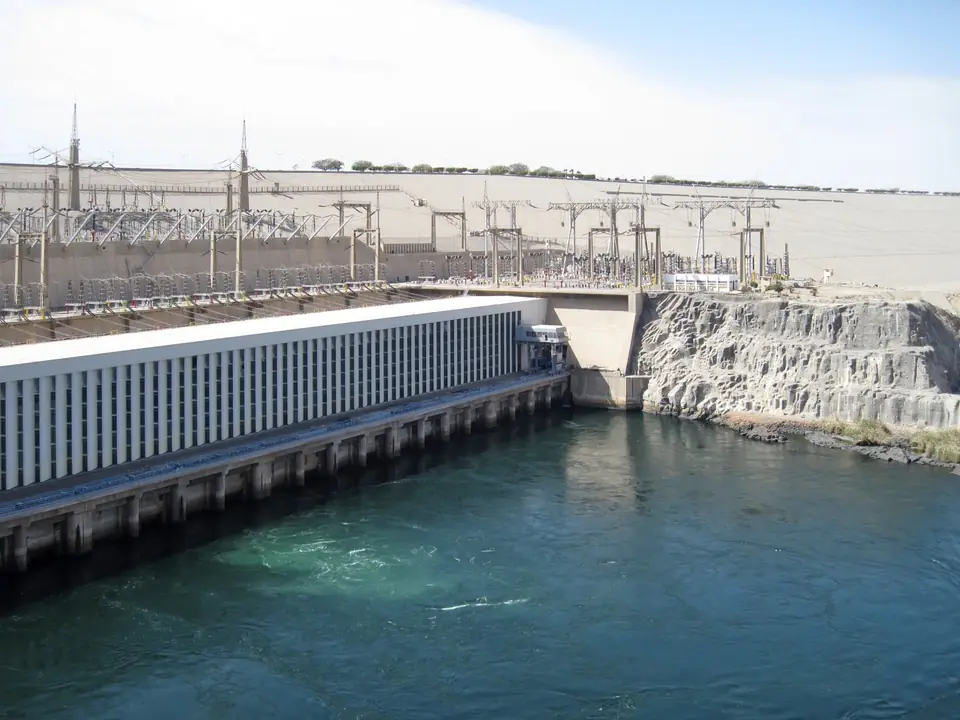
The Aswan High Dam is an embankment of rock, sand and clay about 3.8 kilometres long and 111 metres high that closes the Nile south of the city. Designed in Moscow and built by Egyptian firms between 1960 and 1970, when finished it was the tallest earth dam in the world, and its power station of twelve generators came to supply close to half of the country's electricity. From the crest the lake it created and the river it left behind can be seen at once.
The project carries a paradox: the two men who drove it, Nasser and Khrushchev, never inaugurated it. One was removed from power five months after closing the Nile's channel and the other died months before the 1971 ceremony. And beneath the still water of the reservoir lie the villages of tens of thousands of evicted Nubians, who still speak of the river angels living down there.
Highlights
- Crest of the dam — 3,830 metres long and 40 wide, with 980 metres at the base
- Viewpoint over Lake Nasser — the reservoir that covered much of Lower Nubia
- The Nile downstream — the 2.1 GW power station and a river with no annual flood
- Egyptian-Soviet Friendship Monument — a concrete lotus about 72 metres high
- Model pavilion — the dam in miniature, labelled in Russian and Arabic
South of Aswan, the road crosses an endless straight over the Nile. It is the crest of the High Dam, the Sadd al-Ali, a horizontal mountain of 43 million cubic metres of rock, sand and clay, some 16 times the mass of the Great Pyramid of Giza. Its modern story begins on 19 July 1956, when the United States withdrew its offer to finance it; a week later Nasser nationalised the Suez Canal to pay for it with its tolls, and in October Britain, France and Israel attacked Egypt. The Soviet Union took over the project in 1958, and on 15 January 1971 the dam was inaugurated.
Between one date and the other fit electric light in most Egyptian villages, the end of the Nile’s annual flood, Lake Nasser and the eviction of Lower Nubia. What to see at the Aswan High Dam goes beyond the landscape: the history and architecture of the work are read in the embankment itself, in its two parapets and in the gigantic concrete lotus that accompanies it. The audio guide, documented and cross-checked against historical sources, covers those four points in thirty minutes.
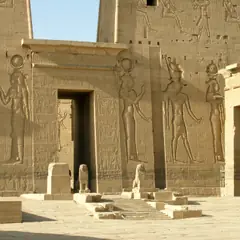
The waters of the lake forced the relocation of Philae Temple and submerged the Nubia whose legacy the Nubian Museum keeps; the flood the dam tamed is the same one that, for millennia, was measured by the nilometer of Elephantine Island.
The dam Ibn al-Haytham judged impossible
Aswan High Dam
Summary of this stop
At the central viewpoint on the crest, what impresses is not the height but the horizontal. The embankment is 3,830 metres long, 980 wide at the base and 40 at the crest, where the road runs; its 111 metres of height are barely noticeable, because the work is more an artificial mountain range than a wall. When finished, in 1970, it was the tallest earth dam in the world, although some sources reduce its length to 3,600 metres.
The idea of closing the Nile at Aswan is almost a thousand years older. Around 1011 the Fatimid caliph al-Hakim bi-Amr Allah commissioned Ibn al-Haytham to build a dam to regulate the flood; the scholar surveyed the ground, judged it unfeasible and, out of fear of the caliph, feigned madness. He spent ten years under house arrest, from 1011 to 1021, and in them wrote his Book of Optics.
On 9 January 1960 Nasser finally opened the works with a blast of 10 tonnes of dynamite. Beforehand he placed in the foundations a wooden box holding a Quran, that day’s newspapers and the coins he carried in his pocket, alongside others placed by Mohammed V of Morocco and the Syrian Shukri al-Quwatli. What is most surprising about that box buried under the embankment is discovered by listening to the narration on the spot.
A river tamed by the Suez crisis
Nile downstream and hydroelectric station
Summary of this stop
From the north parapet, the Nile runs clear and at a constant level, without the annual flood or the silt that defined it for millennia. On the eastern bank, at the end of the diversion canal and its six tunnels, stands the power station: twelve generators of 175 megawatts that have produced electricity since 1967. In 1970, at its first peak, it supplied close to half of Egypt’s electricity and brought light for the first time to most of its villages. It was also a target: in 1968 Israeli commandos damaged its main substation.
The dam was designed by Nikolai Malyshev, of the Moscow institute Hydroproject, and built by Egyptian firms, above all Arab Contractors, of Osman Ahmed Osman, who won the contract by bidding half of his only rival. For eleven years tens of thousands of Egyptian workers laboured on it, 36,000 by the most-cited figure, along with more than 2,000 Soviet experts, although sources agree on neither number.
The other side of that light went untold. Nobody knows how many workers died on the job; accounts speak of a collapse during the concreting of an excavation that buried several dozen men and took a week to clear. The Soviets lived in settlements with air conditioning, a school and a swimming pool, and earned about ten times more than the Egyptians, who slept in mud huts or on sacks of cement.
Beneath the lake, the Nubia of the angels
Lake Nasser
Summary of this stop
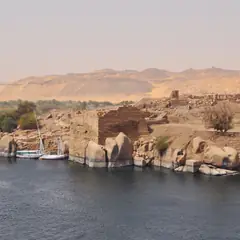
At the south parapet, Lake Nasser stretches to the horizon. That still water saved Egypt between 1979 and 1987, a run of meagre floods in which the reservoir covered the river’s shortfall and spared the country drought and famine; in 1996, with the lake at 178.55 metres above sea level, water entered the Toshka spillway for the first time, opened in 1981 towards a depression in the western desert. On the shore the temple of Kalabsha can be seen, moved during the UNESCO campaign.
Below lay much of Lower Nubia, with its villages and sites such as the fortress of Buhen. Figures for the displaced vary according to who counts the Egyptians, the Sudanese or both; the most widespread speaks of 100,000 to 120,000 people resettled, most around 1964. In Egypt some 50,000 Nubians were taken to “New Nubia”, 47 villages near Kom Ombo. They call that eviction tahjir, and Egypt began to compensate them in 2019-2020.
For the Nubians, the Nile was inhabited by river angels, the malayket al-bahr, lords of fertility, marriage and health, to whom sandalwood, dough or rice was offered. According to tradition, they are still alive down there, in castles beneath the surface of the lake. The lake, moreover, unintentionally revived the crocodiles that had vanished from the lower Nile. The song with which girls bade farewell to those angels each dawn forms part of the narration at this point.
The eighth wonder and its absent fathers
Soviet-Egyptian Friendship Monument
Summary of this stop
Beside the dam rises the monument to Egyptian-Soviet friendship: an open lotus flower of five concrete petals about 72 metres high, built in 1967 to a design by the architects Pyotr Pavlov and Yuri Omelchenko and the sculptor Nikolai Vechkanov. Beneath the petals, socialist-realist reliefs surround a central pillar bearing the coats of arms of the USSR and Egypt, and at the top there is a small viewing platform.
On 14 May 1964 Nasser and Nikita Khrushchev presided over the closing of the Nile’s channel, and Khrushchev called the dam “the eighth wonder of the world”. That year he awarded Nasser the Order of Lenin and the title Hero of the Soviet Union, a gesture that offended Soviet veterans; in October, five months later, he was deposed. Nasser died in September 1970, and the inauguration of 15 January 1971, his birthday, was presided over by Anwar el-Sadat and Nikolai Podgorny beneath a triumphal arch. The plaque calls Nasser “Immortal Leader”, and 15 January is today the feast day of the Aswan governorate.
During that 1964 trip, according to accounts from his entourage, Khrushchev visited Luxor Temple and scorned its columns in favour of Soviet concrete, while his interpreter smoothed every speech so as not to offend the hosts. What he said exactly in front of the columns closes the route.