UNESCO World Heritage
Tombs of the Nobles Audio Guide (Qubbet el-Hawa)
A sandstone hill opposite Aswan where the governors of Egypt's southern frontier left written, in the first person, their caravans to Nubia, the letter of an eight-year-old pharaoh and the rescue of a father's corpse.
- 60 min of audio
- Rock-cut tombs
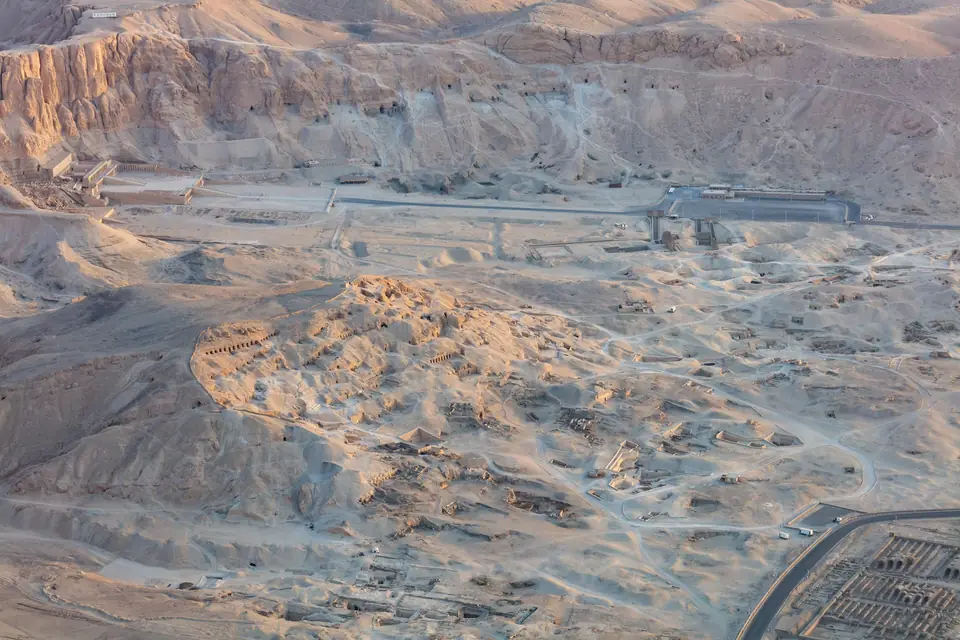
The Tombs of the Nobles occupy the slope of Qubbet el-Hawa, a hill of some 130 metres on the west bank of the Nile, just opposite Aswan. On three levels halfway up the slope open more than 100 rock-cut tombs, with about 1,000 people buried, and the necropolis was in use from the Fourth Dynasty to Roman times. Here were buried the lords of Elephantine, the men who guarded Egypt's southern gate and organised the expeditions into Nubia.
On the façade of Harkhuf is still carved the reply of Pepi II, a boy king who showed no interest in the ebony, ivory or incense arriving from the south, but demanded that the dancing dwarf brought from Yam not fall into the water on the way. A few steps away, father and son share a tomb with joined halls: Sabni crossed the desert with a hundred donkeys to recover Mekhu's body.
Highlights
- Façade of Harkhuf — 58 lines of text and the letter of a pharaoh of about eight
- Double tomb of Mekhu and Sabni — joined halls, 32 pillars and stairways down to the Nile
- Tomb of Sarenput II — the largest and most refined, with six Osiride statues
- More than 100 rock-cut tombs — from the Fourth Dynasty to Roman times
- Terrace above Elephantine — the island governed by the lords of the hill
From Aswan, across the Nile, a golden hill can be seen, pierced by rows of dark doorways and crowned by a small white dome. It is Qubbet el-Hawa, the necropolis the world knows as the Tombs of the Nobles: more than a hundred rock-cut tombs where the governors of Elephantine, the island that guarded Egypt’s southern frontier, had themselves buried from the Old Kingdom onwards. Excavations began in 1885 with the British general Francis Grenfell, Ernesto Schiaparelli brought the tomb of Harkhuf to light in 1892, and since 2008 the University of Jaén has been digging the hill again.
The history of the Tombs of the Nobles is not read in the annals of kings but in the autobiographies of frontier men: months-long journeys towards the land of Yam, corpses rescued from the desert, letters from a boy pharaoh. The slope also holds recent surprises, such as the small intact chamber found in 2019 beneath a Byzantine rubbish dump, with ten crocodiles of up to 3.5 metres laid down around the fifth century BC, some of a species that no longer lives in Egypt. What to see in the Tombs of the Nobles, how to read their rock-cut architecture and who speaks from each façade is what the audio guide covers in an hour, from the access ramps to the terrace facing Elephantine.
From the terrace one looks over Elephantine Island, the city these men governed; what remained of the Nubia of their caravans is displayed today in the Nubian Museum, and on the other bank, opposite the station, begins the Aswan Souk.
The dome of the wind that named the hill
Tombs of the Nobles
Summary of this stop
At the foot of the access ramps, flanked by low stone walls, the hill presents itself whole. Up on the south summit, the white domed tomb of the Muslim saint Sidi Ali bin el-Hawa is what gives the place its name: Qubbet el-Hawa, the “Dome of the Wind”, visible from the city and from the river. The pharaonic tombs, far older than that shrine, lie lower down, spread across terraces halfway up the slope.
The numbers impress before a single tomb is entered: about 130 metres high, more than 100 tombs on three levels and some 1,000 people buried, men, women and children, over a period of use running from the Fourth Dynasty to Roman times. The tombs were not meant to be seen only from inside: the tomb of Sarenput I was approached from the Nile along a 133-metre causeway, announced in 2016 as the longest found on the west bank at Aswan, with men carved dragging a bull as an offering. The hill remains open to archaeology, and what its successive missions have brought out gives this first stop a twist that the narration keeps for the place itself.
A hundred donkeys to bring home a dead father
Double tomb of Mekhu and Sabni
Summary of this stop
The tombs of Mekhu (QH25) and his son Sabni (QH26) are cut side by side with their cult halls joined. Mekhu’s measures around 150 m², with 18 pillars in six rows of three; Sabni’s, about 120 m², with 14 pillars in two rows. There is a granite offering table, false doors at the back and, in front, two stairways that went down to the bank of the Nile. On the back wall of Sabni’s tomb, a hunting and fishing scene with birds and fish ranks among the most beautiful and best-preserved paintings in the necropolis.
The architecture tells a story of filial devotion. Mekhu, governor of Elephantine under Pepi II, died in the desert during an expedition to Wawat, and Sabni set out to recover the body with 100 donkeys, priests, oils, honey and linen; the pharaoh afterwards sent him his best embalmers and numerous gifts. How exactly Mekhu died is a matter of debate, because the long façade inscription that narrated the rescue is almost destroyed today.
That portrait of an exemplary son has a shadow. On Elephantine, the island opposite, a letter from the Old Kingdom turned up accusing Sabni of theft, published in 1942 as “A Letter of the Old Kingdom on the Crimes of Count Sabni”. Two versions of the same man a few hundred metres apart, and the audio guide pits them against each other in front of his doorway.
Sarenput II and the daughter who saved the line
Tomb of Sarenput II
Summary of this stop
The tomb of Sarenput II (QH31), nomarch of Elephantine for at least 12 years under Senusret II and Senusret III, is the largest and most refined at Qubbet el-Hawa. Its plan unfolds like a sequence: a courtyard, a six-pillar hall, a corridor with three pairs of Osiride statues of the governor in niches and, at the end, a four-pillar hall with a niche painted in intense colours. Photographs of Schiaparelli’s excavation in 1914 show, in the second chamber, the preparatory grid that guided the painter.
In 2016 the University of Jaén found the burial of Sattjeni, daughter of Sarenput II, in two coffins of Lebanese cedar. After the death of all the males of her family, she was the sole holder of the dynastic rights of Elephantine and mother of the governors Heqaib III and Ameny-Seneb.
The thread of that family leads to QH33, a tomb from the end of the Twelfth Dynasty, around 1830 BC, oriented so that the winter solstice sunrise lights the place meant for a statue of a governor of Elephantine: the oldest known Egyptian tomb aligned to the winter solstice, and it was left unfinished. It was reused at least three times and held more than 200 skeletons and mummies, whose study put life expectancy at barely 30 years. Who ordered it dug is disputed, and that open question is told in front of the corridor of statues.
The boy pharaoh’s letter and his dwarf
Inscribed façade of the tomb of Harkhuf
Summary of this stop
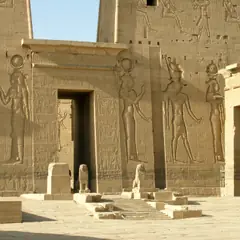
The façade of Harkhuf (QH34n), a governor born on Elephantine, is covered in columns of hieroglyphs above the entrance and on both sides: 58 lines carved in a soft, flaking stone. Harkhuf led great expeditions to Nubia under Merenre I and Pepi II, four according to most sources, as far as the distant land of Yam, and his account is the main source on Egypt’s relations with Nubia in that period. Among his virtues he proclaims having given bread to the hungry, clothes to the naked and a boat to him who had none.
At the far right is the hill’s most famous piece. In year 2 of his reign, Pepi II, a king of about eight, answered Harkhuf with no interest at all in the ebony, ivory and incense, but eager for the dancing dwarf he was bringing from the south: he ordered capable men placed on both sides of the boat so it would not fall into the water, and guards to sleep around it. Harkhuf had the letter copied into his tomb. Who that dwarf was, usually interpreted as a pygmy, remains under discussion.
On the neighbouring façade, Pepinakht (QH35), another governor under Pepi II, had three expeditions carved. The last was a funerary errand: bringing back the corpse of an expedition leader killed by the “sand-dwellers” while building a ship to reach Punt. The account breaks off in the middle of the fight, and what the stone leaves unsaid is told in the narration in front of the façade.
A flesh-and-blood saint facing Elephantine
Panorama of Elephantine and the Nile
Summary of this stop
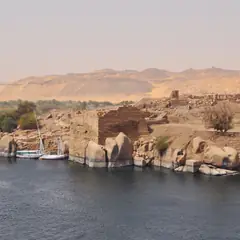
From the terrace of the tombs, Elephantine Island lies directly opposite: the city of which all these governors were lords. That same Pepinakht received the nickname Heqaib, “he who controls his heart”, and soon after his death was deified. According to documented tradition, people venerated him as a local saint, first at his tomb on this hill and later at a shrine on the island, where pharaohs such as Intef II, Senusret III and Neferhotep I left statues. Abandoned in the Second Intermediate Period, the shrine was not rediscovered until 1932.
The veneration did not stop with the pharaohs. In Christian times the hill housed a Coptic monastery, whose walls still show beneath the saint’s dome, and several pharaonic tombs were reused as churches; in that of Setka (QH110), from the First Intermediate Period, a window was opened from the monastery. Then came the shrine of Sidi Ali bin el-Hawa on the summit.
In 1979 Qubbet el-Hawa entered the UNESCO World Heritage List as part of the “Nubian Monuments from Abu Simbel to Philae”, although it is neither Nubian nor between Abu Simbel and Philae. That paradox, and what links so many centuries of pilgrims on one hillside, closes the route with the Nile at its feet.