Museum of Nubia
Nubian Museum Audio Guide
What was saved from a drowned country, kept on a hill of sandstone and pink granite: a Ramesses II rescued from the water, silver crowns still worn on a king's head and a garden where Nubia still sounds.
- 90 min of audio
- Rescue of Nubia (UNESCO)
The Nubian Museum of Aswan grew out of the international campaign UNESCO launched in 1960, at Egypt's request, to save the monuments of Nubia before Lake Nasser covered them. Its foundation stone was laid in 1986 and it opened on 23 November 1997, after more than twenty years of planning. The Egyptian architect Mahmoud El-Hakim built it in local stone on a rocky hill, with a plan recalling ancient temples, fortresses and houses of the region, and the work received the Aga Khan Award for Architecture in the 1999-2001 cycle.
The opening came one week after the Luxor massacre: Aswan woke almost without tourists, with the feluccas moored and the souk empty, and that night the museum's amphitheatre hosted a Nubian concert dedicated to the victims. Today, within the same grounds where kings' crowns are displayed, two Sufi shrines are still in use, and at the gate women dressed in black talk among themselves in the language of the villages the dam took away.
Highlights
- Statue of Ramesses II — at the centre of the great basement hall
- Silver crowns of Ballana — inlaid with carnelian, from the royal tombs excavated by Emery
- Museum garden of about 43,000 m² — a canal symbolising the Nile, a Nubian house and a cave with prehistoric engravings
- Gallery “Submerged Nubia” — some 180 photographs of the sites before the rescue
- Building by Mahmoud El-Hakim — sandstone and pink granite, Aga Khan Award for Architecture
When Lake Nasser began to rise behind the Aswan dam, a whole country went under the water: villages, cemeteries, temples cut into the rock. In 1960, at the request of the Egyptian government, UNESCO launched an international campaign to save the monuments of Nubia, and from that effort, decades later, came this museum. Work to create it began in the early 1980s with a committee of specialists from the Supreme Council of Antiquities, Egyptian universities and UNESCO; the foundation stone was laid in 1986 and the inauguration came on 23 November 1997, with Hosni Mubarak and the UNESCO director-general, Federico Mayor.
The site covers 50,000 m²: 7,000 are the building and the rest is divided among gardens, amphitheatre and open-air exhibition. Construction cost some 75 million Egyptian pounds, about 22 million dollars. What to see at the Nubian Museum runs from a façade that imitates temples and fortresses to a dimly lit hall presided over by Ramesses II, from the silver crowns of Ballana to photographs of a Nubia that no longer exists. Its history and architecture also hide episodes that appear on no wall label, and the audio guide unpacks them in a ninety-minute walk inside and out.
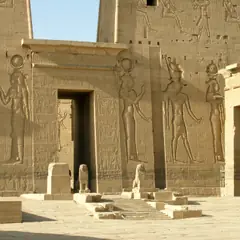
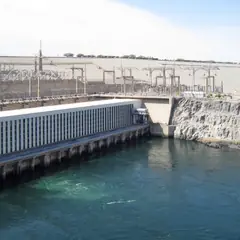
The Nubia that the museum keeps was left under the lake created by the Aswan High Dam; the same rescue campaign produced the relocation of Philae Temple, and the caravans to those lands were already recounted in the first person by the governors buried in the Tombs of the Nobles.
A stone hill for a drowned country
Nubian Museum
Summary of this stop
The museum sits on a rocky hill at the entrance to Aswan, clad in local sandstone and pink granite. The Egyptian architect Mahmoud El-Hakim designed it with a plan inspired by ancient temples, fortresses and the domestic architecture of the region, as if the building wished to resemble what it came to protect. The work, finished in 1997, received the Aga Khan Award for Architecture in the 1999-2001 cycle.
Behind that façade lies a bumpy design history: more than twenty years between the idea and the opening, and an architect who drew five versions before the final one was approved. What happened to the commission afterwards is one of the episodes the narration keeps for this spot.
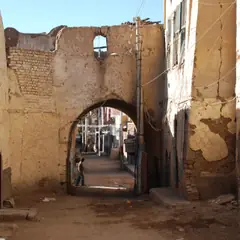
At the gate, a group of Nubian women in tunics and black tobes sell handmade crochet. Among themselves they speak not Arabic but Kenzi Nubian, the language of Lower Nubia, whose speakers had to leave their villages when the dam was built; the neighbourhood around the museum was a Nubian village before it became a district of the city. There is a reason for their black, and the tradition told about the hem of their dresses is heard right there.
A miniature Nile and saints beyond counting
Garden canal and Nubian house
Summary of this stop
The garden works as an open-air museum of about 43,000 m². A canal winds among plants of ancient times, symbolising the Nile; beside it stands the reconstruction of a traditional Nubian house, there is a cave with prehistoric rock engravings and part of a Fatimid cemetery survives, with domes of that era rising beside the hill.
On the steps of the open-air amphitheatre the inaugural night of 1997 was held, one week after the Luxor massacre in which 58 foreign tourists and 4 Egyptians died. That Sunday Aswan woke almost without tourists, with the feluccas moored and the souk empty. In the evening the Aswan Troupe of Walid Aouni performed, Mohamed Mounir sang, and the Nubian oud player Hamza El Din, arrived from Berkeley, dedicated his composition to the victims.
Inside the garden there are also two Sufi shrines in use, that of Sayyida Zeinab and that of the 77 walis, crowned with Fatimid-style domes, and an oratory, the Qubat Al-Mukhasal. In the early 2000s Sufi sheikhs held the dhikr there at weekends, with their own entrance so as not to mix with the visitors. How many saints rest in the second is another matter: several versions circulate in Aswan, and the most curious of all has to do with a name that sounds like a number.
Ramesses II, rescued from a submerged temple
Statue of Ramesses II
Summary of this stop
From the glare outside one passes into the cool half-light of the main hall, which is in the basement. At its centre stands a statue of Ramesses II, pharaoh of the Nineteenth Dynasty, the first focus of the exhibition. The interior design was conceived by the Mexican architect Pedro Ramírez Vázquez, author of the National Museum of Anthropology in Mexico City, and the hall works like an ark where what the water allowed to be saved ended up.
One of those pieces comes from the rock-cut temple of Gerf Hussein, which Setau, viceroy of Nubia, built for Ramesses II some 90 km south of Aswan. In the 1960s only the freestanding part of the temple was dismantled; the part cut into the rock stayed under Lake Nasser, and the statue now in the museum bears witness to what was lost.
The way to reach Ramesses is not the one its architect imagined either. There was a route designed to reveal the hall from above that never came to exist, and the misunderstanding that ended it is part of what is told at the foot of the statue.
The crown still in place at Ballana
Ballana and Qustul display cases
Summary of this stop
The museum’s main collections come from the tombs of Ballana and Qustul, excavated by the archaeologist Walter Bryan Emery between the late 1920s and early 1930s. The display cases glitter with silver crowns inlaid with carnelian, saddles for horses, iron weapons, silver jewellery, bronze vessels and lamps of the sixth century.
Those mounds of the Ballana culture, between the fourth and sixth centuries, were royal burials in which the rulers went down into the tomb with their horses, their harness and their servants. One of the crowns on display comes from tomb 118, which escaped the looters by accident; the original cemetery was afterwards left under Lake Nasser.
What Emery found on entering that chamber turns fascination with silver into a shiver. The full discovery, with everything that lay beside the king, is kept for the narration in front of the display case.
Photographs of a Nubia that no longer exists
“Submerged Nubia” photo gallery
Summary of this stop
The gallery “Submerged Nubia”, opened in 2001 under the sponsorship of the scientific office of the Italian embassy, gathers some 180 photographs of Nubian sites and peoples before the rescue, donated by archaeological missions that had worked in the region since 1900. They are faces, houses and fields that put an image to a word, displacement, before the water covered everything.
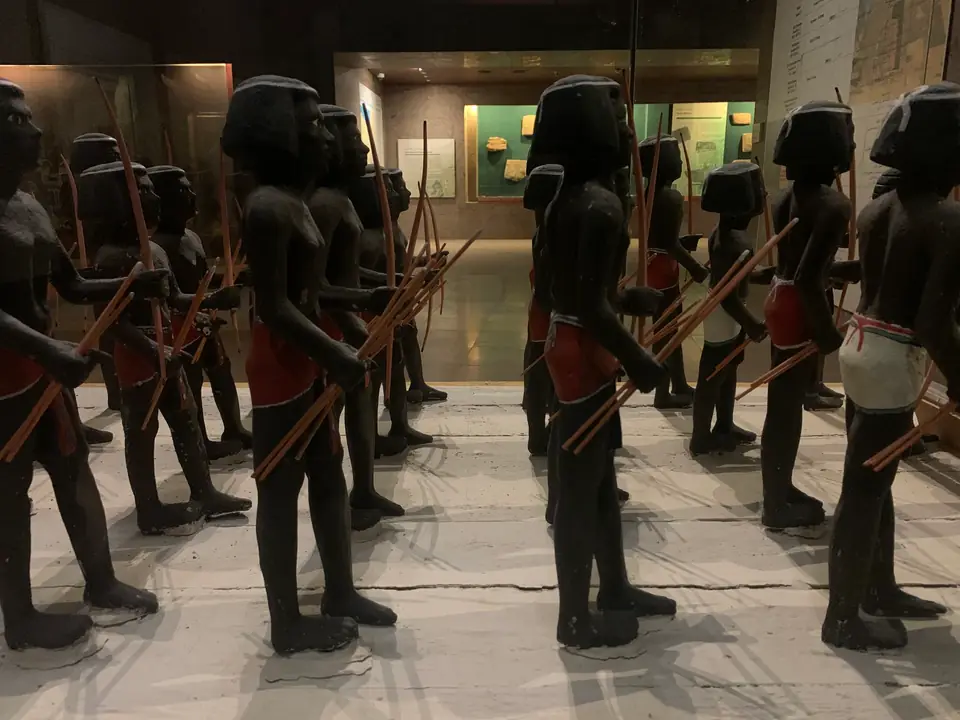
The neighbouring rooms reconstruct life in Nubia before the dam with dioramas and everyday objects: palm basketry, irrigation tools and scenes of customs. And the museum is not only memory. During Eid al-Fitr in 2018 it received 1,706 Egyptian and foreign visitors, with its doors open from nine in the morning to nine at night, and the Sham el-Nessim festival and the two Eids bring its biggest peaks of local visitors, a side of the museum with which the route closes.