UNESCO World Heritage
Unfinished Obelisk Audio Guide
Almost 42 metres of granite that never left its quarry: the cracks doomed it, and that is why the pharaohs' workshop remains here just as it was the day work stopped.
- 40 min of audio
- Pharaonic granite quarry
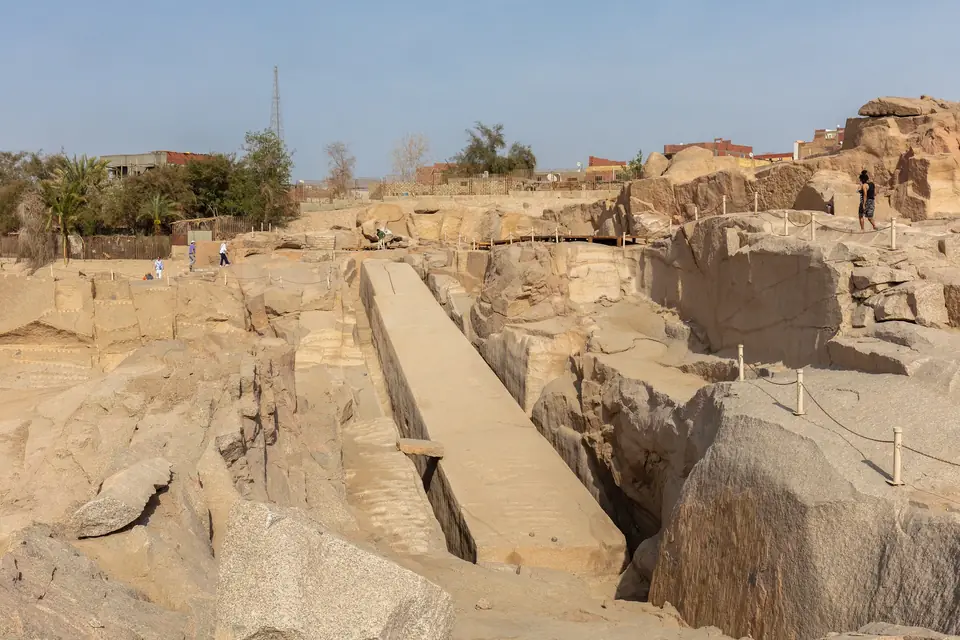
The Unfinished Obelisk of Aswan is the largest known attempt to carve a granite needle from a single piece: 41.75 metres long, 4.20 metres wide at the base and some 1,168 tonnes had it been completed. Everything points to a commission by Queen Hatshepsut for the temple of Amun at Karnak, although authorship is debated. Flaws in the stone and several fissures forced its abandonment, still joined underneath to the bedrock, and since 1979 it has been part of UNESCO World Heritage.
Its failure is its value: what vanished from other obelisks when they were polished is still in plain view here. The trench dug by blows of dolerite pounding balls, the red ochre lines painted every foot, the marks with which the stonecutters probed the crack, and even the outline of a second, smaller obelisk, with measurements almost identical to the one that stands today in the Lateran square in Rome.
Highlights
- Upper face of the obelisk — 41.75 metres of granite still attached to the bedrock
- Scalloped trench — 75 cm wide, with red ochre lines every 29.9 cm, one foot
- Dolerite pounders — balls of 4 to 7 kg used to dig out the granite
- Great transverse fissure — the crack that shrank the project until its abandonment
- Outline of a second obelisk — 32.10 metres, almost the size of the Lateran obelisk in Rome
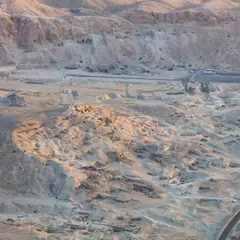
In the quarries north of Aswan, lying at the bottom of a hollow of pink granite, rests an obelisk that never rose. It is 41.75 metres long and 4.20 metres wide at the base; finished, it would have weighed some 1,168 tonnes, although the figures vary by source. Everything suggests it was commissioned by Queen Hatshepsut, who reigned around 1473-1458 BC, for the temple of Amun at Karnak, but since it was a failure nobody wanted to sign it, and not even Reginald Engelbach, who cleared it in 1921-22, found proof of its date. The cracks left it here, still welded underneath to the rock it was meant to come from.
That defeat made the place unique: a pharaonic workshop frozen at the exact moment when work stopped. Aswan is the only usable outcrop of granite in Egypt, and from it came the more than 25 known obelisks of over 50 tonnes, as well as the granite of Khufu’s burial chamber at Giza. What to see at the Unfinished Obelisk, how an obelisk was made and why this one was left half done is what the audio guide unpacks along the upper face, from base to tip, in some forty minutes leaning over the trench.
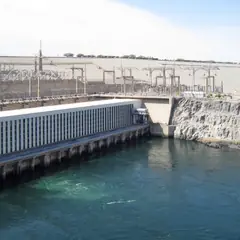
The queen credited with the commission, Hatshepsut, reappears in the temple of Satet on Elephantine Island, and the other great work in stone at Aswan, from the twentieth century, is the Aswan High Dam.
Half an obelisk under a heap of chippings
Unfinished Obelisk
Summary of this stop
From the western edge of the quarry the scale of the block is taken in at a glance: a prism of granite lying flat, its surface levelled by pounding and tilted about 11 degrees towards the base. For centuries the obelisk was not under sand, as is often said, but under an enormous heap of quarry blocks and chippings; only about 22 metres showed. In the winter of 1920-21 the sultan, later king, Fuad visited it and asked for it to be cleared in full so that ancient techniques could be studied.
By April 1921 the excavation had already uncovered 36 metres, more than any known obelisk measured. With Ramadan approaching, Engelbach suspended the campaign, and the complete clearing was finished in the winter of 1921-22 at a total cost of 75 Egyptian pounds. Among the rubble there also turned up a clue that contradicts the most repeated explanation of how granite was split: the one about soaked wooden wedges that, as they swelled, opened the rock.
Engelbach did not believe it, and what came out of the dig pointed elsewhere: burnt mudbricks and pinkish, brittle granite flakes, a sign of stone that had been through fire. Almost a century later, new finds of charcoal in the quarry revived the hypothesis, which is still debated. What happened when a modern team lit a fire on this very granite is something the narration saves for the edge of the quarry.
One foot of ochre, seven months of pounding
Scalloped trench and dolerite pounders
Summary of this stop
Beside the base, the north trench shows how an obelisk was really made. The ditch, about 75 centimetres wide, is formed of vertical concave cuts, like a scallop pattern carved into the rock, and between one cut and the next run red ochre lines every 29.9 centimetres, the length of a foot. It was not dug with chisels but with spherical dolerite pounders 20 to 33 centimetres across and weighing between 4 and 7 kilos, balls of greenish-black stone the size of a melon that can still be seen around the quarry.
There were many more: in 1922 Engelbach buried hundreds of them under the west retaining wall because visitors kept taking them as souvenirs. His calculations give the measure of the effort: with pounders mounted on mallets, completing the trench to a depth of 5.2 metres would have taken some 7.2 months of 12-hour days, a figure very close to the seven months of quarry work that Hatshepsut herself declared for her obelisks at Karnak.
In 1994 a television crew set out to test it at the quarry floor, not far from here, with local stonecutters pounding the granite as the ancients did. After a week of blows the trench had barely advanced, and the outcome of that attempt completely changes how this trench is seen: the audio guide tells it right above it.
The crack that shrank the obelisk
Great fissure of the obelisk
Summary of this stop
At mid-height, a great fissure crosses the body of the obelisk. Along it can be made out hammered hollows and polished channels with which the stonecutters checked how far the damage extended. It was not the only one: Engelbach labelled the fissures from a to p, and each one forced a cut to the original design.
The meeting of fissures a and b pushed the pyramidal tip back by at least half a metre; others required narrowing and shortening it at the base, where a black line marked a trim of more than 2 metres, and the last one separates a corner of the block entirely. The royal commission for Karnak shrank crack by crack until the work was abandoned because of the flaws in the stone.
Abandonment was not the end of its troubles. On one side runs a row of small punch holes made in medieval or modern times to pull a block out of it: the largest obelisk ever attempted came close to being chopped up as a mere quarry. How a royal commission turned into a doomed mass, blow by blow and crack by crack, is what the narration reconstructs beside the fissure.
A tip that ended up in Rome
Pyramidal tip of the obelisk
Summary of this stop
At the eastern end, where the pyramidion was to go, oblong chisel holes open at the base of the tip, made to examine another crack. On the upper face a second project was laid out, probably later, for a reduced obelisk of 32.10 metres and about 507 tonnes. Its dimensions are almost identical to those of the Lateran obelisk, 32.15 metres, which came from Karnak and stands today in Rome.
The layout lines were scored with a chisel and filled with black paint, but the four transverse lines of the reduced projects are so faint that at midday they disappear: they can be made out only in the raking light just after sunrise or before sunset. The hour of the visit changes what is seen in the stone.
The route ends with an administrative paradox. In 1979 the obelisk and its quarry entered the UNESCO World Heritage List as part of the “Nubian Monuments from Abu Simbel to Philae”, although the quarry is neither in Nubia nor between Abu Simbel and Philae. How this unfinished tip connects with the needles that now stand in other cities is the thread with which the audio guide closes the visit.