Traditional market
Aswan Souk Audio Guide (Sharia as-Souq)
Over a kilometre of stalls starting opposite the station, in a city whose ancient name is linked to “market”: where ostrich feathers from Sudan were sold in 1874, hibiscus, spices and Nubian basketry now pile up beneath wooden pergolas.
- 60 min of audio
- Karkadé and Nubian basketry
The Aswan souk is the commercial axis of a city that lived off the caravans entering and leaving Egypt. The street starts at Midan al-Mahatta, the station square, and runs long and narrow towards Salah el-Din Street. The refurbishment that Prime Minister Mostafa Madbouly inspected in July 2020, costing about 80 million Egyptian pounds, covered it with fire-resistant wooden pergolas and paved it with Aswan granite and basalt.
In the winter of 1874 the traveller Amelia Edwards asked here about the slave market and the governor, the mudir and the qadi answered in chorus “Mafeesh bazaar”, there is no market. A century and a half later, the haggling goes on, but the sacks no longer hold feathers or ivory but hibiscus picked by hand between Kom Ombo and Daraw, and among the baskets and carvings there still lurks a crocodile with beads that is not always what it seems.
Highlights
- Fire-resistant wooden pergolas — continuous shade along the souk, with paving of Aswan granite and basalt
- Sacks of karkadé — Egypt's finest hibiscus, hand-harvested between Kom Ombo and Daraw
- Nubian palm-leaf basketry — models that already appear in the tombs of Thebes
- Souvenir shops — signs in several languages, silverware and a catchphrase for every nationality
- Aswan in 1874 — ostrich feathers, ivory and Sudanese caravans in Amelia Edwards's account
For centuries Aswan was a frontier city that lived by trade. Along its bank passed the caravans heading up to Sudan and those coming down to Cairo, and in the winter of 1862-1863 the English writer Lucie Duff Gordon even dined on a mat, among camels and bales, with some slave traders bound for Sennar who invited her to follow them. Eleven years later, when Amelia Edwards asked about the slave market that people in Cairo took to be alive, the authorities of Aswan denied it in chorus and the qadi declared it illegal. What followed that afternoon, with a piano and a Wagner score involved, is one of the episodes the narration keeps for the route.
Today that commercial past is concentrated in a single street: the Aswan souk, which starts opposite the station and stretches beneath wooden pergolas between stalls of karkadé, spices, silver and Nubian basketry. What to see in the Aswan souk, where what is sold in it comes from and how its architecture has changed in the latest refurbishment is what the audio guide unpacks in five stops and sixty minutes of walking, with the eye of a traveller of 1874 as counterpoint.
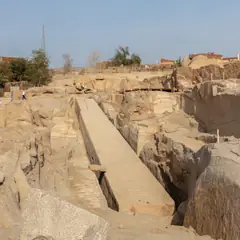
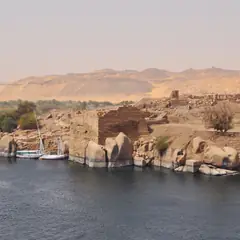
That mercantile past begins on Elephantine Island, ancient Abu of the ivory; the basketry and Nubian crafts seen at the stalls find their context in the Nubian Museum, and a short ride away lies the Unfinished Obelisk.
The city that was called “market”
Aswan Old Souks
Summary of this stop
The north gate, at Midan al-Mahatta, opposite the railway station, opens a street that is no ordinary market. Aswan’s ancient name, Swenett, is linked to the meaning “the market”: the city was a commercial centre for caravans, and the Egyptologist Henri Gauthier records among its ancient names “the market” or “place of trade”. The etymology, however, is disputed: another explanation derives it from a homonymous goddess associated with childbirth, and the reading “Aswan = market” repeated by guides and press is only one of the possible ones.
What is certain is how recent what is seen here is. On 14 July 2020 Prime Minister Mostafa Madbouly inspected the souk’s refurbishment, from the station square to Salah el-Din Street, at a cost of about 80 million Egyptian pounds and with completion planned for early 2021. What that work changed in the way the souk is entered is explained in the narration beside the gate.
Striped shade over Aswan granite
Wooden pergolas and granite paving
Summary of this stop
Beneath the pergolas, light falls in stripes on a floor of Aswan granite and basalt slabs. In November 2020 the old souk measured 1,500 metres long and 11 wide on average, and the project covered it with fire-resistant timber beams on reinforced-concrete footings. It also planned to renovate 10 main gates, add 2 new ones and fit the whole street with water-misting fans, like those of the Great Mosque of Mecca, against the summer heat.
The figures, though, do not agree between sources: 1,400 metres in the March 2020 plan, 2,400 for the project completed in 2022 and about 3 kilometres in some tourist guides, depending on which stretches and side streets are counted. And the new shade brought rules: in February 2022 the municipality closed 5 shops, 2 of them for good, for lacking a licence, encroaching on the street and hanging goods from the awning posts. On those very posts someone still hangs merchandise, and the audio guide tells there how that daily tug-of-war is played out.
Red hibiscus from Daraw and caravan henna
Sacks of karkadé and spices
Summary of this stop
On the spice sellers’ stalls pile up dried calyces of dark red hibiscus, henna, spices ground into cones, dates and peanuts. Aswan’s karkadé is the finest on the Egyptian market, and it is harvested in November in the fields between Kom Ombo and Daraw, where women pick by hand, one by one, the fleshy calyces of the flower before drying them in the sun. In December 2025 its price hovered around 240 pounds, against 100-160 a year earlier, and local production was not enough, so it was imported from Nigeria and Sudan.
It is often sold as the “drink of the pharaohs”, but the plant was domesticated in western Sudan and there is no solid documentary proof of its widespread consumption in pharaonic Egypt. Henna, by contrast, does have history on this bank: in 1874, beside the landing stage, merchants from Abyssinia, Bisharin, Ababda, Nubians and people from Kordofan and Sennar camped, and among their bales were sacks of henna, leopard skins and elephant tusks. How gum arabic reached that camp is a detail the narration keeps for this point.
A catchphrase for every passport
Multilingual bazaar signs
Summary of this stop
The bazaar windows display signs in several languages, silverware, carvings of pharaohs and Sudanese swords, beside housewares shops for the local public. The souk’s touts, as Haitham Ibrahim recalled in 2012, who as a student drew in customers on Sharia as-Souq, had a line ready for each nationality: to the British they promised prices cheaper than Asda; to Australians, “Captain Cook”; to Italians, “Mafioso”. The one reserved for the French is left for the audio guide.
In 1874 the goods were different. Vendors offered Amelia Edwards ostrich eggs and feathers, Nubian silverware, spears, bows, rhinoceros-hide shields and ivory bracelets, and not a single scarab. In a tiny shop beside the shoemakers’ souk she bought, after long haggling, an armful of ostrich feathers 75 to 90 centimetres long that had arrived with merchants from Sudan. After the 2011 revolution tourism fell: in 2012 Mohamed Ali Yassin, owner of the shop Nubian Smile, who had started with 5 kilos of silver and by then had at least 70, reckoned his business 70 % down and switched to spices and flip-flops.
Baskets of Thebes, crocodiles with beads
Nubian basketry and beadwork
Summary of this stop
At the basketry stalls are piled baskets of dyed palm leaf, Nubian plates and bags and beaded jewellery. Already in 1874 the bazaar’s baskets and mats repeated the rushes, dyes and models found in the tombs of Thebes, and the most requested was an oval basket with a domed lid of which the British Museum holds examples. In 2024 an exhibition at the entrance to the tourist souk brought together the work of 32 women of Aswan and Nubia: palm-leaf basketry, or khous, crochet and Nubian-style beadwork.
The Nubian souvenir has its curious side too: in 1874 a boy chased the boats shouting “Madame Nubia!” to sell fringed leather skirts soaked in castor oil, the garment of girls south of the cataract, which in Aswan were bought mostly by the English and Americans. And it has its dark side. The Nubian custom of stuffing a crocodile with straw, decorating it with beads and hanging it over the door against the evil eye is real, but not every crocodile in the bazaar is an innocent amulet. The story that closes the route tells one from the other.