UNESCO World Heritage
Philae Temple Audio Guide
The sanctuary of Isis where the last known hieroglyphic inscription was carved, later turned into a church, drowned by a dam and raised again, block by block, on another Nile island.
- 90 min of audio
- Sanctuary of Isis
The temple of Philae was for centuries the great sanctuary of Isis on the frontier with Nubia. Ptolemy II Philadelphus began it, and more than two thirds of what survives today dates from the Ptolemaic period, although two pieces by Nectanebo I endure from earlier temples. Here the cult of the goddess held out when pagan temples elsewhere in the empire had been shut for decades, and here, in 394, the last known hieroglyphic inscription was written.
The island visitors walk on today is not the original one. The British dam of 1902 left the temple underwater for most of the year, and between 1977 and 1980 the complex was dismantled into about 40,000 blocks and rebuilt on the island of Agilkia, some 500 metres away, with its summit lowered to echo the profile of the old island. Every column, every relief and every graffito travelled to remain standing.
Highlights
- Last known hieroglyph — carved on 24 August 394 in Hadrian's Gate
- First pylon — Nectanebo I's gateway and a French inscription of 1799
- Temple turned church — Coptic crosses over the faces of Isis
- Trajan's Kiosk — 14 columns and 15.85 metres high beside the water
- UNESCO rescue — some 40,000 blocks moved to Agilkia island
Philae Temple is reached by boat, just as pilgrims once arrived. Philae, Philai or File: the name shifts with the language, but the place is the same sanctuary of Isis raised on Egypt’s southern frontier, where the river breaks over the First Cataract. Its story begins with a kiosk of Psamtik II, the first certain temple on the island (of an earlier sanctuary of Taharqa only reused blocks remain, and they may come from elsewhere), continues with Nectanebo I, of whom two pieces survive, and bursts into life with Ptolemy II Philadelphus, who began the great temple of Isis around 285 BC.
What sets Philae apart is its ending. In 298 Diocletian pulled the Roman frontier back to the island, and the cult of Isis stayed alive when the rest of the empire had already closed its pagan temples. In 394 a priest carved the last known hieroglyphic inscription here; in 452 a pilgrim left the last Demotic one; in 537, according to Procopius, the temple was closed on Justinian’s orders, a date commonly taken as the end of ancient Egyptian religion. Then came Christians, Bonaparte’s soldiers, Romantic travellers and, finally, the water of a British dam that kept it submerged for decades.
What to see at Philae Temple, how to read its architecture and why every wall holds several layered eras is what the audio guide unfolds across five stops and ninety minutes on the island of Agilkia, with narration that is documented and cross-checked against historical sources.
Its relocation belongs to the story of the Nile dams, which culminates in the Aswan High Dam and Lake Nasser, and to UNESCO’s campaign for the monuments of Nubia, whose rescued legacy is displayed in the Nubian Museum.
Windows onto Osiris’s forbidden island
West colonnade facing Bigeh
Summary of this stop
The route begins in the west colonnade, the long row of columns along the entrance court. Between the columns open windows facing the water, and a staircase descends to a nilometer. It is the first hint that this temple, begun by Ptolemy II Philadelphus, does not look at itself: it looks across to the opposite shore.
There lies Bigeh, the island where the Egyptians placed the tomb of Osiris, the Abaton or “place not to be trodden”, reserved for priests. Diodorus of Sicily describes in the first century BC the 360 libation bowls filled with milk each day beside the tomb, and reports that in the Thebaid the most solemn oath was “by Osiris who lies in Philae”. Plutarch adds that on that island neither birds alighted nor fish came near.
According to tradition, the statue of Isis left her shrine in the sacred barque to cross the channel and visit her dead husband. What the priests did on that crossing, and beneath which tree, is one of the details the narration saves for the moment when the colonnade windows have Bigeh in front of them.
A pylon signed by pharaohs, Romans and Napoleon
First pylon of the temple of Isis
Summary of this stop
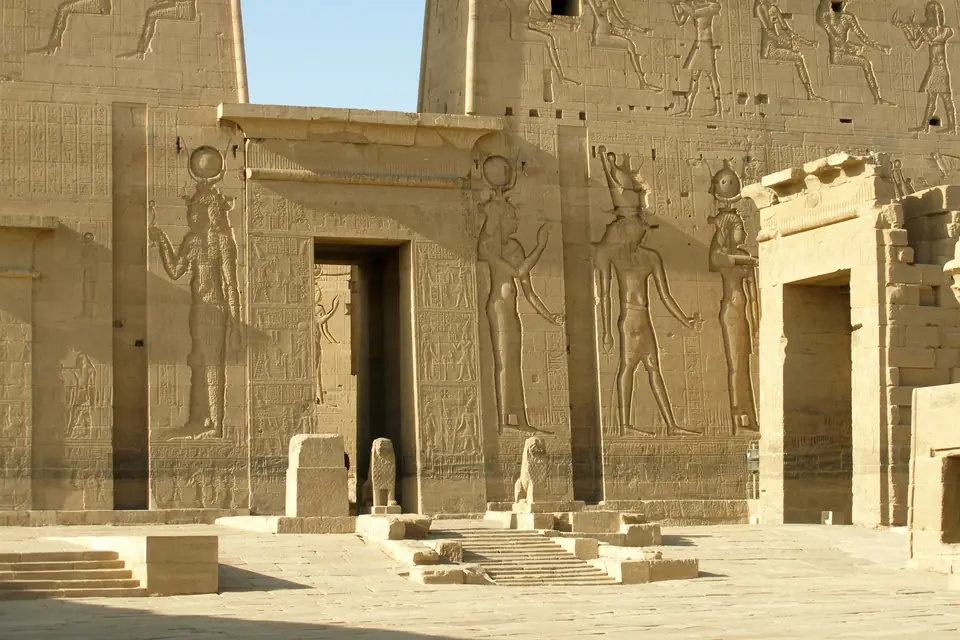
The first pylon is a two-towered façade covered in reliefs of the pharaoh before the gods. Set into its central passage is the gateway of Nectanebo I, from the fourth century BC, one of the two oldest pieces to survive on the island. In front of it the two obelisks that once flanked it are missing: one of them, bearing a cartouche of Cleopatra, ended up in an English garden and played a part in the decipherment of hieroglyphs that still sparks debate over who deserves the credit.
The stone is full of signatures. On the side wall of the passage, a block of capital letters records in French that on 3 March 1799 General Desaix’s division pursued the Mamluks beyond the cataracts; it was carved by the sculptor Castex, of Bonaparte’s expedition. On the jambs of the same passage, crosses are cut where the face of Isis used to be, a foretaste of what waits inside.
For the people along the river, these towers were for centuries not Isis’s at all. In the Islamic era the temple was taken for the fortress of Anas al-Wujud, the lover in a tale from the Thousand and One Nights, and the popular version tells of a young man who crossed the Nile in a most unusual way to free his beloved. How he did it is told in front of the pylon.
The house of Isis turned into a church
Hypostyle hall and sanctuary turned church
Summary of this stop
Past the pylon, the hypostyle hall unfolds columns with plant capitals. Among them stands something that does not belong in an Egyptian temple: a Christian altar. Under Bishop Apa Theodore, active around 525-577, the sanctuary of Isis became the church of Saint Stephen, and a Greek inscription on the doorway of the sanctuary still proclaims it.
The temple was not torn down. It was converted: figures were chiselled away, crosses were cut over the goddess’s faces, and the island came to have five temples transformed into churches and two churches built from scratch. The result is a building that reads in two religious languages at once, one on top of the other.
But before that change, on the portico ceiling, a pilgrim left on 11 December 452 the last known Demotic inscription, a very brief sentence and probably a drawing. What it says exactly and why it moves is something the audio guide points out with eyes on the ceiling.
The last hieroglyphic sentence in history
Hadrian's Gate and the Esmet-Akhom graffito
Summary of this stop
West of the temple, Hadrian’s Gate faces the Abaton of Bigeh. On it can be made out the chiselled figure of Mandulis, a Nubian god, and beside him a small text that closes three millennia of writing: on 24 August 394, the birthday of Osiris, the priest Nesmeterakhem, or Esmet-Akhom, carved the last known hieroglyphic inscription, accompanied by a parallel Demotic text.
That this sentence was written here is no coincidence. Philae was a frontier land: in 452 a treaty between the Roman commander Maximinus and the Blemmyes and Nobades of the south guaranteed these peoples access to the cult image of Isis, when pagan temples elsewhere in the empire had been shut for some sixty years. The official closure came in 537, when Narses the Persarmenian closed the temple on the orders of Justinian I, although some historians hold that the organised priesthood had already faded in the fifth century.
What the priest asked for in his inscription, and in what words, gives this gate a weight that is hard to forget. The narration reveals it in front of the stone.
The Pharaoh’s Bed and the island that drowned
Trajan's Kiosk
Summary of this stop
The route ends beside the east shore, at Trajan’s Kiosk, which locals call “the Pharaoh’s Bed”. It measures 15 by 20 metres and is 15.85 high, and its 14 columns, each with a different capital, supported a wooden roof that has vanished. Above the capitals, blocks 2.10 metres tall were meant to be carved as pillars of the god Bes and were left unfinished. It is attributed to Trajan because of an interior relief, although much of the structure may be older, perhaps from the time of Augustus.
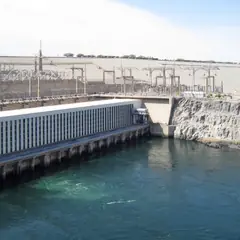
From here can be seen the reservoir where the original island lies. The Aswan Low Dam, completed by the British in 1902 and raised twice, left the temple underwater for most of the year: it surfaced only from July to October, and the flood stripped away the vegetation and the colours of the reliefs. The rescue began in 1972 with 3,000 steel sheet piles driven into the Nile bed and ended in 1980, with some 40,000 blocks of 2 to 25 tonnes rebuilt on Agilkia by the Italian firms Condotte and Mazzi Estero and the Egyptian High Dam Company.
In the early twentieth century the writer Pierre Loti rowed into the flooded temple on a cold February night and left in La mort de Philae a scene of Nubian boatmen, the moon and a stone sinking into the dark. That scene, told beside the water, explains better than any figure why Philae had to be saved.