National museum
Azerbaijan Carpet Museum Audio Guide (Azərbaycan Milli Xalça Muzeyi)
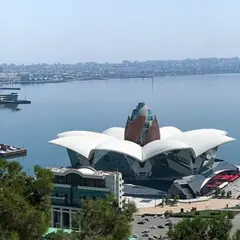
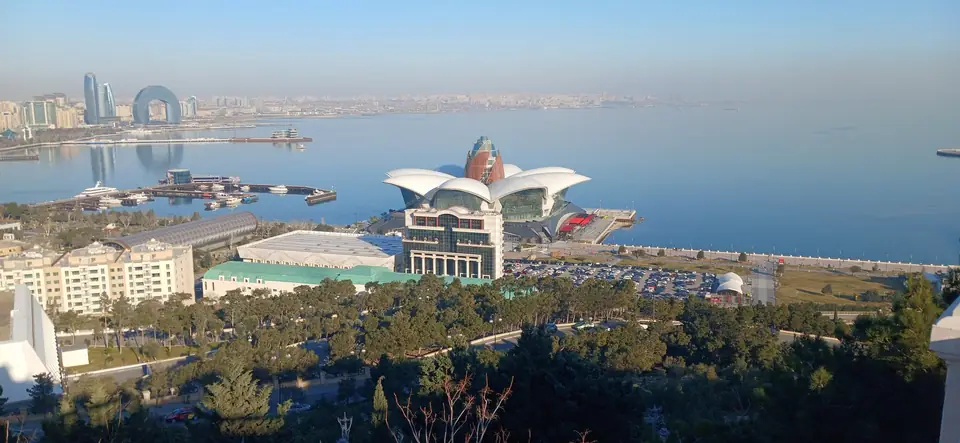
A building shaped like a half-rolled carpet, facing the Caspian, holds the world's first museum devoted to carpets and the pieces that left Shusha in the dark in the middle of a war.
- 60 min of audio
- Textile art
The Azerbaijan Carpet Museum was founded in 1967, on the initiative of the artist and scholar Latif Karimov, as the only museum in the world specialising in carpets. It moved through the Juma Mosque in the old city and the former Lenin Museum on the seafront before settling in 2014 in the building by the Austrian architect Franz Janz: five floors imitating a rolled-up carpet on Baku's boulevard.
Inside, the walls are read by region according to Karimov's classification, which arranged 144 styles into four schools. And among the antique pieces waits a section with another story: the carpets evacuated by night from the Shusha branch in 1992, without the copperware, which stayed behind.
Highlights
- Franz Janz building: a five-storey rolled carpet opened in 2014
- The four schools: Guba-Shirvan, Ganja-Gazakh, Karabakh and Tabriz, according to Latif Karimov
- Ajdahali carpet: S-shaped dragons from Karabakh, late 17th century, donated from Chicago
- Shusha collection: 183 pieces evacuated by night in February 1992
- Copy of the Sheikh Safi carpet: the original is in the Victoria and Albert Museum
On 13 March 1967, order no. 130 of the Council of Ministers of the Azerbaijan SSR created the State Museum of Carpets and Applied Folk Art in Baku. It had been driven by Latif Karimov, an artist and scholar of weaving, and at that moment there was no other museum in the world devoted solely to carpets. Five years later, on 26 April 1972, its first exhibition opened inside the Juma Mosque in Icherisheher, with Heydar Aliyev, then first secretary of the Communist Party of Azerbaijan, among those attending.
The history of the Carpet Museum is that of a collection that has never stopped moving: from the mosque to the former Lenin Museum in 1992, and from there, in 2014, to Franz Janz’s building on the boulevard, shaped like a half-rolled carpet. What to see at the Carpet Museum goes beyond wool: a building turned symbol, a classification that still organises the galleries, the pieces saved from Shusha and a founder full of paradoxes. In 2019 it received 122,143 visitors, the record in its history, and became the most visited museum in the country. Walking through it with the audio guide, researched and checked against historical sources, lets you link each floor to the story that explains it.
From the boulevard you can see, on the hill, Highland Park, the best viewpoint over the bay; and to complete the portrait of the country’s culture, the Azerbaijan History Museum is a short walk away.
A five-storey carpet by the sea
Carpet Museum
Summary of this stop
The visit begins outside, in the National Seaside Park, in front of the long, curved volume that from the boulevard reads as a half-rolled carpet facing the Caspian. The architecture of the Carpet Museum is the work of the Austrian Franz Janz and it opened on 26 August 2014, after six years of construction. The 2013 project gave it about 122 metres in length, 22 in width and 18 in height, and reserved the underground part for archives, storage, a laboratory and a restoration workshop.
This building is the last stop of a museum that began as the first of its kind. But it has its flip side: to raise it, the historic building that previously occupied the site was demolished. The narration returns to that decision in front of the facade itself, where the symbol and its price stand side by side.
The map of the four schools and the dragon that came back
Carpets of the four schools
Summary of this stop
In the regional schools gallery, the carpets of Guba, Shirvan, Baku, Ganja, Gazakh, Karabakh and Tabriz hang grouped according to the system of Latif Karimov (1906-1991), who catalogued 144 styles by locality and gathered them into four schools: Guba-Shirvan, Ganja-Gazakh, Karabakh and Tabriz. That classification still organises the exhibition, and one woven piece sums it up in a single design. Some researchers also read it as a map with political implications, a debate the tour presents cautiously and without taking sides.
Among the pieces the Ajdahali carpet stands out, the dragon one: a Karabakh carpet from the late 17th century with stylised S-shaped dragons, donated in 2013 by Beverly Schiltz, widow of the Chicago collector Grover Schiltz, along with a 19th-century Salyan Khilasi from Shirvan.
A popular belief adds another layer to those walls. Alisafa Nuriev, head of the Shusha branch and veteran of the Azerkhalcha cooperative, maintains that a good connoisseur reads the weaver’s mood in the knots: too tight would betray a tense morning; loose, a mind elsewhere. Impossible to prove, but it changes the way you look at each piece.
Shusha, 1992: what was saved without headlights
Shusha collection
Summary of this stop
The Shusha collection section, known as “Burnt Culture”, brings together carpets, jewellery and embroideries from the branch the museum opened on 19 May 1987 in the 19th-century Mehmandarov mansion. On 29 February 1992, 183 of its 246 pieces were evacuated to the interior of Baku, although some sources give much higher figures. The evacuation was done at night: a driver took out everything he could, in the dark and without headlights. Nearly all the carpets were saved; the heavy copperware stayed behind, and its absence is also part of the room.
Three decades later, on 10 May 2023, the branch reopened in its own city, in the upper-quarter building restored since 2021 by the Heydar Aliyev Foundation. And this chapter has room for a smaller, more intimate episode: a little Karabakh rug of 1971 with a dedication woven into the border, bought at an auction in 2017 to return it to its family. How that search ended is told in the narration, in front of the Shusha pieces.
Latif Karimov, between Stalin and the museum
Bust of Latif Karimov
Summary of this stop
On the floor devoted to the modern carpet, the bust of Latif Karimov recalls the man who obtained the museum in 1967. His prestige had an unexpected origin: in 1950 he received the first-class Stalin Prize for the carpet dedicated to Stalin’s 70th birthday. Seventeen years later, that same author drove the creation of the first carpet museum, which today holds carpets and sketches of his such as “Firdovsi”, “Vaqif”, “Səməd Vurğun” or “Əsrlərin nəğməsi” (“The Song of the Centuries”).
From here you can also follow the odyssey of the venues. The Juma Mosque was closed to worship in Soviet times but was not demolished, unlike most of Baku’s mosques, and it housed the first exhibition in 1972. In 1992 the collection moved to the former Lenin Museum on Neftchilar Avenue and the mosque became a place of prayer again. The founder’s more human side, that of his first weaving courses in Shusha, is left to the audio guide.
Sheikh Safi, the great Ardabil carpet
Copy of the Sheikh Safi carpet
Summary of this stop
On the fourth floor waits a copy of the Sheikh Safi carpet, the great Ardabil carpet, one of the most famous in the world. The original is not in Baku but in the Victoria and Albert Museum in London, and the replica brings to the Azerbaijani capital the design of a piece that would normally mean a trip to London.
This stop closes the tour with the balance of a museum that, through moves and rescues, reached in 2019 its record of 122,143 visitors, became the most visited in Azerbaijan and received the “National” status on 15 July that year. Why a carpet can occupy in this country the place of an entire house is the idea the narration ends on.