Oil magnate's palace
Azerbaijan History Museum Audio Guide (Azərbaycan Milli Tarix Muzeyi)
An oil magnate who could not read built himself a palace the size of a whole city block; the Bolsheviks took it from him in 1920 and made it the country's great history museum. The millionaire's house and the national story now share the same walls.
- 75 min of audio
- House-museum and prehistory
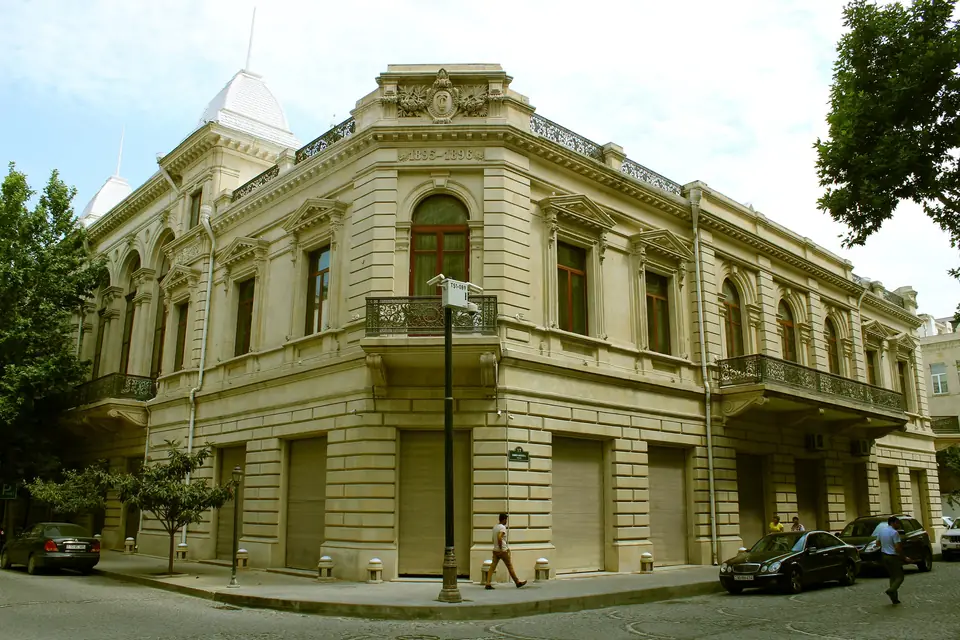
The residence of Haji Zeynalabdin Taghiyev was built in the late 19th century to a design by Józef Gosławski, chief architect of Baku, with some 270 craftsmen, among engineers, carpenters and painters, and a build cost of 1.2 million roubles, not counting furniture brought from Russia, France, America and Germany. Its Renaissance facade of Baku stone, with two loggias of three arches, announces from the street the two great halls of the second floor.
In June 1920, just confiscated by the Red Army, the mansion became a museum and was spared the fate of almost every house in the centre: it was not split into communal flats. But the new power wanted to erase its owner, and in the centre of the facade, above the balcony, the monogram with the initials ZT, deliberately chiselled away, is still in plain sight.
Highlights
- Oriental Hall: a Neo-Moorish salon of about 180 m² with Quranic verses in gold on the ceiling
- Sona khanum's boudoir: a mirrored ceiling and floral paintings rescued in 2000 from under four coats of whitewash
- Taghiyev's study and dining room: Brodsky's portrait, an Aivazovsky and the Emir of Bukhara's tableware
- The emir's sword: confiscated in 1920, with a dedication to a Bolshevik that could not be erased
- Azıx jaw: a pre-Neanderthal found in Karabakh in 1968, its wisdom tooth still firm
Few houses tell at once the rise and the fall of a man like the one Haji Zeynalabdin Taghiyev had built in the centre of Baku. The son of a cobbler, without a single day of schooling, he is said to have started as a boy carrying buckets on building sites for six kopeks a day, and ended up an oil magnate. His residence occupies an entire block and was built, according to the inscriptions on the pediment, between 1895 and 1901, although other sources give different dates for a work that advanced in phases.
The history of the Azerbaijan History Museum begins precisely with the loss of that house: the Red Army entered Baku in April 1920, confiscated the mansion and in June a resolution of the People’s Commissariat turned it into a museum. Since then the national story, starting with prehistory, has lived alongside the gilded salons, the mirrors and the millionaire’s furniture. Walking through it with the audio guide, room by room, lets you read the two superimposed histories: that of the private palace and that of the power that wanted to erase its owner.
The mansion rounds off Nizami Street, the showcase of the oil millionaires; whoever wants to continue with Azerbaijani art has the Azerbaijan Carpet Museum on the boulevard, and whoever prefers medieval Baku, the Palace of the Shirvanshahs in the Old City.
The scraped-off initials above the balcony
National History Museum of Azerbaijan
Summary of this stop
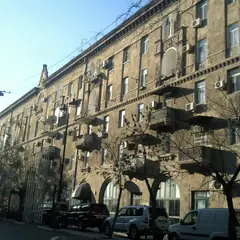
The visit starts on Taghiyev Street, in front of a symmetrical facade of stone from the Baku quarries: a rusticated ground floor, fluted domes and two great loggias of three semicircular arches. There is no central door, but two entrances, and the loggias give away from outside the twin salons of the second floor. The architecture of the Azerbaijan History Museum is that of a Renaissance palace designed to say, bluntly, that someone very rich lived there.
Behind it was Józef Gosławski, chief architect of Baku between 1893 and 1904, and a colossal project on which some 270 craftsmen worked, at a cost of 1.2 million roubles for construction alone. And at the centre of it all, above the great balcony window, an absence appears: Taghiyev’s monogram, with the initials ZT chiselled away in Soviet times so that nobody would remember who had built the house. What that scar in the stone means is truly understood by listening to the narration in front of it.
Gold, Quran and a scandal on the staircase
Oriental Hall
Summary of this stop
A compact staircase lined with large mirrors climbs to the Oriental Hall, the Neo-Moorish salon of about 180 m² where Taghiyev held receptions, official meetings and ceremonies. A portico of three arches on slender columns, tympana covered in plant motifs, a great gilded lamp and a coffered ceiling with Quranic verses: according to the museum, 9 kilos of gold were used in those inscriptions and ornaments, although other sources give smaller figures. Taghiyev’s own name is written in Arabic letters on the windows, and throughout the hall the six-pointed star of Solomon’s seal repeats, an amulet against the evil eye in Islamic architecture.
The salon also has a literary life: in the novel “Ali and Nino” it is the setting of the graduation ball of Ilyas Taghiyev, who really existed and was the youngest son of the magnate and his second wife, Sona. But the staircase also holds the house’s darkest episode, a drama of jealousy and honour in 1911 that ended with Baku’s great philanthropist in the dock and a trial followed across the Russian Empire. How it all began, at a breakfast, is left to the audio guide.
The illiterate millionaire and the emir’s sword
Taghiyev's study
Summary of this stop
The wood-panelled study keeps its desk, its bookcase, the portrait Isaak Brodsky painted of Taghiyev in 1912 with his decorations and Aivazovsky’s painting “Storm at Sea”. Next door, the dining room with velvet and silk walls displays the enamelled silver tableware given to him by the Emir of Bukhara alongside the French tableware with his monogram, and the library holds his books, most of which the museum keeps, with a rare set of the Brockhaus encyclopedia. The paradox is plain to see: the owner of those books could neither read nor write, and yet he financed the first translation of the Quran into Azerbaijani.
The museum also keeps the Order of the Star of Bukhara that the emir awarded him, a photo of the two taken in Baku in 1896 and a jewelled sword, a gift from the same emir. That sword is the first warning of the end: confiscated in 1920, it was handed to Yefremov, the Bolshevik who took Baku with the 11th Red Army, and it still bears the dedication that the museum tried to erase without success. What this part of the house reveals about the man who lived in it is left for the narration.
Flowers under four coats of whitewash
Sona khanum's boudoir
Summary of this stop
After the great salons comes a small, suddenly intimate room: the boudoir of Sona khanum, daughter of General Balakishi bey Arablinski, who married Taghiyev in 1896 with an age gap of more than 40 years and bore him five children. Its ceiling is made of cut mirror plates, which is why it is also called the Mirror Room, and in the centre stands a round sofa.
The walls tell another story. In the mid-20th century, in Soviet times, their floral paintings were covered with four coats of white paint as “bourgeois remnants”, and they did not reappear until the repair of 2000. The original paint of the main rooms was made with finely ground eggshell, the technique of Byzantine icon painters, and almost a hundred years later its colours had neither faded nor flaked. The harshest contrast of the house, however, is the fate of Sona herself after the family’s fall, a story the audio guide tells in this room.
From confiscated house to national memory
Azıx jaw
Summary of this stop
The tour ends in front of a display case with one of the oldest and most valuable pieces in the museum: the Azıx jaw, found in 1968 by Mammadali Huseynov in the Azıx cave in Karabakh. It belonged to a pre-Neanderthal woman between 18 and 20 years old, and of its three teeth only the wisdom tooth remains firm. It is the start of the story of an entire country, displayed inside a millionaire’s house.
That turn has a date: in 1920 the residence became a museum instead of being divided into communal flats, and for years it shared the building with other uses, from the Council of People’s Commissars to an archive of technical and medical documentation. Taghiyev, stripped of his property, obtained from Nariman Narimanov permission to keep a single possession, his summer villa in Mardakan, on the Absheron peninsula, where he died on 1 September 1924. Why Narimanov, whom the magnate had humiliated in public years earlier, did him that favour is the irony with which the visit ends.