Historic walk
Nizami Street Audio Guide (Nizami küçəsi)
The old Torgovaya, “the commercial street”, is the showcase that the millionaires of the first oil boom built for themselves in honey-coloured limestone. It has carried Nizami's name since 1940, but in Baku everyone still calls it Tarqovı.
- 45 min of audio
- Oil-boom architecture
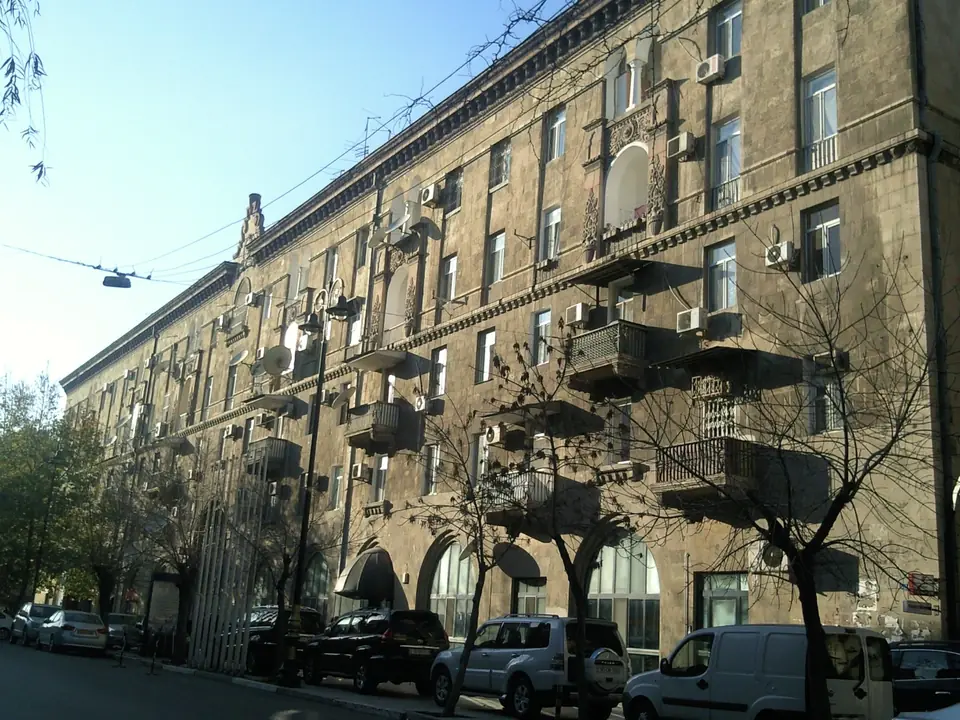
Nizami Street grew out of the first urban plan of the Baku governorate, from 1864, which took up the idea of the architect Gasim bey Hajibababeyov: streets radiating like sunbeams from the Old City. Its pedestrian stretch, between Fountain Square and Rashid Behbudov Street, brings together facades from three eras: those commissioned in the late 19th and early 20th centuries by the oil magnates, the Stalinist ones of the 1950s to 1970s and the present-day ones, the first two clad in aglay, the local limestone.
Every building has changed its life with the city: a synagogue of 1901 now bears a lyre on its pediment because since 1968 it has been the State Song Theatre, the house of the Taghiyev “brothers” was in fact built by two cousins, and the oilmen's houses of 1949, with their monumental vases, were built with the labour of German prisoners of war.
Highlights
- Naghiyev House (Nizami 48): Baroque facades by Józef Płoszko with red monograms, from 1910-1911
- Taghiyev Brothers' House (1912): the street's first four-storey building and one of the first in Baku with a lift
- Mukhtarov House (Nizami 79): semicircular facade and dome added by Płoszko around 1910
- Oilmen's houses (Nizami 66 and 83): muqarnas cornices, turrets and the “house of the vases”
- Opera and Ballet Theatre: the former Mailov Theatre, built in under 10 months and opened in 1911
Nizami Street is much more than Baku’s shopping artery. It measures 3,538 metres, from Abdulla Shaig Street in the upper part to the tracks of the old oil “Black City”, but its heart is the pedestrian stretch that starts at Fountain Square: the old Torgovaya, “the commercial street”, which Bakuvians still call Tarqovı. From 1888 photo studios, confectioners, florists and prestigious hotels such as the Bolshaya Moskovskaya, the Imperial and the London lined up here.
The history of Nizami Street is read in its names and in its stone. It was Krasno-Presnenskaya by a decree of 1925, took the name of the poet Nizami Ganjavi in 1940 and in 1962 merged with the old Gubernskaya; even that chronology is told two different ways depending on the source. Its facades signed by Józef Płoszko, I. V. Edel or Nikolai Bayev, its Stalinist houses and its two theatres make up a walk of five stops that the audio guide follows on foot, amid the conversation of oil money, Soviet power and the people who never stopped calling it Tarqovı.
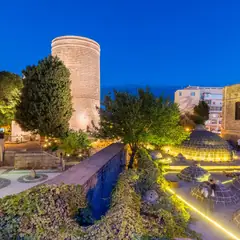
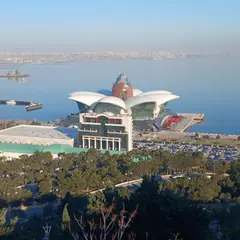
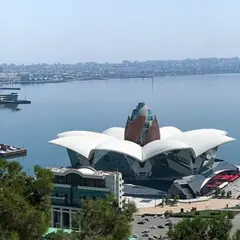
The street begins beside the walls of the Maiden Tower, and a block away the Taghiyev palace, now the Azerbaijan History Museum, shows from the inside how the owners of these facades lived. To see how far the city went a century later, the counterpoint is the Heydar Aliyev Center.
A plan shaped like a sun
Fountain Square
Summary of this stop
The walk begins at the mouth of the Passage, on Fountain Square. Its origin is far from here: the Shamakhi earthquake of 1859 moved the governorate’s capital to Baku, and the architect Gasim bey Hajibababeyov, a native of Shamakhi, proposed for the new seat a semicircular square “shaped like a sun” from which streets would radiate like sunbeams. That philosophy of radial streets from the Old City was set down in the urban plan of 1864, from which the street was born.
Underfoot, the wavy-patterned paving marks the stretch closed to all vehicles. According to a documented tradition, the Passage had a tram until it was closed to traffic around 1980, and in Soviet times paintings were sold here on the sly, until perestroika brought the painting sellers into the open. In this very corner a young Bakuvian lived a Cold War episode that the narration tells on the spot, in front of the sellers who now serve tourists in English.
Red monograms and the first lift
Naghiyev House of the monograms
Summary of this stop
At the crossing with Rasul Rza Street, the old Mariinskaya, two corners face each other in a contest of magnates. On one side, the house at Nizami 48, commissioned by the oilman Musa Naghiyev from Józef Płoszko and built in 1910-1911 (sources hesitate between the two years), with Baroque facades and red monograms. On the other, the house of the Taghiyev brothers, from 1912: the first four-storey building on a street of two and three floors, and one of the first in Baku with a lift.
Its semicircular corner, with mask corbels and a classical cornice, also holds a neighbourhood mix-up: Agha-Huseyn and Najafgulu Taghiyev were cousins, but the city always saw them together and called them brothers. Both houses belong to the first wave of facades, clad in aglay, the local limestone. Opposite the mansion of the monograms stands a low little house that nobody notices, and long-time residents have a story about it that the audio guide saves for this spot.
A dome on a rental house
Mukhtarov House dome
Summary of this stop
On the corner with Mardanov Qardashlari, a curved facade topped by a round dome sums up how oil made houses grow upwards. The house at Nizami 79 began in 1896 as a two-storey rental house, the work of I. V. Edel for the merchant Mnatsakanov; the oilman Murtuza Mukhtarov bought it in the mid-1900s and, around 1910, Płoszko raised it to four storeys with its semicircular facade.
Next to it, the house at Nizami 75, built in 1890-1896 by Hajji Rajab-Ali Hajiyev, housed the Vatan cinema on its ground floor in Soviet times. This is the stretch where the shine of the commercial Torgovaya is best felt, when A. Mishon’s studio, the most expensive in the city, charged 5 roubles for a photo with a backdrop when a worker’s wage was 10 roubles.
Oilmen’s vases, prisoners’ hands
Lev Landau's house
Summary of this stop
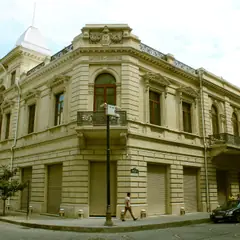
The crossing at the Landau house brings two eras face to face. At Nizami 64, a building of 1911 with corner towers, a lookout and a continuous balcony, Lev Landau, the future Nobel Prize winner in Physics, lived until 1924, as his plaque recalls. Around it, from 1949, rose the two oilmen’s houses (Nizami 66 and 83), by Mikayil Useynov and Sadig Dadashov: muqarnas cornices, turrets and large vases that gave the second its nickname, the “house of the vases”.
That Stalinist grandeur, the street’s second wave of facades, has an uncomfortable side: it was built with the labour of German prisoners of war. And at this same point the succession of names that Soviet power imposed on the old Torgovaya, from Krasno-Presnenskaya to Nizami Street, makes sense.
A lyre on the pediment
Opera and Ballet Theatre
Summary of this stop
The pedestrian stretch ends at Rashid Behbudov Street, the old Kaspiyskaya, where a temple with an Ionic portico shows its side facade to Nizami. It was a Neo-Greek style synagogue, dated to 1901 by some sources and to 1910 by another; on its pediment, where the Tablets of the Law once appeared, there is now a lyre, because since 1968 it has been the State Song Theatre founded by Rashid Behbudov.
Very close stands the Opera and Ballet Theatre, the former Mailov Theatre, which Nikolai Bayev designed for the magnate Daniel Mailov. It was built in under 10 months, with 200 workers in three shifts and more than 250,000 roubles, and opened on 28 February 1911. It survived a serious fire in 1985 and since May 2022 has been undergoing a new complete restoration. Disputed versions circulate about its origin, and an urban legend that swaps patronage for spite closes the walk in the audio guide.