UNESCO heritage
Maiden Tower Audio Guide (Qız Qalası)
A limestone cylinder shaped like a “9” that nobody has managed to date or fully explain: it was a lighthouse of the Russian Empire, it appears on manat banknotes, and around it Baku has woven its best-loved legends.
- 45 min of audio
- 19th-century lighthouse
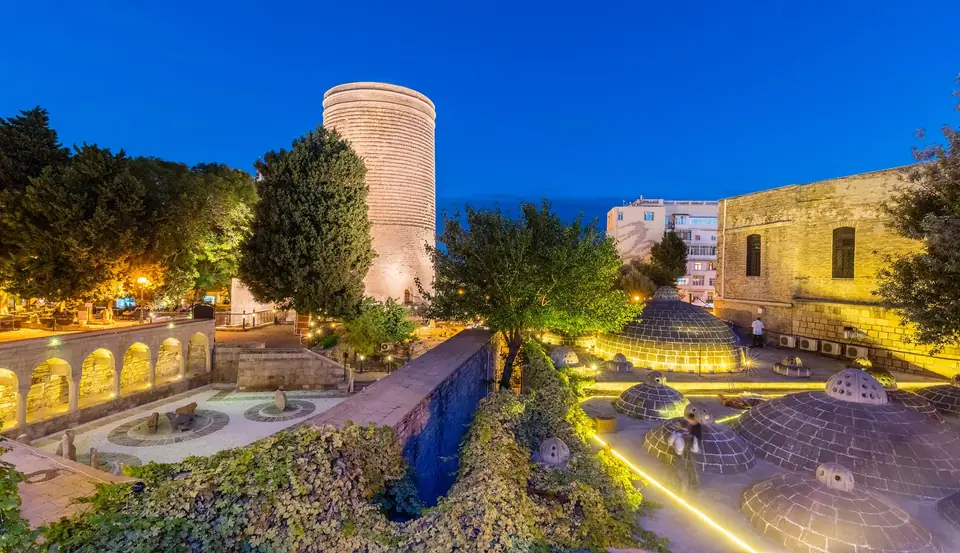
The Maiden Tower is the emblem of Baku and the most enigmatic monument of the Old City. Its walls, 5 m thick at the base, rise 31 m on the north side from a rock sloping towards the sea, and inside they hide 8 floors covered by flat stone domes. A museum since 1964, it joined the UNESCO World Heritage List in 2000 together with the walled city and the Palace of the Shirvanshahs.
Its history is full of open questions: proposed dates span more than two millennia, and its original function is debated between fire temple, observatory, defensive tower and signal lighthouse. The only well-documented chapter is its life as a lighthouse: between 1858 and 1907 its lantern guided ships on the Caspian, until the lights of the growing city made it indistinguishable.
Highlights
- Seaward buttress: the projection that turns the plan into a “9” and anchors the tower to the rock
- Kufic slab at 14 m: the inscription of Masud ibn Davud, set into the wall at a later date
- 13 m well hidden in the wall, with drinkable water and in use since the 12th century
- Door to nowhere on the fourth floor, tied to a hypothesis about the winter solstice sun
- Rooftop viewpoint over the Old City and the bay, where the lighthouse lantern stood (1858-1907)
The Maiden Tower, Qız Qalası in Azerbaijani, stands on the edge of Baku’s Old City like a grey limestone cylinder with a massive buttress attached on the seaward side. It is 31 m high on the north side and 28 m on the south, 16.5 m across at ground level, and it appears on Azerbaijan’s banknotes and coins. Even so, nobody has settled the two basic questions about its history: when it was built and what for. Some argue for a fire temple of the 8th-7th centuries BC, others place its lower part between the 4th and 6th centuries, and others settle on the 12th century of an inscription now known to have been added later.
Baku has filled that gap with legends: the princess who asked for a tower by the sea to escape an imposed fate, or the girl with fiery hair born from a sacred flame during a siege. The legend inspired Jafar Jabbarly’s poem (1923), the first Soviet film shot in Azerbaijan (1924) and the first Azerbaijani ballet, by Afrasiyab Badalbeyli (1940). The audio guide takes you around the tower outside and then through its walls, floor by floor, up to the rooftop, with an account researched and checked against historical sources.
A few steps away, inside the same walls, the Palace of the Shirvanshahs completes the visit to the Old City; leave through its gates and Nizami Street begins, the Baku that oil built.
A stone “9” driven into the rock
Maiden Tower
Summary of this stop
The tour starts beneath the buttress on the east side, the great projection that climbs almost to the top and that, seen in plan, draws a “9”. Excavations in 1962-1963, which went 5 m below the ground-floor level, showed that the tower rests on a large rock sloping towards the sea and that this buttress works as its main support against the slope. In 1964 large timber beams were also found running into the wall from the foundations.
At the foot of the tower another, lesser-known story survives. According to local Christian tradition, the apostle Bartholomew was crucified here around AD 71; an Orthodox chapel, the work of Johann Edel, was built on the spot in 1892 and demolished in 1936 during the Soviet campaign against religion. Its ruins came to light in 1964, and every 24 June, early in the morning, the Orthodox diocese of Baku holds a sung service on its foundations. The narration explains on the spot what that buttress reveals about how the tower stays upright.
A 12th-century signature that came late
Raised west door
Summary of this stop
On the outer wall, 14 m up, a small slab measuring 0.4 x 0.6 m carries two lines of Kufic script: “dome of Masud ibn Davud”. The orientalist N. Xanıkov was the first to read it, and its lettering is dated to the 12th century, the most quoted date for the tower. But conservation studies begun in 2008 concluded that the slab was set into the wall later: it is roughly wedged into the masonry and its stone is paler than the rest. Who Masud ibn Davud was, an architect, a patron or a nobleman who wanted to perpetuate his name, is still debated.
On the west side is the only door, an arched opening 1.10 m wide raised 2 m above the old ground level, with a passage as long as the wall is thick and several wells in front of it. Inside, between the first and second floors there is no fixed staircase: you climbed through the central hole in the ceiling with a rope or a ladder. Everything points to a building meant to withstand attack, not to receive visitors.
The door that leads nowhere
Fourth-floor door to nowhere
Summary of this stop
Once inside, the vaulted ceilings of each floor have a circular opening aligned vertically with the others, and on the third floor opens the mouth of a well 0.7 m in diameter hidden in the southeast wall. It drops 13 m hugging the stone, its water has no connection with sea level, tested drinkable in chemical analysis, and finds indicate it was in use from the 12th century.
On the fourth floor waits the most talked-about oddity: an exterior door that opens onto the void, with the slot of an old wooden crossbar that served as a bolt. Abbas Islamov and Ronnie Gallagher observed that at the winter solstice the sun rises in the southeast framed exactly in that opening as seen from inside, and Islamov photographed it on 21 December 2005. Whether this was the builders’ intention or pure coincidence has never been proved, and the audio guide poses that question in front of the door itself.
A lighthouse put out by Baku’s lights
Rooftop viewpoint
Summary of this stop
The rooftop, surrounded by plexiglass screens since 2011, looks out over the lanes and minarets of the Old City, the boulevard and the bay. The lighthouse lantern stood here: it was installed in 1858, after the wreck of the steamer Kuba off Cape Shuvalan, with oil lamps and reflectors visible up to 8 nautical miles. In 1895 a wide white band was painted near the top so that ships could tell the tower apart by day, as its grey limestone blended into the landscape.
In 1907 the growing city ended the lighthouse: its light was lost among the street lighting, and the role passed to Böyük Zirə island, off the bay. From up here you can also grasp the most popular legend, that of the maiden who, according to tradition, threw herself into the sea from the top. Today the sea is a block away, but the level of the Caspian has risen and fallen over the centuries, and the narration ends by looking towards the place where the waves may once have broken.