Viewpoint and memorial
Highland Park Audio Guide (Dağüstü park)
The highest view over Baku bay is enjoyed from a hill that was a multi-faith cemetery, a Soviet park presided over by Kirov and, since January 1990, the national pantheon of the martyrs.
- 45 min of audio
- 20th-century memory
Highland Park, Dağüstü park in Azerbaijani, crowns the hill beside the Flame Towers. Its history begins in 1883, when the Baku Duma opened the Pirvanzari cemetery here, with Muslim, Orthodox, Catholic, Lutheran, Jewish and Molokan sections. In the 1930s the cemetery was levelled to lay out Kirov Park, and since 1990 the summit has housed the Şəhidlər Xiyabanı, the Martyrs' Lane, with the Eternal Flame monument opened in 1998.
The layers are still there, one on top of another: headstones of the old cemetery that ended up as building material, a statue of Kirov that fell without anyone noting the exact day, three dead of 1918 who turned up when the 1990 graves were dug, and glass towers raised over the former Catholic section. Only a perforated rock, venerated since ancient times, stood firm through all those changes.
Highlights
- Bay viewpoint: the Old City, the boulevard and the Caspian from the highest point
- Eternal Flame monument: an eight-pointed star and a glass dome with a gilded frame (1998)
- Şəhidlər Xiyabanı: more than 150 black marble headstones of the victims of Black January 1990
- Pirvenzere rock: a sacred stone with a nameless tomb carved inside it
- 1918 memorials: red granite for 1,130 Ottoman soldiers and the wall of the British soldiers
Few views of Baku match the one from Highland Park: at the foot of the hill stretch the Old City, the seafront boulevard and the whole curve of the bay. But the history of Highland Park goes far beyond the viewpoint. In 1883 the Baku Duma opened the Pirvanzari cemetery on this summit, and the city plan of 1899 draws it divided into Muslim, Orthodox, Catholic, Lutheran, Jewish and Molokan sections, with several chapels. In 1918 it received the victims of the March Days and the Ottoman and British soldiers killed in the battle of Baku.
In the 1930s the graves disappeared under Kirov Park, with its giant statue and its nights of fireworks over the Caspian. And in January 1990 the hill changed function again: the victims of Black January were buried here, and since then it has been the pantheon where Azerbaijan honours its martyrs and a regular stop for official visitors, from John Paul II in 2002 to Pope Francis in 2016. What to see at Highland Park is therefore also which layers of the country’s history you tread on each terrace. The audio guide, researched and checked against historical sources, walks through them stop by stop on the ground.
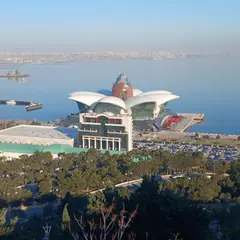
At the foot of the hill, on the boulevard, the Azerbaijan Carpet Museum can be recognised from above by its shape of a half-rolled carpet, and at the far end of the bay the white silhouette of the Heydar Aliyev Center appears.
The summit where Kirov greeted the bay
Highland Park
Summary of this stop
At the very top of the park the panorama takes over everything: the Old City and the boulevard lie far below, and the Caspian opens to the horizon. Yet the most eloquent thing about this spot is what is no longer there. In 1939 a great statue of Sergey Kirov in granite and bronze was raised here, the work of the sculptor Pinkhos Sabsay and the architect Lev Ilyin, with its right arm raised over the city and a pedestal on which workers extracted oil and harvested grapes. Among those who inaugurated it was Mirjafar Baghirov.
For half a century it presided over Baku. On 26 August 1991 the city’s executive authority ordered the statues of Lenin, Kirov, Dzerzhinsky and Fioletov to be taken down; the newspaper Sahar announced the removal of Kirov’s on 5 January 1992, and its bronze ended up as scrap at the city’s Industrial Centre. Some sources date the removal to 1991, others to the first days of 1992. Today not even the pedestal remains, and how that giant fell is an episode the narration keeps for when you stand on the summit.
A sacred rock among vanished headstones
Perforated Pirvenzere rock
Summary of this stop
Below where Kirov stood, on the slope, an enormous rock pierced by a hole appears, with its name written on the stone: Pirvenzere. “Pir” means sacred place. According to local elders, between the 19th and 20th centuries the Muslims of Baku attributed a miraculous power to it, and childless women came to it in order to conceive. Through the hole you can make out a rectangle carved into the rock like a tomb, of unknown owner and probably pre-dating Islam. The hill’s cemetery grew up around it.
In 1931 Lev Ilyin was commissioned to design the park, and on his second visit to Baku he found the summit abandoned, with forgotten headstones lying side by side. The cemetery was razed and, given the shortage of stone, its own headstones were used as building material. The exact date and the reason are still disputed: sources of the period speak of urban sanitation, others read it as an attempt to erase the memory of the victims of 1918. The rock, on the other hand, was left standing a few metres from the monument’s staircase, and some still credit it with healing powers.
From the 9 May fireworks to the Eternal Flame
Eternal Flame monument
Summary of this stop
Beside the terrace open over the bay stands the Eternal Flame monument, designed by the architect Elbay Gasimzade, ordered by decree of Heydar Aliyev and inaugurated on 9 October 1998: a mausoleum on an eight-pointed star, crowned by a glass dome with a gilded frame, the flame burning inside. In 2007 its columns were raised and the star and the octagonal mirror were gilded.
In Soviet times this same spot was a place for family strolls and concerts, and every 9 May Bakuvians climbed up to watch the fireworks over the Caspian. Everything changed on 20 and 21 January 1990, when more than 120 graves were dug in the park and the bodies of the victims of Black January were carried on shoulders from Azadlıq Square through the streets of Baku, in a funeral that lasted five hours.
That funeral is remembered every 20 January: thousands of people climb up from first thing with red carnations, the flower of mourning in Azerbaijan since 1990, and at 12:00 the country stops for a minute of silence amid the sirens of ships, cars and trains. What happens that noon underground, in the metro, is one of the moments the audio guide tells at this point.
Ilham, Fariza and the nameless headstones
Şəhidlər Xiyabanı
Summary of this stop
The Şəhidlər Xiyabanı, the Martyrs’ Lane, is a row of black marble headstones lined against a white wall, with the faces of the victims of Black January engraved in the stone and dates that range from teenagers to the elderly. Figures vary by source: some speak of 126 buried, others of 159 tombs or more than 150 headstones. The first, at the entrance, is that of the Allahverdiyev couple: Ilham, aged 27, died from Soviet gunfire on 20 January 1990, and Fariza, aged 19, took her own life on learning of his death.
When the graves were dug in January 1990, the remains of three victims of the March 1918 massacre turned up on the hill, the year in which the Muslim section of the old cemetery had received the dead of the March Days and, in September, the Ottoman soldiers of the battle of Baku. Those three bodies were buried on 22 January beside the new martyrs, under the inscription “Martyrs of 1918”.
Among so many portraits some headstones say only “Naməlum”, unknown. Today the lane counts four nameless tombs, and the story of who lies beneath them is one of the quietest of the place; the narration saves it for the moment of standing in front of those stones.
1918 memorials in the shadow of the Flame Towers
Şəhidlər Məscidi
Summary of this stop
The tour ends at the memorial to the 1,130 Ottoman soldiers of the Army of Islam who fell in the battle of Baku in 1918: a truncated pyramid of red granite with crescents and stars in white marble, inaugurated on 15 September 1999 before Süleyman Demirel and Heydar Aliyev, with walls recording names, ranks and places of origin. Beside it, the Martyrs’ Mosque, opened in 1996, stayed closed between 2009 and 2017. Nearby, a small wall remembers the British soldiers who died in Baku that same year, a memorial that has proved more controversial than the Turkish one.
Those British soldiers were buried in the Catholic section of the cemetery, on the ground now occupied by the Flame Towers, finished in 2012, whose facades project flames over the city every night. When the cemetery was demolished, the remains of Huseyn Arablinski, Jalil Mammadguluzadeh and Abdurrahim bey Hagverdiyev were moved to the Alley of Honour, but the tombs of Samad bey Mehmandarov, Alirza Rasizade and Zivar bey Ahmadbeyov, the chief architect of Baku who had designed on this hill a hexagonal mausoleum for the fallen Azerbaijanis and Turks of 1918, were lost. With those lost tombs the circle of 1918 closes, and the audio guide goes through it in front of the memorials themselves.