Kinetic sculpture
Ali and Nino Audio Guide
Two eight-metre steel silhouettes that seek each other out every evening, pass through one another without touching and part again on the Black Sea shore. Batumi christened them with names from a novel; their creator had imagined a nameless man and woman.
- 25 min of audio
- Kinetic art by the sea
At the start of Batumi Boulevard, beside the port, the Ferris wheel and the Alphabet Tower, stands the sculpture the city knows as Ali and Nino. Tamara Kvesitadze designed it in 2007 under the title “Man and Woman” and it was installed on the shore in 2010, created together with Paata Sanaia: two 8-metre figures made of metal discs, about 7 tonnes in all, mounted on a moving platform.
What many photograph as a monument to love was born, according to its creator, from a personal wound: the idea of being with someone for only a moment and then losing them. She never linked it to Kurban Said’s novel; the name was given by the people of Batumi. And in 2015, when it was moved away from the sea that was undermining its base, one of the figures ended up against a concrete wall.
Highlights
- Two 8-metre steel figures — series of metal discs totalling about 7 tonnes
- Daily cycle from 19:00 — about 10 minutes of contactless crossing under coloured lights
- Rotating platform — lets one figure pass through the other
- The 2015 move — Nino’s fall, the restoration and the glass case over the base
- A novel’s name — Kurban Said’s Azeri-Georgian couple, published in Vienna in 1937
At dusk, at the far end of Batumi Boulevard, the crowd sits on the wooden benches and waits. At 19:00 the two steel figures begin to turn, approach one another, merge and part in a cycle of about 10 minutes, lit by coloured lights. This is the Ali and Nino sculpture, the work of Tamara Kvesitadze, designed in 2007 as “Man and Woman” and installed facing the Black Sea in 2010 (some sources say 2011). In 2016 it appeared among the ten most romantic statues in the world, and tourists simply call it the “Statue of Love”.
But the story of Ali and Nino has more layers than the postcard: a title its creator did not choose, a novel published in Vienna in 1937 under a pseudonym that is still disputed, a mechanism that makes the impossible possible and a troubled move in 2015. The audio guide covers the sculpture in three stops, with narration that is documented and checked against sources, to explain what to see at Ali and Nino while the cycle unfolds in front of you.
The figures stand at the start of Batumi Boulevard, about 300 metres from the Alphabet Tower. Following the coast northwards, the Black Sea leads to the terraces of the Batumi Botanical Garden.
A man and a woman the city renamed
Ali and Nino
Summary of this stop
Standing before the two figures, the first surprise is the name. The piece was conceived as “Man and Woman”, and among the titles its creator weighed were also “Love” and “Adam and Eve”. It was the people of Batumi who ended up calling it “Ali and Nino”, after the couple in Kurban Said’s novel: the Muslim Azerbaijani aristocrat Ali Shirvanshir and Nino Kipiani, the Christian daughter of a Georgian prince. Sources disagree on what the official title is today, and Kvesitadze herself never connected the work with the book: she conceived it from a personal wound, as the idea of being with someone for only a moment and then losing them.
In front of the steel, almost always the same question comes up: whether Ali and Nino really existed. Legend has it that their love was real, and in Georgia the story is also known as “the Romeo and Juliet of the Caucasus”. Most people regard it as a product of the novelist’s imagination, yet old photographs labelled “the real Ali and Nino” even circulate online, with no archive, date or names to show who the sitters are. What the narration says on the spot about that doubt changes the way the couple looks.
The mechanism: discs that pass through each other without touching
Rotating platform and glass case
Summary of this stop
From the benches by the pedestal, the architecture of Ali and Nino can be appreciated: each figure is 8 metres tall (some of the 2015 press said 7) and is made of series of metal discs mounted on a moving platform. That design lets one silhouette pass through the other without ever touching. The contactless crossing fits the novel’s ending uncannily well, which takes place not in Batumi but in Baku: around 1920 Nino flees to Georgia with her daughter while Ali stays behind and dies defending the city of Ganja.
Behind the movement lies a little-known biography. Kvesitadze, an architect by training, made a living in 1990s Tbilisi making collector dolls with porcelain faces, inspired by an old French doll found in a drawer of her grandmother’s. She then met Paata Sanaia, with whom she founded TamaraStudio in 2000 and who has built the mechanisms of her kinetic sculptures ever since. In 2007 the two, together with Zura Gugulashvili, signed the RE-TURN project in the Georgian pavilion at the Venice Biennale. The obsession with movement also has a philosophical origin, which the audio guide reveals beside the platform.
Nino’s fall beside the Ferris wheel
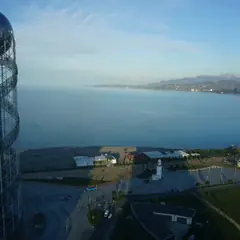
Ferris wheel and Black Sea shore
Summary of this stop
Looking towards the Ferris wheel and the sea, the sculpture’s recent history can be read. Until 2015 it stood about 50 metres away, closer to the shore, until the sea began to undermine its base. On 26 August of that year, as it was being hoisted for the move, a cable snapped and one of the figures fell against a concrete wall; most sources say it was Nino, although the company in charge denied any breakage and spoke of a slight scrape. The episode turned into a political quarrel: the opposition United National Movement called it a “barbaric act” against a work erected under the previous government. In September the sculpture reopened restored, with a glass case over the base plate, the pedestal clad in granite and wooden benches around it; the move cost about 185,550 lari.
The creator was not convinced by the new neighbour. At the reopening, Kvesitadze said that beside the Ferris wheel the work is hard to understand, because it is unclear whether it is an attraction or something more, and she hoped that one day one of the two figures would move. The question took on another dimension when, in 2019, an 8.5-metre replica, half a metre taller than the original, was installed beside a beach in Vietnam. Where that distant twin points, and what it says about the fate of the Batumi couple, is the closing note heard facing the sea.