Seafront icon
Alphabet Tower Audio Guide (Alphabetic Tower)
A hundred and thirty metres of steel up which the 33 letters of the Georgian alphabet climb in a DNA-like double helix to a glass sphere with a revolving restaurant. A national emblem of 2011 that was once leased for one lari.
- 30 min of audio
- Contemporary engineering
The Alphabet Tower went up beside Batumi’s port in little more than a year: work began on 10 October 2010 and the exterior was finished in December 2011. It was signed by the Spanish engineers Alberto Domingo Cabo and Carlos Lázaro of the Valencian firm CMD Ingenieros, and its architecture is that of a habitable sculpture: eleven lattice modules of steel tube, a core with panoramic lifts and an outer ring holding a skin of four-metre aluminium letters.
The contrast comes with recent history. Conceived as a symbol of a country looking upwards, with 64 million lari invested, by 2014 its lift was stopped and hundreds of dead birds lay on its floors. In 2015 the city hall, which spent 700,000 lari a year maintaining it, leased it for 20 years to a Spanish company in exchange for a single lari. And every night its letters still light up over the sea.
Highlights
- Double helix of letters — the 33 of the Mkhedruli alphabet, 4 m tall and in aluminium
- Glass sphere — between 27 and 30 m across, glass triangles and five floors
- Revolving restaurant — a floor on 40 wheels that completes a full turn in 60 minutes
- 50-tonne pendulum — a mass damper that curbs the sway from the wind
- LED letters — luminous outlines that turn the tower into a column of writing at night
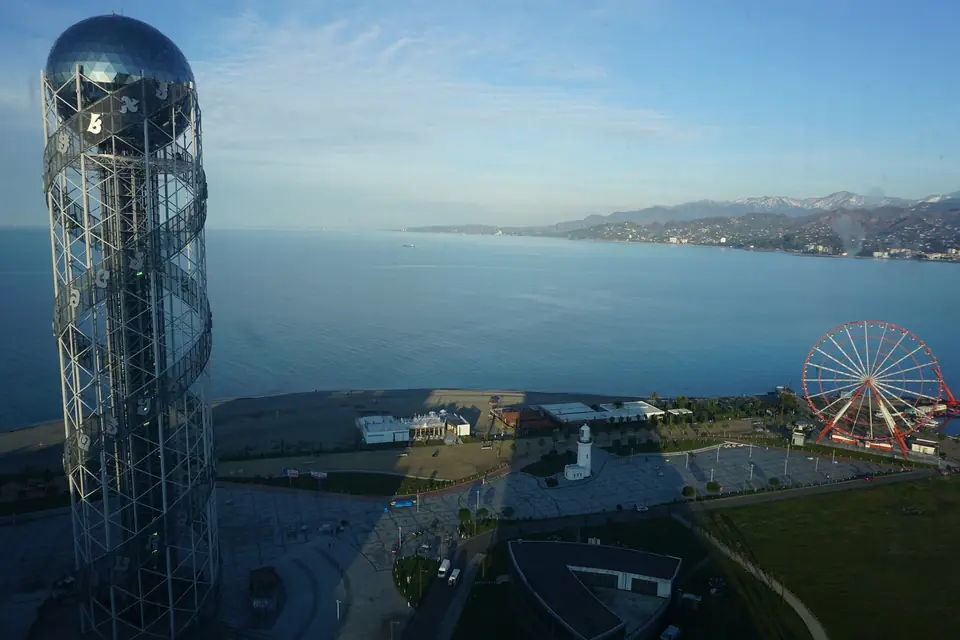
On Batumi’s seafront, between the port and the boulevard’s skyscrapers, stands a tower unlike any other: a 130-metre steel shaft around which two spiral bands coil, inspired by the DNA double helix, carrying the 33 letters of the Georgian alphabet. At the top, a glass sphere houses a restaurant whose floor turns on itself. Anyone looking for what to see at the Alphabet Tower finds at once a monument to writing and a piece of engineering: it was designed by the Spaniards Alberto Domingo Cabo and Carlos Lázaro of CMD Ingenieros, and built between October 2010 and December 2011.
The history of the Alphabet Tower is also that of an era. It was born in the middle of President Mikheil Saakashvili’s building drive, paid for with 65 million lari allocated by the city hall and the President’s Fund, and in barely four years went from national emblem to a nearly abandoned building leased for one lari. Today it still stands, in use and lit every night. The audio guide goes round its silhouette from Miracle Park, its base and the lift entrance, with narration that is documented and checked against historical sources.
The tower shares the seafront with Ali and Nino, the steel couple that pass through each other every evening about 300 metres away, and with the gardens of Batumi Boulevard, which follow the shore for seven kilometres.
Thirty-three readable letters in a double helix
Alphabetic Tower
Summary of this stop
From Miracle Park, what from afar looks like an ornament turns out to be writing: every shape climbing the tower is a letter, four metres tall and made of aluminium. They are the 33 of Mkhedruli, the modern Georgian alphabet. Georgian once had 38 letters and lost five in the reforms driven by Ilia Chavchavadze in the 1860s, so the tower shows the alphabet as it is written today.
The origin of those letters is another story, and a disputed one. The Georgian tradition of the Lives of the Kings of Kartli attributes the invention of the alphabet to King Parnavaz I in the 3rd century BC, an account now considered legendary because no excavation confirms it. The Armenian tradition, which begins with Koryun, biographer of Mesrop Mashtots in the 5th century, holds that the creator of the Armenian alphabet also invented the Georgian one, a passage the historian Ivane Javakhishvili considered a later addition.
The tower, in short, celebrates an alphabet whose inventor nobody has been able to prove. Which arguments still set the two neighbouring nations against each other is left to the narration, with the letters in view.
A one-year build with letters assembled at ground level
Lattice base and ring of letters
Summary of this stop
At the foot of the tower, the scale of the Alphabet Tower’s architecture can be appreciated. The shaft consists of eleven lattice modules of steel tube forming two concentric bodies: an inner core with panoramic lifts and stairs, and an outer ring holding the skin of letters. Everything rests on a foundation slab 34 metres wide and four deep.
The letters were not fitted at height: they were equipped at the factory with LED strips tracing their outline, fixed to the two spirals at ground level and only then hoisted into their final position. That explains why the exterior was finished in little more than a year.
The works coincided with Saakashvili’s dream of turning Batumi into the “Las Vegas of the Black Sea”. In October 2010 the president announced a modernist tower for the city and compared it with the Eiffel Tower; given the dates, he was probably referring to this one. Around it the plot for a Donald Trump development was being cleared and a large hotel was rising: a portrait of an era that the audio guide completes on site.
A glass sphere with a revolving floor and a pendulum
Lift core and glass sphere
Summary of this stop
From the entrance to the panoramic lifts, the view climbs the lattice core to the sphere at the top: a ball between 27 and 30 metres across, clad in two-metre glass triangles, which spreads over five floors a television studio, the kitchen, a restaurant, a 250 m² viewing deck for 200 people and the damper room. The restaurant floor, at the sphere’s equator, turns on 40 wheels and completes a revolution in exactly 60 minutes.
Higher up hangs a 50-tonne tuned mass damper, a pendulum designed to curb the sway from the wind; from the viewing deck, when it is open, its movement in strong wind can be seen. The original plan reserved the sphere for an observatory, a television studio and a restaurant, but the use changed and today it works mostly as the restaurant, with a tourist information point and photographs of old Batumi at the foot of the lift.
In 2012, with the tower freshly finished and closed, a travel writer who sneaked in as far as the lift asked the guards what the place was. The answer he received, after a pause, has something of a prophecy about it, and is best heard beneath the sphere itself.
From national emblem to a one-lari lease
Lit letters over the boulevard
Summary of this stop
From the seafront promenade, the tower can be seen whole, and with it its most recent history. To build it, 65 million lari were allocated and construction consumed 64. Almost as soon as it opened it fell into disuse: in 2014 the lift did not work and there were hundreds of dead birds on its floors, although the building was still powered and looked almost new.
In May 2015 Batumi city hall, which spent 700,000 lari a year maintaining it, leased it for 20 years to a Spanish company for one lari, about 0.36 euros. An enormously expensive monument handed over for less than a coffee.
At nightfall, the LED outlines of each letter switch on and turn the tower into a column of luminous writing above the boulevard. That image closes the audio guide’s tour, and with it the question of what remains of an era that dreamed big.