Batumi’s only active mosque
Orta Jame Mosque Audio Guide
The 19th-century “middle mosque” that outlived its two neighbours and years as a Soviet military store, and that is now so small that every Friday prayer spills onto the pavement.
- 25 min of audio
- Georgian Islam of Adjara
Orta Jame stands on the site of the Ahmediye, Batumi’s first mosque, built in the 1830s beside the residence of the Georgian Muslim nobleman Ahmed Pasha Khimshiashvili. That one was of wood and burned down; in its place stands a white two-storey building on a rectangular plan, with a tall minaret on one corner and a golden dome in the centre, which today rises above the rooftops of Kutaisi Street.
Its name describes a vanished landscape: it was the middle mosque between two others, and both were demolished. The one still standing is the only active mosque in a city with about 39,000 Muslims according to the 2014 census, and on Fridays those who cannot fit spread their prayer rugs in the courtyard and in the street.
Highlights
- Golden dome and white minaret — visible above the rooftops of Kutaisi Street
- Carved doors — the vine with grape clusters, a Georgian motif, at a mosque entrance
- Painted hall — ornaments in pinks, greens and blues by an unnamed Laz master
- Soviet military store — closed to worship in 1935 and reopened in 1946
- Friday prayer — worshippers who cannot fit pray in the courtyard and on the pavement
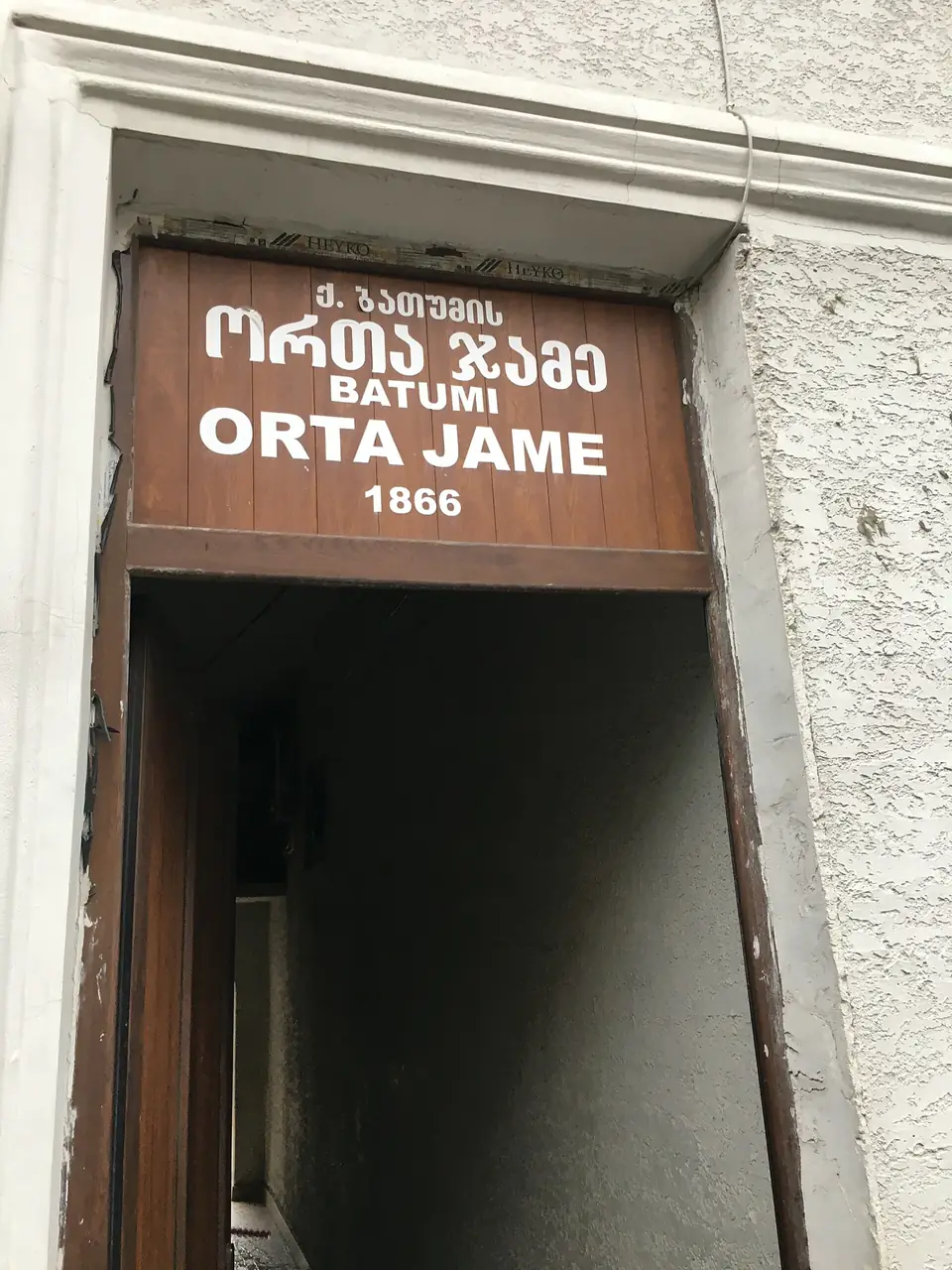
Among restaurants, tea houses and shops on Kutaisi Street, in Batumi’s so-called “Turkish quarter”, stands a white building with a golden dome that holds almost two centuries of the city’s history. The history of the Orta Jame mosque begins in the 1830s, when Ahmed Pasha Khimshiashvili, a Georgian Muslim nobleman and deputy governor of Lazistan, moved his residence to the south-west shore of the bay and built beside it the Ahmediye, Batumi’s first mosque. It was of wood and burned down, and on its site the present Orta Jame was built in the 19th century. The exact date remains disputed: some sources give 1866, others 1886 and others place it in the late 1890s, and there is no agreement either on which branch of the Khimshiashvili family, or which residents, paid for the work.
What is documented is its later course: it operated without interruption until 1935, served as a military store in Soviet times and returned to worship in 1946. Today it is Batumi’s only active mosque and the centre of a community, mostly Georgian Muslims from Adjara, that no longer fits inside. The audio guide tour, documented and checked against historical sources, runs from the façade to the prayer hall and ends in the courtyard where every Friday the prayer spills into the street.
Batumi Cathedral, born Catholic and now Orthodox, is about 500 metres away, and Europe Square, with its golden Medea, a few minutes’ walk.
A middle mosque left alone
Orta Jame Mosque
Summary of this stop
From Kutaisi Street, facing the façade, the building’s name makes sense. “Orta Jame” means “middle mosque”: it stood between two other Batumi mosques, the Aziziye and a second known as Ahmed Jame or Muftiye. Neither is still standing, so the middle one is today a mosque with no neighbours, and on either side there is only city.
The Aziziye was of stone, built in 1868 on the north-west of the bay after a firman of Sultan Abdulaziz in 1863, and was destroyed in the 1930s, at the same time as the Russian cathedral of Alexander Nevsky; its site became a public garden. In Batumi it is told that it vanished overnight and that residents found a garden where the day before there had been a mosque. Of that square a photograph by Dmitri Ermakov survives, kept by the National Library of Georgia.
Decades later, an agreement negotiated between Georgia and Turkey envisaged rebuilding the Aziziye on its old site in exchange for rehabilitating Georgian churches in Tao-Klarjeti. Patriarch Ilia II warned of the risk of tensions and in 2012 there were protests of several thousand people. How that attempt to give the middle mosque a neighbour back ended is one of the stories heard on the spot.
Grape clusters on a mosque door
Carved doors of the east entrance
Summary of this stop
The east entrance is the most decorated part of the building: flanked by pilasters and crowned by a tall helmet-shaped arch with an oculus in the tympanum. Its carved wooden leaves bear a motif unexpected in a mosque, the vine with grape clusters, a Georgian emblem, beside an ornament of yellow flowers. The carving of doors, balconies and minbar follows the tradition of Georgian wooden architecture.
That blend sums up Orta Jame’s architecture and the identity of those who attend it. The site comes from the mosque of a Georgian Muslim nobleman, and although locals call Kutaisi Street and its surroundings the “Turkish quarter”, the nickname is recent: the district began to form in 2003. With the Turkish border about 20 km away, visitors from Turkey and the Middle East join the prayers, but the mosque’s worshippers insist that most of those who come are Adjarian Georgians.
A single hall behind two rows of windows
Painted prayer hall
Summary of this stop
The white façades show windows on two levels, rectangular ones with flat pediments alternating with round ones topped by reclining crescents. Inside, however, there is a single space: the wooden gabled roof rests on four free-standing round pillars and the dome rises on wooden posts in the central bay.
The ceiling, dome and the railings of the pulpit and the minaret are painted with oriental ornaments in pinks, greens and blues, with Quranic calligraphy on the walls. They are attributed to a Laz master of unknown name, from Lazistan, in the north-east of present-day Turkey; some sources speak instead of “the Laz brothers” or of several unnamed artists.
This same hall was a military store from 1935. Worship returned in 1946, after a Soviet decree of November 1944 on the opening of places of worship triggered Muslim petitions to reopen closed mosques, a process that left a trace in the archives of Adjara, Georgia and Russia. Not all versions agree: some place the reopening in the 1990s and others hold that the mosque never stopped functioning.
When Friday prayer reaches the pavement
Mosque courtyard and small square
Summary of this stop
The 1946 restoration gave the mosque a courtyard, a small landscaped square and a tall minaret. That outdoor space is today part of the prayer hall: Orta Jame is the only active mosque in a city of some 150,000 inhabitants with about 39,000 Muslims, and on Fridays and at Kurban Bayram those who cannot fit inside spread their prayer rugs in the courtyard and on the pavement.
The ritual is well documented: worshippers from mountain villages 100-120 km away come down with their produce to the market and reach the mosque around midday, the courtyard fills and some young men stretch a large blue tarpaulin over the narrow street. In rain or snow, the mufti has even excused those praying outside from touching their foreheads to the mud. In 2021 the muftiate estimated some 5,000 worshippers at Friday prayer for a building designed for 2,000.
The community tried to solve it with a second mosque: it bought a plot for 400,000 dollars after gathering 12,000 signatures, and in May 2017 the mayor signed the refusal to build it. What happened three weeks later, under a sheet-metal roof, closes the tour.