Old town main square
Europe Square Audio Guide (Evropis Moedani)
A fugitive princess holding a fleece coated in real gold has presided since 2007 over the square Batumi named after Europe: the myth of Colchis turned into the city’s showcase.
- 30 min of audio
- Mythology and belle époque architecture
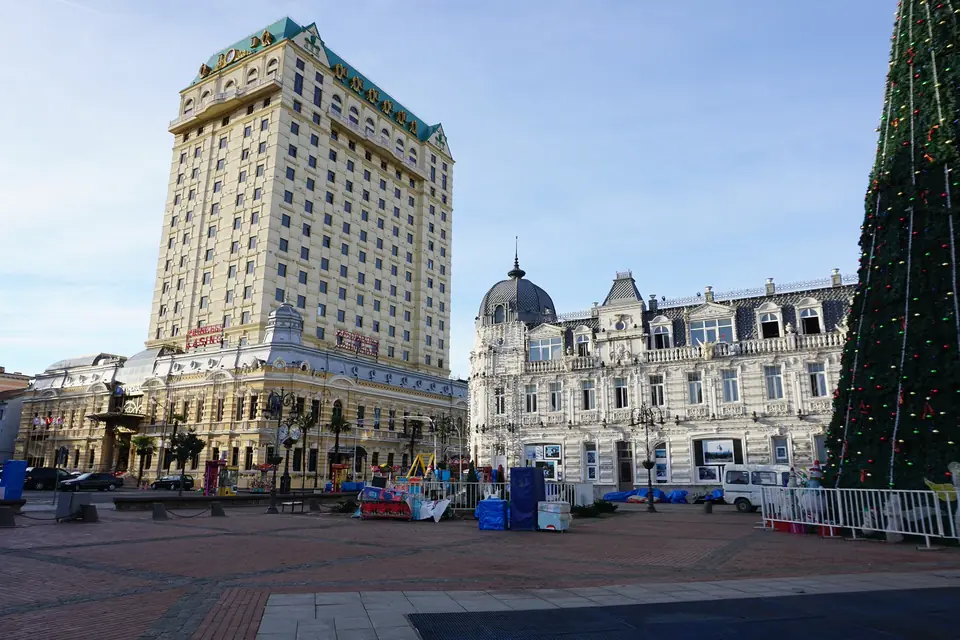
Europe Square is the heart of Batumi’s old town, on Memed Abashidze Avenue. It owes its name to Adjara’s entry into the Assembly of European Regions, of which it has been a full member since 1997. Around it closes a ring of 19th- and 20th-century belle époque façades, survivors of the city’s first heyday, mixed with 21st-century buildings that imitate that style.
At the centre, on a very tall white pillar, a bronze Medea raises the golden fleece. The authorities presented it in 2007 as the figure who brought Georgia closer to Europe; critics recalled that the myth portrays her as the woman who betrayed her father and her homeland. That uncomfortable choice says a lot about how Batumi has reinvented itself.
Highlights
- Medea monument — a ram’s-head fleece coated in real gold, unveiled in 2007
- White marble pedestal — the ship Argo and scenes from the myth carved at the foot of the column
- German astronomical clock — some fourteen quantities on the dial, from the Sun and Moon to the zodiac
- Belle époque façades — 19th- and 20th-century buildings beside 21st-century replicas
- The city’s great stage — 50,000 people at the 2011 Enrique Iglesias concert
In few cities does a square carry a political programme in its name. Europe Square (Evropis moedani in Georgian) has been called that since Adjara joined the Assembly of European Regions, of which the autonomous republic has been a full member since 1997. Many locals, however, still call it simply “Era square”. In 2007 the city gave it an emblem equal to that ambition: a bronze Medea, designed by the architect and sculptor Davit Khmaladze, with a fleece coated in real gold at the top of a column.
What to see in Europe Square goes beyond the statue: the architecture of belle époque façades and their modern replicas, an astronomical clock commissioned in Germany and paving from which jets of water spring in the warm months. The history of Europe Square is also that of a controversy that has not closed, of a city that chose a fugitive princess as its ambassador. Walking it with the audio guide, stop by stop, joins the myth, the debate and the stone in one place.
A few minutes’ walk away stand the old town’s two houses of worship, Batumi Cathedral and the Orta Jame Mosque, and about 300 metres away begins the seafront promenade of Batumi Boulevard.
Europe on the shore of the Black Sea
Europe Square
Summary of this stop
At the edge of the square, on Memed Abashidze Avenue, visitors meet a ring of towers, spires and ornate façades. Not everything is what it seems: the restored belle époque buildings of the 19th and 20th centuries survived Batumi’s first heyday, but they share the perimeter with 21st-century constructions that diligently imitate that style.
The name is the other half of the setting. Evropis moedani, Europe Square, refers to Adjara’s accession to the Assembly of European Regions, a declaration of intent engraved in the street map. Among locals it coexists with a more homely name, “Era square”. Telling old from rebuilt at a glance is part of the game, and the narration on site gives the clues for doing so.
A real golden fleece on the column
Medea Monument
Summary of this stop
At the foot of the column the gaze goes upwards. There, atop a pillar of excessive height, the bronze Medea raises in her right hand a ram’s-head fleece coated in real gold, her eyes on the sea. President Mikheil Saakashvili unveiled it on 6 July 2007, as part of a programme to promote Batumi as a Black Sea destination. On the white marble pedestal is engraved the ship Argo, in which Medea and Jason escaped from Colchis with the fleece.
That gold has an earthly explanation that has been debated for two thousand years. The Greek geographer Strabo wrote that in the Caucasus mountain torrents carried gold and the natives caught it with woolly skins; in 2014 the Georgian geologist Avtandil Okrostsvaridze revived the idea after locating large ancient gold placers near Svaneti. Not everyone accepts it: some recall that a relative of Strabo had governed Colchis, and Diodorus Siculus told a very different version of the fleece.
Batumi’s uncomfortable heroine
Ground-level fountain
Summary of this stop
Beside the ground-level jets in the middle of the square, facing Medea, the gap between the official narrative and the full myth becomes perceptible. At the 2007 unveiling, Batumi’s mayor presented the princess who fled with Jason and the stolen fleece as “the person who brought Georgia closer to Europe”. The monument cost more than a million Georgian lari, around half a million dollars according to other sources, and the expense was criticised from day one.
The protest was not only about the price. A local intellectual accused the pro-European authorities of wanting to “trample our traditions” with a statue of a woman who “betrayed our country”, as the anthropologist Tamta Khalvashi recorded. And the myth holds an even darker episode: according to a tradition documented by the Roman historian Arrian in the 130s, in ancient Apsaros, today’s Gonio, south of Batumi, travellers were shown the tomb of Apsyrtus, the brother Medea is said to have killed in the flight. Other versions of the myth place the crime in very different locations.
The clock that reads the sky
Batumi Astronomical Clock
Summary of this stop
On a corner of the square, in the tower of the former National Bank of Georgia (44 Konstantine Gamsakhurdia Street), a large dial with Roman numerals and a zodiac scale shows much more than the time. The city council decided to install it in 2010 and the mechanism, commissioned in Germany for about 1.7 million lari, was finished in 2011. It indicates some fourteen quantities: the position of the Sun and Moon, the phases and age of the Moon, the constellations of the zodiac, the meridian, the horizon, rising and setting. On the hour a melody plays; on the half hour, a single chime. At the foot of the tower, a panel explains how to read each hand.
From that corner, the square reveals itself as the city’s great stage. José Carreras, Andrea Bocelli and Buena Vista Social Club have performed here, and in 2011 the Enrique Iglesias concert drew 50,000 people. Since the 2010s the square has hosted Batumoba, the city’s day, festivals, the Christmas market and the New Year tree. The narration on site closes the tour by tying the clock, the festivities and Medea into a single idea of a city.