Botanical garden of 1912
Batumi Botanical Garden Audio Guide
A living world map hung in terraces above the Black Sea: nine regions of the planet each planted on the slope that most resembles its homeland, and in the middle, the tomb of the geographer who conceived it.
- 120 min of audio
- Nine regions of the world
In Mtsvane Kontskhi, north of Batumi, more than a hundred hectares of garden descend from the mountain forest to the cliff. Andrey Krasnov, a geographer and botanist from Kharkiv University, officially opened it on 3 November 1912 and arranged it not by plant families but by regions of the world: East Asia, the Himalayas, New Zealand, Australia, Mexico, North America, South America, the Mediterranean and the humid subtropics of the Caucasus. From here the eucalyptus, the camphor tree, the feijoa and the Oriental persimmon spread across Georgia.
The garden holds stories that have little to do with botany. Its founder, already ill when he opened it, died two years later and asked to be buried inside; his brother Pyotr, a Cossack general, ended up hanged in Moscow by the same state that honoured the botanist with a bust. In the North American sector, according to accounts, a tulip tree felled in 1985 stayed alive, sent up twelve new trunks and became the so-called “living bridge” over a ravine.
Highlights
- Nine phytogeographic sectors — from the Himalayas to New Zealand, each on the slope with the most similar microclimate
- Krasnov’s tomb and bust — the founder buried in his garden, with a 1962 monument sculpted by his granddaughter
- East Asian bamboo grove — filming location of the Soviet comedy Love and Pigeons (1984)
- 1902 mansion and camellias — a manor house and camellias that predate the garden’s founding
- Cliff-top viewpoints — terraces over the Black Sea and the Batumi coast
Before the palms and bamboos, this strip of nearly a kilometre of coast between the mouth of the Chakvistskali and Mtsvane Kontskhi was Colchian forest of beech, chestnut and lime, with cherry laurel and Pontic rhododendron, rising from sea level to about 220 metres. On that ground Andrey Krasnov built in 1912 one of the most distinctive botanical gardens of the former Russian Empire, with a very practical mission: to acclimatise useful crops for the south of the country, starting with twelve “gifts of the East” such as tea, citrus, bamboo and persimmon.
The history of the Batumi Botanical Garden does not begin in 1912, however. From 1881 an owner named D’Alphonse introduced exotic species on his estate near Chakvi, and in 1892 Pavel Tatarinov created a 10-hectare acclimatisation garden that is today the Upper Park; that is why some sources move the founding back to the 1880s and others fix it at Krasnov’s official opening. The present area also varies, between 108 and 111 hectares depending on who measures it. What to see in the Batumi Botanical Garden, its history and the logic of its layout are better understood by walking it from terrace to terrace with the audio guide, which in about two hours links the management mansion, the founder’s tomb, the lower park, the bamboo grove and the viewpoints.
In the city centre, Batumi Boulevard offers another face of the coast’s subtropical gardens, planted since 1884 on sand, and at its start the steel figures of Ali and Nino cross each other every evening.
A 1902 mansion older than the garden
Upper Park management mansion
Summary of this stop
The tour starts in the Upper Park, the former acclimatisation garden that Pavel Tatarinov, a geographer, botanist and traveller, planted in 1892. There stands the management mansion, a manor house built in 1902, a decade before the botanical garden officially existed. The Upper and Lower parks were private estates before the 1917 revolution, and so they hold the oldest exotics in the grounds: ginkgo, large-flowered magnolias, eucalyptus, cork oak, araucarias and Himalayan cedar.
Between the squares dedicated to the botanist Iason Gordeziani and to Patriarch Ilia II, abelias, fatsias and Japanese camellias appear. The camellias are a chronicle in themselves: two species and 54 varieties of Camellia japonica grew here before 1912, in 1937 varieties arrived from Japan and in 1959 seeds from China, until today there are 78 varieties of C. japonica and 18 of C. sasanqua. The question of when the garden was really born is left open at this point, and the narration raises it in front of the house itself.
A geographer buried among his plants
Krasnov’s tomb and bust
Summary of this stop
On the path down to the lower park lies the tomb of Andrey Krasnov, professor at Kharkiv University, founder and first director of the garden. He opened it on 3 November 1912, already gravely ill, with an initial 71 hectares, and died at the end of 1914; sources hesitate between 1914 and 1915 because of the change from the Julian to the Gregorian calendar. By his will he was buried here, in the spot he himself had chosen. In 1962, on the 50th anniversary, a monument with his bust was erected over the tomb, the work of his granddaughter M. N. Vertinskaya.
By then the garden was something else: in 1925 a decree of the Council of People’s Commissars of the USSR made it the main Soviet scientific institution for subtropical crops on the Black Sea coast, with tea and citrus at the head. Before this bust the history of his brother Pyotr Krasnov also crosses, a Cossack general who collaborated with Nazi Germany during the Second World War, was handed over to the Soviets in 1945 and hanged in Moscow in 1947. The paradox of one surname on the gallows and in bronze is unpacked right there, beside the tomb.
Magnolias and the dacha of The Twelve Chairs
Large-flowered magnolia alley
Summary of this stop
The lower park opens into an alley flanked by Magnolia grandiflora, among oleanders, cedars, palms and cypresses. Very close is the old house of D’Alphonse, the owner who in 1881 began bringing exotic species to Adjara simply to beautify his garden. It was one of the coast’s first acclimatisation efforts, earlier than the botanical garden itself, and arose more from a whim than from a scientific programme.
This coast of holidaymakers, the “Cape Verde” of Russian literature, also entered the most famous satirical novel of the Soviet era. In “The Twelve Chairs” (1928), by Ilf and Petrov, Father Fyodor finds here the engineer Bruns on the veranda of his dacha and falls to his knees to buy the chairs he is chasing. Valentin Kataev later wrote that this engineer was himself. The whole scene, with its famous goose, takes on another flavour heard in the shade of the magnolias.
Bamboo, tea and a scene from Love and Pigeons
East Asian bamboo groves
Summary of this stop
In the East Asian sector the path narrows between dense groves of bamboo. It is one of the nine regions Krasnov distributed over the slopes according to microclimate, alongside the Himalayas, New Zealand, Australia, Mexico, North America, South America, the Mediterranean and the Caucasian subtropics. Behind it were the two great expeditions Krasnov himself led to South-East Asia in the 1890s, whose plants, tea among them, ended up in a nursery in Chakva, and the list of the twelve gifts of the East: bamboo, banana, wax tree, camphor tree, lacquer tree, ramie, tung, persimmon, citrus, tea, loquat and yam.
These canes also have their place in Soviet cinema. According to the garden’s tradition, the scene from “Love and Pigeons” (1984), by Vladimir Menshov, was shot here, in which Vasily Kuzyakin and Raisa Zakharovna lose themselves in the “tropical jungle” and talk about telekinesis and green humanoids. The bamboo grove through which Aleksandr Mikhailov and Lyudmila Gurchenko walked is still standing, and the narration reconstructs the scene among the same canes.
From the Colchian forest to terraces above the sea
Cliff-top viewpoints
Summary of this stop
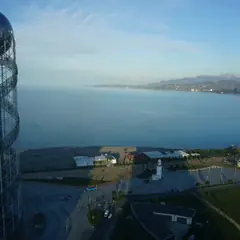
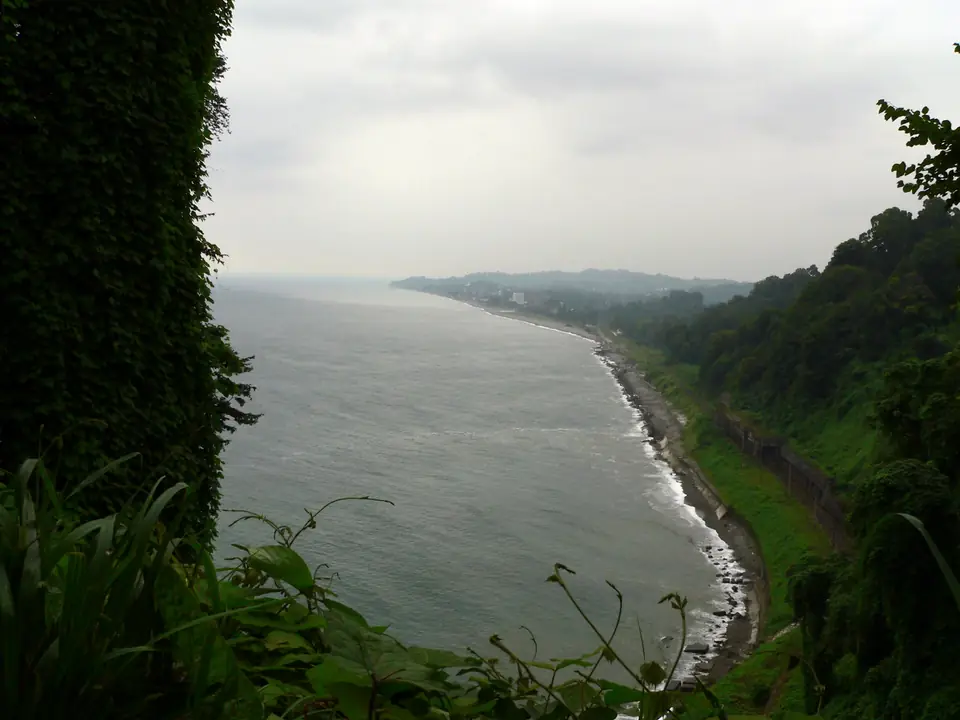
From the upper terraces, like the coastal park, the view takes in the Black Sea, the coastal railway and, to the south, the Batumi coast. From here the whole layout can be read: Krasnov designed the garden in terraces that descend to the sea in the image of the Hanging Gardens of Babylon, with the ambition of turning swampy Colchis into “a little Japan”. At the same time, a Colchian forest reserve preserves within the grounds part of the original vegetation of beech, chestnut, cherry laurel and Pontic rhododendron.
The experiment did not stay among these slopes. From the garden the eucalyptus, the camphor tree, the eucommia, the tung, the Washington Navel orange, the feijoa, the Oriental persimmon and New Zealand flax went out to the rest of Georgia, and a grove of very tall Australian eucalyptus recalls that expansion. How a garden changed what is grown across an entire country is the close of the tour, with the sea at the viewpoint’s feet.